
Browse using the new Vinous website now. Launch →
Printed by, and for the sole use of . All rights reserved © 2015 Vinous Media
Greece: From Ancient Roots to Modern Glory
BY NICOLAS GREINACHER | DECEMBER 30, 2025
Our inaugural Greece report offers a contemporary overview of the country’s wines, spanning the major styles and regions across 14 vintages from 2024 to 1947. The nearly 200 wines I tasted for this article include a staggering 27 different single-variety wines and countless blends from Greece’s native grapes, capturing a nation whose winemaking is as varied as its landscapes. The result is a portrait of a modern, ambitious wine culture grounded in centuries of tradition, where progress is driven by authenticity rather than imitation.
After a brief historical catch-up, this article details the eight wine regions I explored in my tastings and then focuses on Santorini, Greece’s most celebrated winegrowing area. My five days in Greece were divided between Athens and Santorini, a structure I plan to repeat in the future, exploring one key region in depth while continuously including relevant wines from elsewhere in the country.
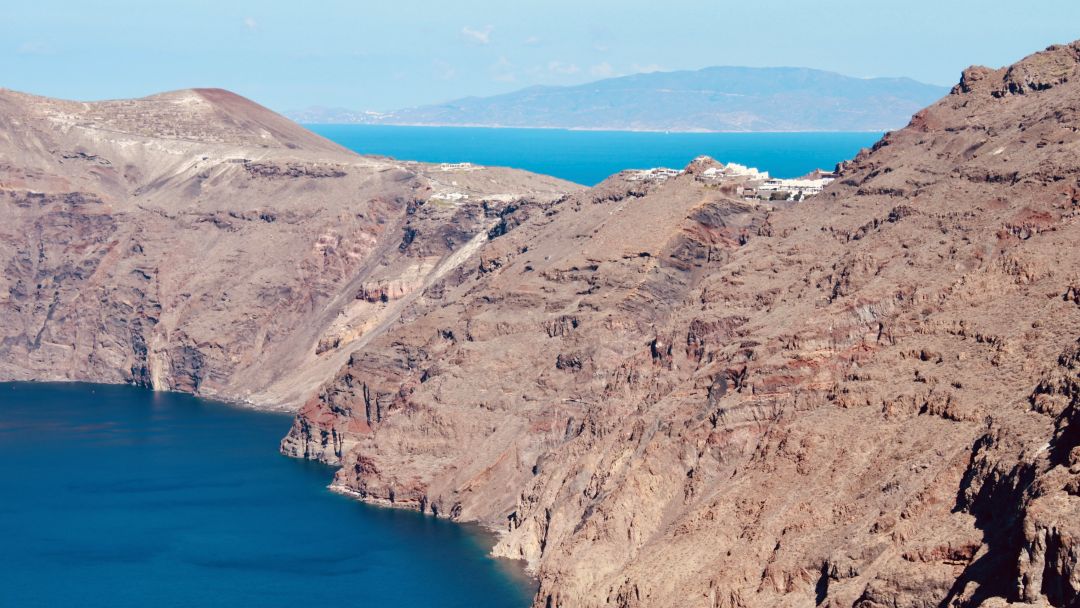
Santorini’s volcanic mountains and soils define the unique terroir that gives its wines their unmistakable character.
Greek Wine’s Long Road to Today
Greece has been a wine-producing country for a long time, with evidence showing production dating back at least 5,000 years. Although not the first nation to produce wine, Greece played a historical role in improving grape cultivation and winemaking methods. In ancient times, wine was deeply connected to daily life and often featured in social gatherings known as symposiums. During the Golden Age, between 500 and 300 BCE, Greek wine and culture spread across the Mediterranean.
Early Greek writings on wine reveal an advanced understanding of how geography and soil affected quality. However, the wines of that era were quite different from those of today. Producers commonly mixed herbs, spices, flowers, honey and oils into wine to alter flavor and prevent spoilage. One of the most distinctive additions was pine resin, a tradition that continues today in the production of Retsina.
When Greece fell under Roman rule in the second century BCE, the country’s wine exports declined sharply. Roman wines became more dominant, reducing the demand for Greek bottlings. By the time Greece regained independence in 1830, much of its agricultural land had long been neglected. Subsequent wars and the phylloxera outbreak in the late 19th century devastated most of the remaining vineyards, Santorini being a notable exception.
Throughout much of the 20th century, Greek wine was considered low-quality and inexpensive. Large cooperatives and a few major producers focused on volume, with Retsina being the most widely recognized example. In the 1980s, a new generation of winemakers shifted their focus to quality, estate-based production. Many of these producers brought new energy and skill to the industry, inspired by international standards. Their efforts helped shape the foundation of modern Greek winemaking, emphasizing local grape varieties and quality-driven wines.
Fast forward to today. Greece’s roughly 64,000 hectares of vineyards dedicated to winemaking are cultivated by roughly 180,000 growers, many of whom maintain these vineyards as a secondary source of income or as land passed down through generations. The number of wineries has risen to around 1,600, of which roughly 200 sell a portion of their wines outside of Greece. The United States is the largest export market, followed by Canada.
Greece’s vineyards stretch from 34° N to 42° N in latitude and experience a wide range of climates, from hot Mediterranean summers to cooler mountainous conditions. Another defining feature of Greek wine production is the diversity of native varieties, which make up roughly 90% of the country’s total vineyard area. The exact number of these indigenous grapes remains uncertain, as new varieties continue to be identified. Current estimates place the figure at around 200 distinct types. While many are cultivated only in small, localized regions, approximately 60 varieties are grown more extensively across the country.
Greek Wine Law in a Nutshell
Greece follows a wine appellation framework aligned with that of the European Union. This framework differentiates between Protected Designation of Origin (PDO) wines, which are governed by detailed regulations covering vineyard practices and winemaking methods (including permitted grape varieties and yield limits) and Protected Geographical Indication (PGI wines). Famous PDO examples would be Santorini or Naoussa, whereas Attica or Crete can carry PGI status. In the case of PGI wines, the regulatory requirements are more flexible, particularly with respect to grape varieties, allowing the use of international cultivars. Wines that do not qualify for either PDO or PGI are labelled Wine of Greece. This category is often associated with large-scale productions from blends of grapes sourced from multiple regions, and it represents approximately two-thirds of total annual Greek wine production.
Land, Light and Latitude: Greece’s Wine Mosaic
Greece’s landscape offers a much greater climatic diversity than one might expect. The country’s mountainous terrain plays a key role in shaping its viticulture. Vineyards are frequently situated at higher elevations (up to 1,100 metres above sea level), where cooler temperatures extend the grape-ripening cycle. In Naoussa, the climate can be cool enough that certain varieties struggle to reach full maturity. Conversely, the plains of central Greece are warmer, while coastal areas benefit from the moderating influence of the sea, creating a variety of microclimates.
Vineyards are also prominent on many of Greece’s islands, such as Santorini and Paros, where growers contend with minimal rainfall. Harsh winds can disrupt flowering and fruit-set and may even damage vines that lack protection. Rainfall varies significantly across the country, from the extremely arid conditions of the Cyclades to the more moderate climates of the western and northern regions.
Cyclades
The Cyclades encompass a cluster of sunlit Aegean islands, with Santorini the crown
jewel. Here, vineyards thrive in volcanic soils that resist phylloxera,
allowing ancient, own-rooted vines to endure. To cope with strong winds and
arid conditions, growers use basket-training systems to protect grapes and
retain moisture. Santorini’s Assyrtiko-based dry whites are prized for their acidity
and minerality, while its finest Vinsantos can age for over half a century. Nearby
Paros Island produces noteworthy whites from Monemvasia and basic reds from
Mandilaria.
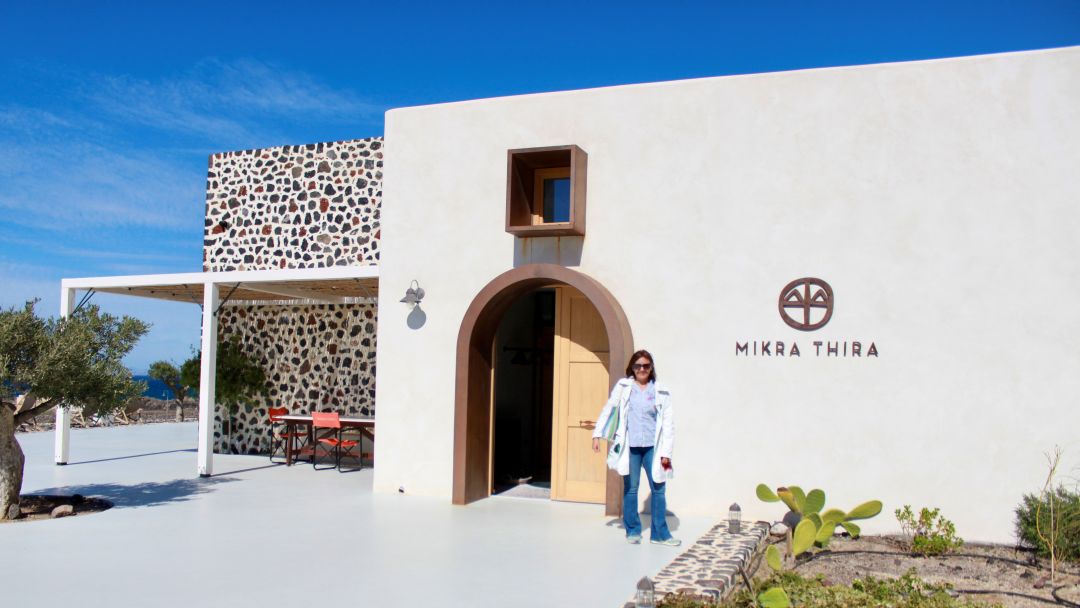
Winemaker and co-owner Ioanna Vamvakouri
at Mikra Thira, the sole producer on the island of Thirassia, part of the
Cyclades.
Central Greece
Stretching from the Pindos Mountains to the plains of Attica and Boeotia,
Central Greece is one of the country’s most geographically diverse regions. Its
varied terrain and soils create distinct microclimates that influence wine
styles across the area, from the humid west to the cool central zones and the
warm, dry east. The subregion of Attica is best known for the Savatiano variety—which
is produced in several styles, including dry and sweet white—as well as orange
and sparkling wines. I also tasted two wines from the Slopes of Kitherona, a
subregion that spans parts of Viotia and eastern Attica.
Crete
Crete’s mountainous terrain, soil diversity and contrasting climates between
the cooler north and the warmer, drier south create interesting conditions for
growing grapes. Indigenous varieties like Vidiano, Liatiko and Kotsifali
dominate, while international grapes like Syrah also thrive. The subregions of
Chania and Dafnes produce distinctive wines that reflect the island’s varied
terroir. Dafnes excels with its elegant
Liatiko-based reds, and Chania with its wide-ranging stylistic offerings,
covering still white, Rosé and red, as well as fortified wines.
Epirus
Zitsa is the main winemaking area of Epirus, a mountainous region in
northwestern Greece, where cool, humid conditions and limestone soils yield elegant
wines. The white grape variety Debina dominates, delivering crisp still and
sparkling wines. Occasionally, Debina is blended with international varieties, such
as Chardonnay. Light to medium-bodied reds from the local Vlachiko variety can also
yield positive surprises.
Ionian Islands
The Ionian Islands are situated off Greece’s west coast, across the Ionian Sea
from Italy. Cephalonia is the primary region within the Ionian Islands, with its limestone
slopes around Mount Ainos providing the ideal home for Robola, the island’s
signature white grape variety. Robola of Cephalonia produces zesty,
mineral-driven wines with bright acidity and subtle citrus notes. Grown at
elevations up to 800 meters above sea level, these wines reflect the island’s
mountainous terrain and mild maritime climate. The local Vostilidi also
delivers noteworthy wines.
Macedonia
Stretching across northern Greece, Macedonia produces a wide range of styles
including white, Rosé, red, sparkling and orange wines. Macedonia’s predominant
variety, Xinomavro, excels in the high-elevation zones of Naoussa and Amynteo,
yielding complex reds with robust tannins, bright acidity and impressive
longevity. Xinomavro also makes refined Rosés and lighter reds, while blends
with international varieties like Merlot result in softer expressions. Further
east, around Drama, producers craft crisp whites from Sauvignon Blanc, Assyrtiko
or Malagousia.
Peloponnese
Forming the southern part of mainland Greece, the Peloponnese is the country’s
largest wine region, home to the famed Nemea and Mantinia regions. In Nemea, the
Agiorgitiko variety produces reds ranging from fresh and fruity to structured
and ageworthy, while on the cooler Mantinia plateau, the Moschofilero grape
yields alluringly aromatic whites brimming with floral and tropical notes. The Peloponnese
also cultivates lesser-known grapes like Avgoustiatis (which yields spicy reds)
and Kidonitsa (which can deliver ageworthy whites).
Thessaly
Thessaly produces a diverse range of styles,
including still whites, Rosés, reds and sparkling wines. The region’s most
exciting variety is Limniona, a native red grape. After years of research and
revival, Limniona has gained recognition for its lively acidity and herbal aromas.
Alongside Limniona, Thessaly also gives rise to zesty whites made from
Assyrtiko and Roditis.
Santorini: Greece’s Volcanic Crown Jewel
Santorini continues to produce some of Greece’s most distinctive and sought-after wines, made primarily from the native Assyrtiko variety. The island’s volcanic soils and harsh ecosystem, with an arid climate and strong winds, shape wines of singular character. Very old vines and low yields further contribute to these wines’ uniqueness.
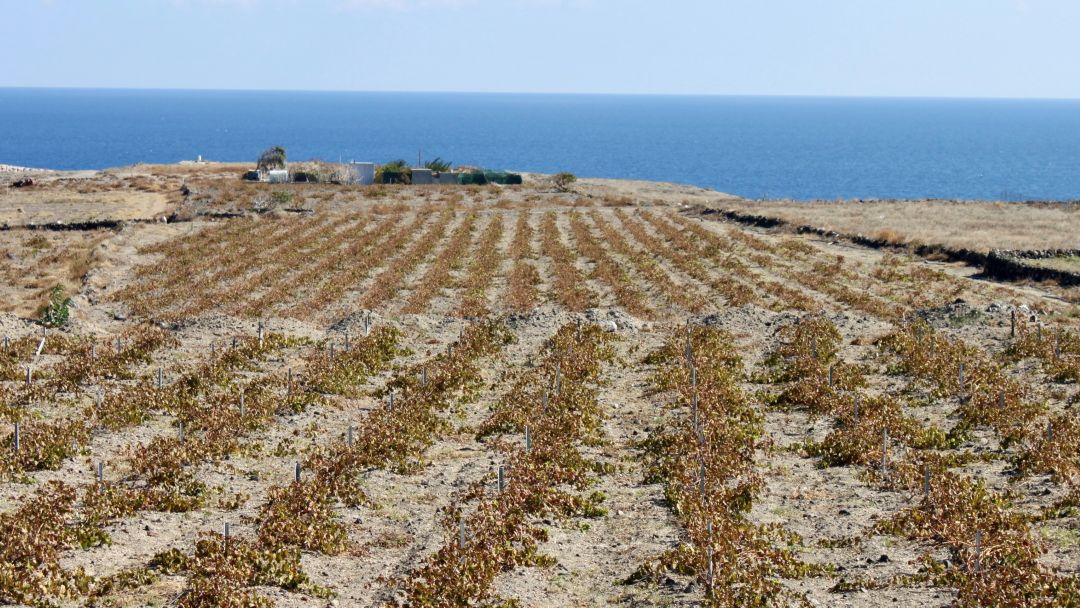
Across Santorini’s rocky landscape,
widely spaced bush vines cling close to the ground.
Santorini’s volcanic Aspa soil, made up mostly of sand, pumice and ash, shielded its vineyards from the phylloxera plague that devastated most of Europe. Because the island’s soils contain almost no clay, the pest could not survive, allowing Santorini to maintain some of the world’s oldest own-rooted vines. New plants are propagated through layering, a method in which a cane from an existing vine is bent and buried until it develops its own roots. This makes it difficult to determine the exact age of each vine. Some are likely up to 400 years old, but the average vine age across the island is between 60 and 70 years.
One of the most distinctive features of Santorini’s viticulture is the traditional Kouloura, or basket-shaped vine training system, used for centuries to protect vines from the island’s harsh conditions. Growers weave the canes into baskets that shelter the grapes from the island’s fierce winds and help trap moisture from morning dew, as there is virtually no rainfall during the growing season. The Aspa soil absorbs and retains this moisture, keeping the vines alive through extreme drought. Stones in the soil also help regulate temperature and are sometimes used to prop up the baskets for better air circulation, making the Kouloura the only viable training method in Santorini’s most wind-exposed vineyards.
In more sheltered areas, some growers use another traditional system called Koulouri (or Kladeftiko), where the canes are bent into small, vertical rings close to the ground. This form allows slightly greater exposure to sunlight and gentle winds. Like Kouloura, Kolouri requires entirely manual labor. Though Koulouri can yield grapes of excellent quality, its use is limited to areas less affected by strong winds, while Kouloura remains essential for vine survival in Santorini’s most extreme landscapes. In parts of the island protected from the wind, producers have experimented with modern VSP trellising, but this practice remains rare and controversial among traditional growers.
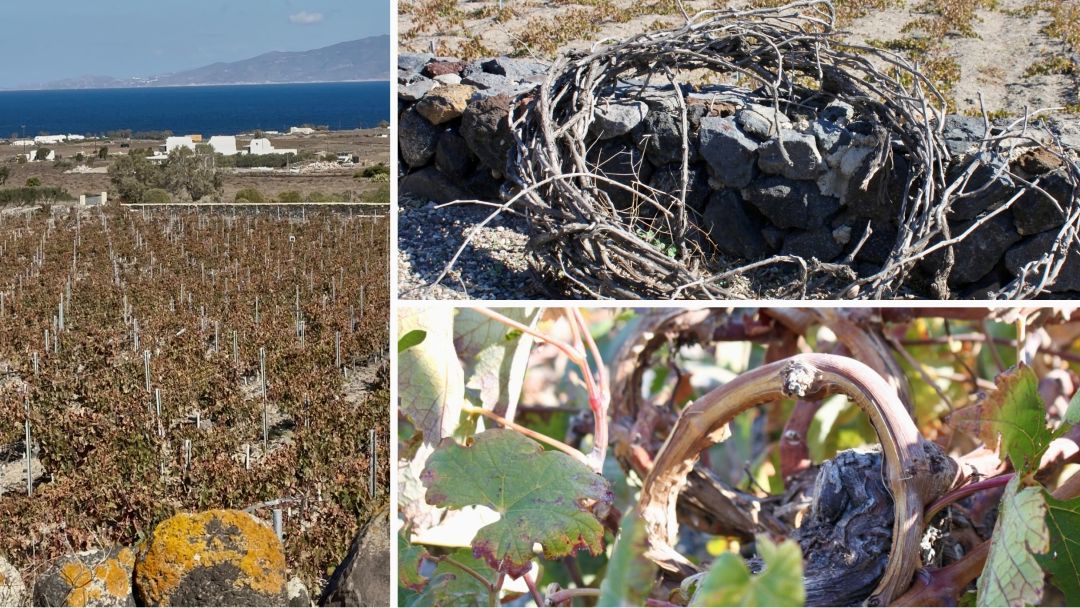
Santorini’s three vine-training systems:
at left, the locally uncommon VSP (Vertical Shoot Positioning); at right, the
traditional basket-training methods, Kouloura (top) and Koulouri (bottom).
In today’s commercial realities, Santorini’s wine industry faces serious structural challenges that threaten its long-term sustainability. Most wineries on the island do not own their vineyards and rely on grapes purchased from independent growers. However, many of these growers are no longer dedicated viticulturists, but part-time farmers who now work primarily in tourism-related jobs. As a result, less time and care are devoted to vineyard maintenance, leading to declining grape quality and even lower yields. This shift away from traditional grape-growing represents a fundamental break in the island’s once self-sufficient winemaking model.
Land use is another critical issue. Despite laws that prohibit the conversion of vineyard land into housing, new villas and tourist properties continue to replace agricultural plots. Authorities are now attempting to define and protect agricultural zones to prevent further encroachment, but enforcement remains inconsistent. Without stronger regulation, Santorini risks losing much of its viticultural heritage to real estate development.
While vital to the island’s economy, tourism has also contributed to this decline. The tourism industry brought Santorini its global fame, wealth and millions of annual visitors, yet it has also diverted attention and labor away from grape growing. Although tourism provides economic benefits, it has created an imbalance where the short-term rewards of development threaten the long-term survival of the island’s traditional wine culture. On the other hand, many wineries sell more than one-third of their entire production to the hospitality sector on the island, which allows for higher profit margins compared to shipping wine away from the island.
Soaring land prices and market dynamics are further intensifying economic pressures. Vineyard plots have become prohibitively expensive, with some selling for as much as €300,000 per hectare. At the same time, the scarcity of grapes has driven purchase prices to record highs, passing €10 per kilogram in 2025—even higher than in Champagne.
Vintages
The past three vintages—2023, 2024 and 2025—have pushed Santorini’s vineyards to their limits, deepening an already fragile supply situation. The 2023 season started with just 180 millimetres of winter rainfall, well below the island’s modest average of 330 to 350 millimetres. In April, a rare and destructive hailstorm struck most vineyard zones, cutting yields by around half and damaging buds that would have produced the following year’s canes. Already weakened by heat and drought, many vines struggled to recover. Two thousand twenty-four brought even less rain—only 100 millimetres—leading to severe water stress, limited growth and one of the earliest harvests on record.
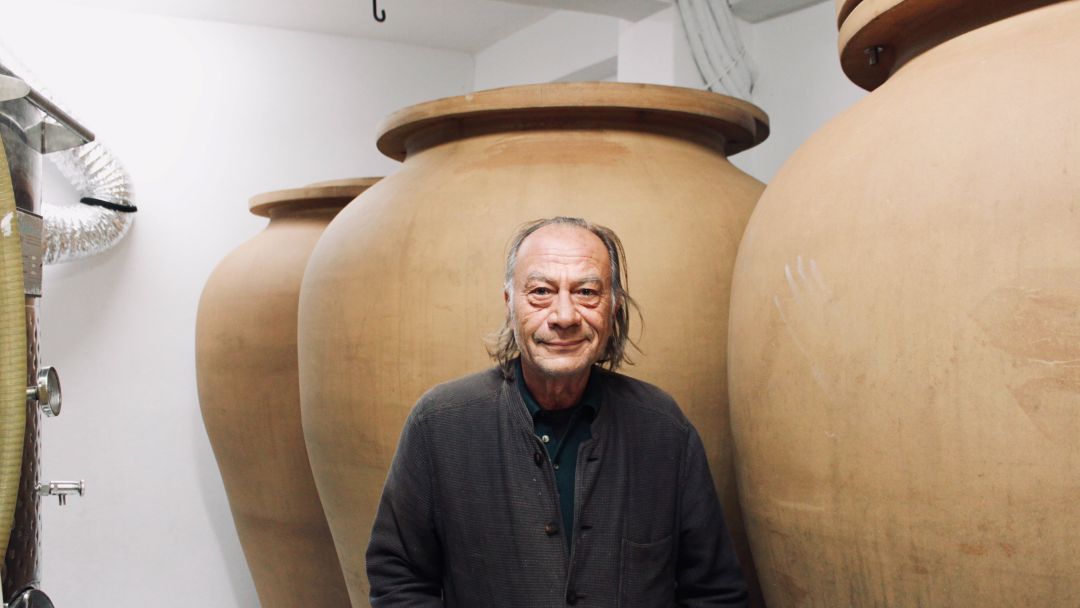
A thorough understanding of Santorini
Assyrtiko begins with a conversation with Paris Sigalas, who crafts exceptional
wines at Oeno P, following his departure from Domaine Sigalas.
By 2025, the compounded effects of two parched winters and the 2023 hailstorm had left the island’s vineyards highly vulnerable. Rainfall during the 2024–2025 winter was almost non-existent, and yields suffered once more. At Oeno P, production totalled only 3,000 bottles of their Tria Ampelia in 2025, compared to the usual 8,000. Some producers, like Domaine Sigalas, have begun experimenting with limited irrigation to simulate winter rainfall, but ongoing drought and rising temperatures continue to jeopardize both yields and the long-term sustainability of Santorini’s vineyards. In recent years, some Santorini producers even used foliar sprays of natural kaolin clay to protect vines from intense sunlight, heat and water stress in an environmentally friendly way.
Despite the challenges facing the island, Santorini Assyrtiko continues to shine. Whether in the form of taut, bone-dry and mineral whites, subtly off-dry styles, or opulent Vinsantos made from sun-dried grapes with 200 to 300 grams per liter of residual sugar, these wines capture the island’s volcanic intensity like no other. Assyrtiko’s naturally low pH—occasionally below 3.0—helps create an electrifying acidity that defines these wines’ character and prevents malolactic conversion. The result is wines of striking vibrancy and longevity.
Assyrtiko harvested from Santorini’s ungrafted, low-yielding old vines produces wines that are unmistakably different from those made on the mainland. These wines can carry an intense mineral edge, a tension that seems to encapsulate the island’s volcanic essence. Assyrtiko’s firm structure gives these wines remarkable aging potential, developing complexity and depth over time. In their youth, the wines can show delicate floral, citrus and stone fruit aromas, sometimes enhanced by small proportions of the more aromatic Athiri or Aidani varieties. After three to four years in bottle, the fruit and floral notes fade, and the variety’s mineral character becomes more pronounced. With eight or more years of bottle age, gentle oxidative tones emerge—honeyed, nutty and occasionally a distinctive, beguiling toastiness.
Seven Key Takeaways
- Dizzying Diversity
Greece has an extraordinary amount to offer wine lovers. Tasting so many grape varieties and wine styles in a short time can feel like navigating a dense jungle. In a wine world dominated by international varieties, Greece stands out with a remarkable wealth of native grapes and distinctive wines waiting to be discovered. - Red Wines Show Notable Freshness
I was pleasantly surprised by the freshness and vibrancy of most Greek red wines. Xinomavro is a prime example, but Limniona, Mavrotragano, Vertzami and Avgoustiatis also stand out for their notable brightness. - White Wines Steal the Spotlight
The best Greek whites still outperform the best reds. However, this takeaway rests largely on one particular grape variety, which brings me to the next point. - Assyrtiko: The Titan of Greek Whites
Assyrtiko is the undisputed star, with no other Greek grape variety coming close. The finest examples from Santorini can stand confidently on the world stage alongside the greatest white wines, both dry and sweet. Assyrtiko’s hallmark acidity and mineral edge give it crystal-clear geographic transparency. - Xinomavro: Greece’s Answer to Nebbiolo
Greece’s most celebrated red grape produces pale, tannic, highly acidic wines that share similarities with Nebbiolo. Traditionally known for their complexity and ability to age, modern interpretations of Xinomavro are increasingly fruit-forward and approachable, with some winemakers blending in Merlot to soften the variety’s naturally firm structure. - Moschofilero Lights up the Glass
A fast-rising star, Moschofilero captivates with its fragrant aromas of lychee, rose petal, melon and delicate spice. Light-bodied and crisp, this occasionally pink-hued wine stands among Greece’s most distinctive and enchanting contemporary wine styles. - Robola Finds Its Voice
Often planted ungrafted on the limestone soils of Cephalonia, the white Robola variety produces wines with flinty complexity and notable acidity. The finest examples are lively, refined and brim with personality. Keep an eye out for this one.
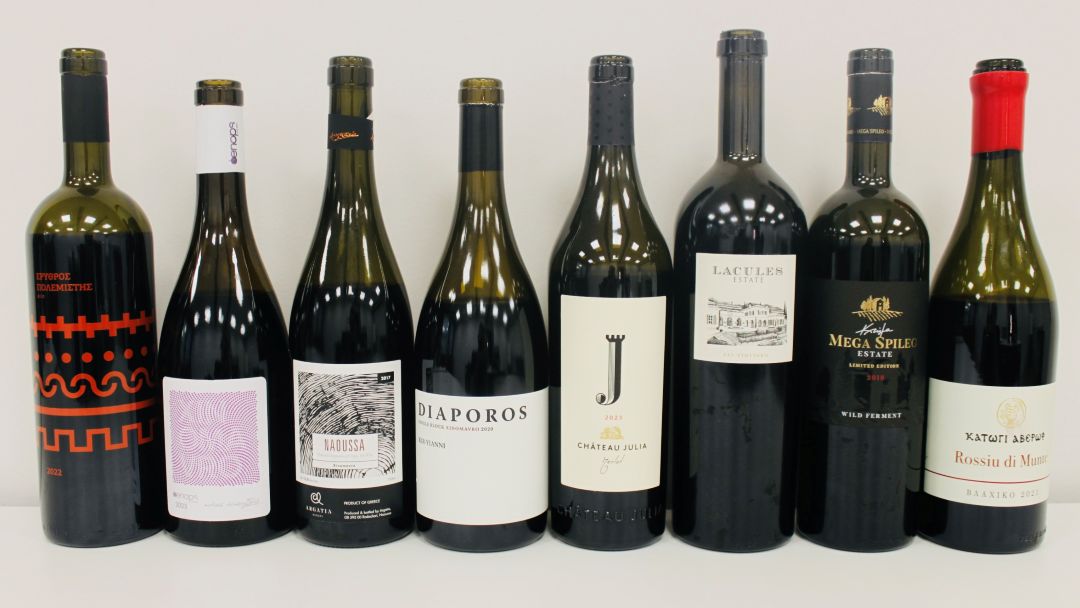
A selection of standout Greek reds from my tastings.
Final Thoughts
As you’ll see in the tasting notes that accompany this report, Greek wines are far too compelling to overlook. The next time you dine at a Greek establishment, take a moment to explore the local gems featured on the wine list. If your budget allows, seek out the finest Assyrtikos; they can captivate even the most discerning palate. Lastly, visiting Greece offers a remarkable opportunity to tour wineries and immerse yourself in the nation’s rich wine culture amid breathtaking landscapes. Judging by the speed of its progress in recent decades, the finest chapter in Greek wine is likely yet to come.
I tasted all the wines from this report in Greece in October 2025.
© 2025, Vinous. No portion of this article may be copied, shared or redistributed without prior consent from Vinous. Doing so is not only a violation of our copyright but also threatens the survival of independent wine criticism.
You Might Also Enjoy
A Shard of Greek Sunshine, Neal Martin, June 2021
Show all the wines (sorted by score)
- Adam Oinos
- Albert Bichot
- Alexakis
- Alpha Estate
- Amoenos Vineyards
- Argatia
- Bizios Estate
- Bosinakis
- Boutari
- Cooperative Union of Tyrnavos
- Costa Lazaridi
- Douloufakis
- Estate Argyros
- Estate Constantin Gofas
- Gai'a Wines
- Karavitakis
- Katogi Averoff
- Kir Yianni
- Ktima Biblia Chora
- Ktima Dio Ipsi
- Ktima Gerovassiliou
- Ktima Palivou
- Ktima Pavlidis
- Ktima Spiropoulos
- Lacules Estate
- Lantides
- La Tour Melas
- Mega Spileo
- Mikra Thira
- Mikro Ktima Titos
- Monemvasia Winery Tsimbidi
- Monsieur Nicolas by G. Karamitros
- Moschopolis
- Mylonas
- Nikolou Winery
- Oeno P
- Oenops Wines
- Orealios Gaea
- Papantonis Winery
- Paros Farming Community
- Rouvalis
- Sarris
- Scalarea
- Scaperdas Frères
- Seméli
- Sgouridi Wines
- Sigalas
- Sim
- Skouras
- Sokos
- Tsililis Terres
- Vassaltis Vineyards
- Wine Art Estate
- Zoinos