
Browse using the new Vinous website now. Launch →
Printed by, and for the sole use of . All rights reserved © 2015 Vinous Media
Rosé, Reframed
BY BILLY NORRIS | JUNE 23, 2026
In a global wine market plagued by macroeconomic uncertainty, declining sales, tariffs, reports of less alcohol consumption among younger drinkers and a general sense of unease, the once white-hot Rosé category has been in limbo since its 2019 peak. But the numbers tell a more nuanced story than simple decline. While it’s undeniable that Rosé has lost ground, it has lost less ground than still wine as a whole. Rosé is showing surprising resilience.
The more interesting story is what is happening within the category. As producers leave behind the volume-driven boom of the 2010s, we are beginning to see the signs of a stylistic recalibration that has actually been in the making for years. In last year’s report, I highlighted the emergence of darker-colored Rosés that are closer to red wine in body, flavor and overall complexity. This trend continues, along with notable premiumization and a focus on high-end (read: expensive) Rosés. Numerous conversations with importers, distributors and retailers suggest that Rosé is following the broader contours of the wine market: The entry-level tier is taking a beating, the mid-tier wines are treading water, and the luxury tier is, in many cases, thriving.
Rosé is often treated as a seasonal afterthought, an affordable entry point into a producer’s range, a tasting-room staple or a wine with little utility beyond the poolside. Many are made from press wine, bled-off juice or lesser fruit that would never make the cut for a producer’s more “serious” bottlings. However, the best wines I tasted for this report are something else entirely: wines made with intent and an eye toward terroir-driven complexity. That ambition is not new; it’s just becoming more obvious as the lower-tier wines lose traction. Bandol, Tavel, Rioja Rosado and certain Italian Cerasuolo traditions have long been oriented toward the production of ageworthy “pinks.”
A Rosé Refresher
Though Provence would eventually become the global shorthand for pale-hued, dry, crisp Rosé, Tavel was formalized as a Rosé-only AOC 90 years ago, in 1936. Rosé’s commercial power picked up steam through the twentieth century, but its visibility and market share came at the expense of quality, shifting consumers’ perception of Rosé toward sweet, simple, crushable wines. It wasn’t until the 2010s that the story began to change. Provence exports to the United States grew at double-digit rates for more than a decade. Rosé sales in the United States climbed to 18.7 million cases by 2018, and the following year, Rosé sales volume grew while still wine sales declined. After that peak, the category's retreat globally has been less stark than the broader wine market, falling roughly 1.7% annually compared to 3.8% for still wines overall as of the most recent reporting in 2025.
The challenges of the economic climate were immediately
apparent in requesting samples for this report, a process we typically begin in
early spring. As inquiries went out, many wines had yet to land on US shores,
even as recently as a few weeks before this writing. Global economic
uncertainty is largely to blame, specifically the burdens of the nebulous
United States tariff environment. In a normal year, importers build spring and
summer portfolios months in advance. Though a few still have deep enough pockets
to have done so for this year, tariffs caused a ripple effect of hesitation
throughout the supply chain in 2026. Some wines were delayed, some allocations
were reduced and some pricing decisions are still up in the air (as
readers will notice in the accompanying reviews that lack prices). For a
category still anchored to spring releases and summer consumption, that
uncertainty is especially challenging.
The Wines
The vast majority of the wines in this report are from the 2025 vintage, widely regarded as favorable across many parts of the world. As a general observation, the 2025 Provençal Rosés are considerably lighter, airier and more compact than the more concentrated, flavor-packed 2024s. California is especially strong in 2025, with several wines that show real freshness, texture and distinctiveness.
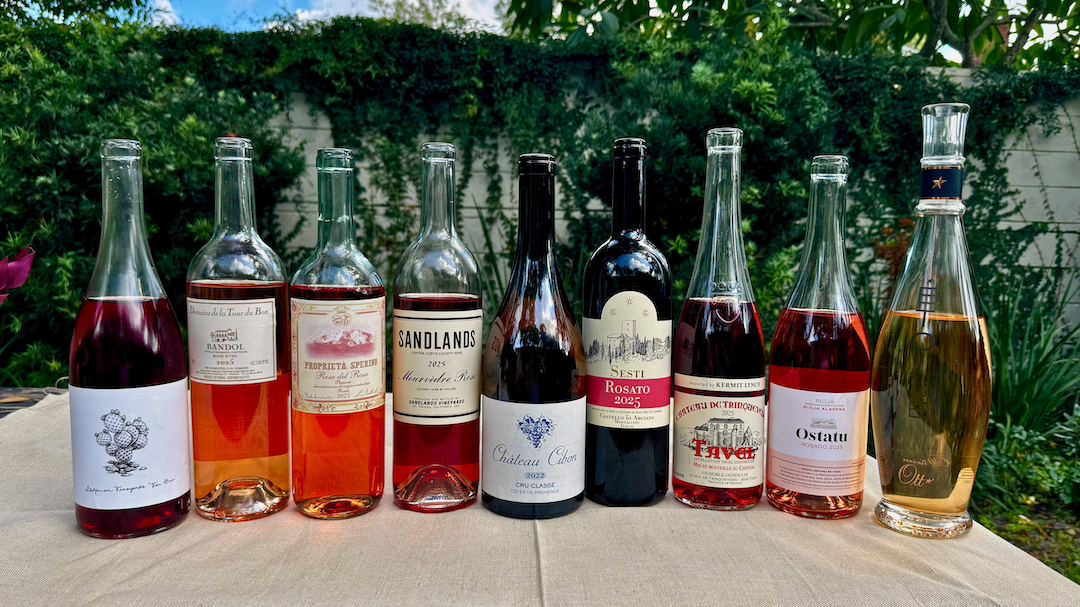
The standouts here are the wines made with ageability and complexity in mind, most of which come from Bandol and its environs. Again, this is nothing new, as estates like Domaine Tempier, Domaines Ott and Clos Cibonne have treated Rosé as a serious, ageworthy wine for generations. Careful farming, intentional vinification, bespoke élevage and terroir-driven winemaking do not come cheap, but they can yield Rosés of real mettle. Case in point: The 2022 Château Cibon Cuvée Marius (from Clos Cibonne) is the single most evocative Rosé I’ve ever tasted, a wine that reframes expectations of what Rosé can be. If there’s one takeaway from this report, it’s that you should do whatever you can to find it and try it for yourself.
In that sense, Rosé’s resilience is both commercial and qualitative. The category may no longer be riding the boom of the 2010s, but the best wines are more convincing, complex and serious than ever.
© 2026, Vinous. No portion of this article may be copied, shared or redistributed without prior consent from Vinous. Doing so is not only a violation of our copyright but also threatens the survival of independent wine criticism.
You Might Also Enjoy
Rosé Revolution: Light Red is the New Pink, Billy Norris, May 2025
Rosé New Releases: All Over the Map, Vinous, May 2024
A Kaleidoscope of Colors: New Rosé Releases, Vinous, May 2023
2022 Rosé – New Releases, Vinous, May 2022
2021 Rosé – New Releases, Vinous, June 2021
Show all the wines (sorted by score)
- Abacela Winery
- Abbotts & Delaunay - Domaine de La Métairie d'Alon
- Abloom
- Adelsheim
- Ameztoi
- Antxiola
- Apolloni Vineyards
- Apollo's Praise
- Arabilis
- Arnot Roberts
- Assuli
- A to Z Wineworks
- A Tribute to Grace
- Attems
- Bargemone
- Barone di Villagrande
- Barrel Oak Winery & Brewery
- Barton & Guestier
- Bedrock
- Belle Pente
- Bellingar Estates
- Bells Up Winery
- Berne
- Bieler Père et Fils
- Big Table Farm
- Bodega Garzon
- Botromagno
- Boundary Breaks
- Brave & Maiden
- Brick House
- Caelestis Cellars
- Calcagno
- Can Sumoi
- Cantine di Ora
- Capranera
- Casa Santos Lima
- Castello Monaci
- Catherine & Pierre Breton
- Cavalchina
- Caves d'Esclans
- Cayuse Vineyards
- Cenatiempo
- Chamisal Vineyards
- Charles Joguet
- Château Canadel
- Château d'Esclans
- Chateau d'Estoublon
- Chateau du Seuil
- Château Gassier
- Chateau La Gordonne
- Château La Mascaronne
- Chateau L'Escarelle
- Chateau Les Mesclances
- Chateau Pradeaux
- Chateau Simone
- Chateau Soucherie
- Clos Canarelli
- Clos Cibonne
- Coelho Winery
- Commanderie de Peyrassol
- Comtesse Marion
- Convene
- Coria Estates
- Corte Gardoni
- Corzano e Paterno
- David Hill Vineyards & Winery
- Del Rio Vineyard Estate
- Devison
- Domaine 524
- Domaine d'Ansignan
- Domaine de Fenouillet
- Domaine de Fondreche
- Domaine de Fontsainte
- Domaine de la Tour du Bon
- Domaine de Reuilly
- Domaine de Sulauze
- Domaine de Terrebrune
- Domaine du Bagnol
- Domaine du Gros Noré
- Domaine Dupeuble
- Domaine Gavoty
- Domaine Giacometti
- Domaine La Manarine
- Domaine Les Mesclances
- Domaine Marquiliani
- Domaine Pierre Martin
- Domaine Roger Neveu
- Domaine Royal de Jarras
- Domaines Ott
- Domaine St. Laurent
- Domaine Tempier
- Donnachadh
- Donnafugata
- Donna Laura
- Epiphany
- Erath
- Erath Winery
- Failla
- Famiglia Statella
- Famille de Lorgeril
- Fattoria Zerbina
- Fess Parker
- Feudi di San Gregorio
- Feudo Montoni
- Figuière
- Finca Torremilanos
- Folded Hills
- Franchere
- Frescobaldi
- Fullerton Wines
- Gianni Doglia
- Girolamo Russo
- Graci
- Gran Moraine
- Grgich Hills
- Gulfi
- Hanson Vineyards
- Héritage du Pic Saint Loup
- I custodi delle vigne dell’Etna
- Idi Di Marzo
- I Favati
- Il Colombaio di Santa Chiara
- Illuminati
- Irvine & Roberts Vineyards
- Isabelle Garrault
- Isle Saint-Pierre
- J. Lohr Vineyards & Wines
- King Estate Winery
- La Bernarde
- La Marca di San Michele
- Lange Estate Winery
- La Spinetta
- Le Fraghe
- Les Alliés
- Les Rocailles
- Le Vigne Winery
- Librandi
- Liquid Farm
- Longoria
- Lucien Crochet
- Lytle-Barnett
- Maison Foucher Chais St. Laurent
- Maison Mirabeau
- Maison Wessman
- MARABINO
- Martin Woods
- Mas Champart
- Mas de Valeriole
- Maugeri
- Mézy
- Monteleone
- Montenidoli
- Montevetrano
- Morgante
- Morgen Long
- Moulin de Gassac
- Murgo
- Nervi-Conterno
- Olivares
- Ostatu
- Pala
- Paolo Calì
- Pasqua
- Penya
- Peter William
- Phelps Creek Vineyards
- Philippe Gilbert
- Pink Pegau
- Planeta
- Poggerino
- Poggio al Sole
- Presqu'ile
- Proprietà Sperino
- Quady North
- Quinta da Lixa
- Rambeaux - Dusky Goose
- Ravoire & Fils
- Red Car
- Rocca di Montegrossi
- Ronchi di Cialla
- Roots Wine Co
- Rose Gold
- Rotie Cellars
- Sandlands
- Sangiacomo Family Winery
- Sanguis
- San Salvatore 1988
- Santi
- Scherrer Winery
- Schloss Gobelsburg
- Sesti
- Seven Hills Winery
- Silverback Estate Winery
- Soter Vineyards
- St. Innocent Winery
- Stolpman
- Story of Soil
- Sylvain Bailly
- Tenuta Boccarossa
- Tenuta delle Terre Nere
- Tenuta di Fessina
- Tenute Bosco
- Terra Costantino
- Thibaud Boudignon
- Toil Oregon
- Trinquevedel
- Trisaetum Winery
- Troon Vineyard & Farm
- Ultimate Provence
- Underwood
- Valo
- Van Duzer Vineyards
- Villa des Anges
- Violet Vines
- Willamette Valley Vineyards
- Wineforces
- Yalumba
- Zenato