
Browse using the new Vinous website now. Launch →
Printed by, and for the sole use of . All rights reserved © 2015 Vinous Media
2024 Barossa and Clare Valley: A Return to Form
BY ANGUS HUGHSON | NOVEMBER 3, 2026
While climate change has been a growing concern for the wine industry, 2026 is looking like a watershed year. The summer heat and wildfires across Europe are a significant and growing concern, as is the Super El Niño developing in the Pacific Ocean that will send a broad streak of warm water from the west coast of the United States into southern Asia. Given Australia’s history of extended droughts, one can only hope that we are not entering another run of hot and dry vintages. Strong recent winter rainfall — in some places, the most robust in decades — offers a promising start to the 2027 growing season, but only time will tell.
This was not the case for the 2023 and 2024 red wines from Barossa and Clare Valley, which are the main focus of this report. While 2019 and 2020 had significant heat challenges, 2021 to 2023 delivered cooler-than-average conditions. What has been most noticeable to grape growers and winemakers in Barossa and Clare Valley is that growing seasons have become less predictable, with a general trend toward drier conditions since 2023. This has also brought about significant frost events that have hit many vineyards, including some of the best in the regions. While 2024 was significantly warmer in Barossa than 2023, the wines are far from overbearing, making this a vintage of powerful and harmonious expressions with wide appeal. However, early releases from 2025 suggest a year in which increasingly dry and hot conditions made their mark.
A quick scan of the leading wines in recent years illustrates the increasingly overriding power of old vines, not only in Barossa and Clare, but across Australia. Even in difficult years, such as 2023, older vineyards show that they are better able to cope with challenges that come their way. In a progressively warmer and drier climate, this is a trend that is likely to become even more prevalent.
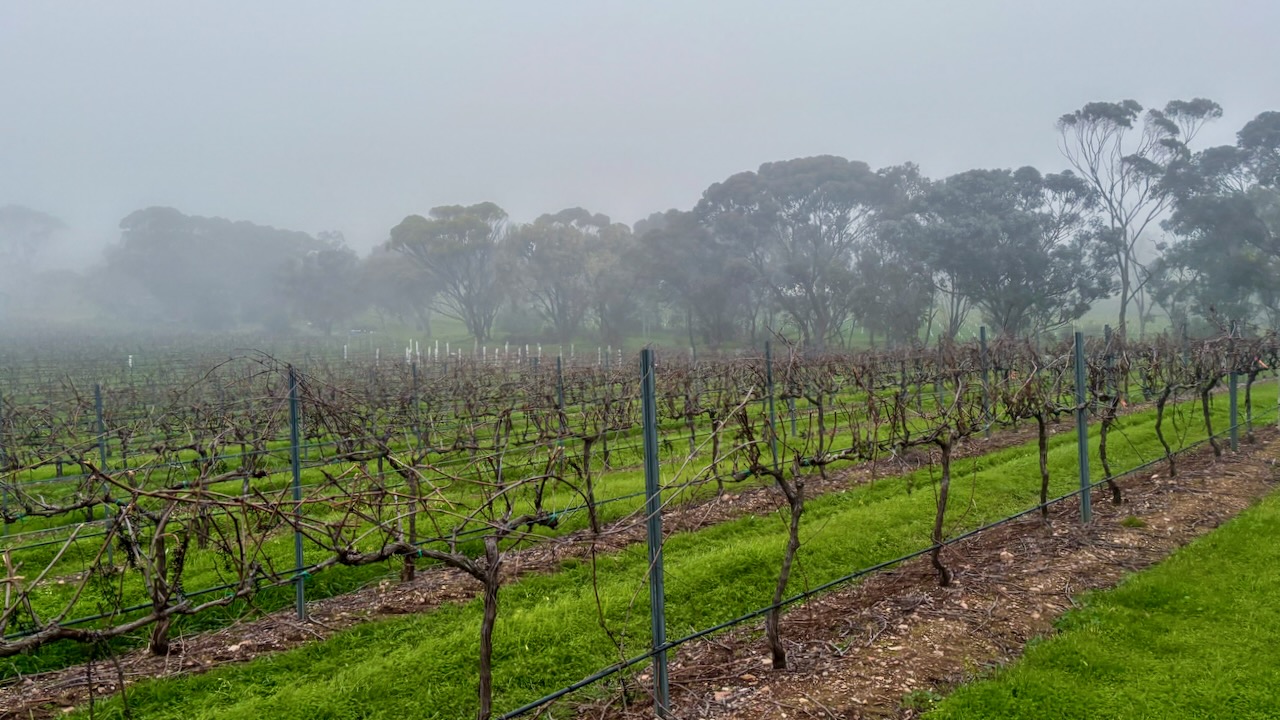
A cold, frosty morning in Marananga’s heartland at Schubert Estate’s Goose Yard vineyard.
The Legacy of Generations Past
The Barossa is a vital part of the Australian wine story, with 14,000 hectares under vine (10% of the Australian total) and 500 grape growers servicing 170 wineries. Comparatively, Clare Valley is much smaller, with 4,800 hectares under vine. Two thousand five hundred hectares in the Barossa are over 35 years of age, with 250 hectares planted over a century ago, including some vineyards planted as far back as the 1840s. Old vines are rarer in the Clare Valley, with the oldest vineyards planted in 1893.
While old vines are often grubbed up when their yields fall below optimal levels elsewhere in the world, Australian growers frequently treat heritage vines with greater reverence. Perhaps as a function of more irregular rainfall, local growers prefer to keep established vines in the ground, prioritising quality over yield, which also avoids the risk that new plantings will fail to take. Better the devil you know. The argument is that these older vines naturally regulate their yields. Thanks to their deep root systems, these vines also possess greater carbohydrate reserves and access to water and nutrients, allowing them to better ride out challenging seasons. There is a notable density of flavour in old-vine wines, which helps elevate them above their peers.
The existence of old vineyards is in itself a mark of their value, their survival due to the quality of fruit that they deliver and its commercial return. As succinctly described by Robert Hill-Smith, Chairman of Yalumba, “The vines are old because they are good, not good because they are old.” It should come as no surprise that many of the Barossa’s most iconic wines have been crafted off the back of old vines. Penfolds’ Block 42 Cabernet Sauvignons were made from the oldest Cabernet Sauvignon block in the world, dating to 1888, and bottled as single-vineyard wines in 1996 and 2004. These wines are only now starting to hit their drinking windows, as are numerous vintages around the same age of Henschke’s Hill of Grace, sourced from a block first planted in the 1860s.

Samantha Chandra is the winemaker behind Setiono Wines, an emerging producer of bespoke Riesling and Shiraz.
Today, a number of single-vineyard wines are joining their ranks, such as the Cirillo 1850 Grenache and the Hewitson Old Garden Mourvèdre, made with fruit from vines planted in 1853. Others such as Penfolds Grange and Torbreck’s RunRig also draw heavily on the deep reservoirs of flavour found in old-vine fruit. In many ways, these older vines are the glue that underpins the best wines from the Barossa, delivering both power and savoury detail.
Fruit from these old vines has long been prized and locked into long-term supply contracts. However, the Barossa is not immune to the global downturn. Old-vine fruit from some of these mature vineyards has recently come on the open market for the first time in years, making high-quality fruit sources available to new entrants in the market where none existed in the past. This offers exciting opportunities for emerging projects in the Barossa, with promising first vintages noted in this report from Ms. L Wines and Setiono. The Barossa has always attracted its fair share of young winemakers willing to try their hand with a couple of tonnes of fruit. But today, younger winemakers seem more confident in challenging the perceived wisdom of the day and are writing their own unique story in terms of winemaking techniques and style. This is a positive in a region where tradition is king.
Australian Riesling Reimagined
Riesling has a long and proud history in Clare Valley and Eden Valley, championed by early German settlers. The Australian Riesling style has generally prized purity and pristine fruit, with cool ferments in stainless steel de rigueur. Clearly, Australia’s Clare Valley and Germany’s Mosel offer vastly different expressions of Riesling thanks to polar opposite climates. But a chance meeting between Germany’s Ernie Loosen and Australia’s Peter Barry in the 1990s led these two unlikely partners to later collaborate on a project. The goal was to unleash Loosen’s Grosses Gewächs winemaking in Australia and provide a revolutionary take on the local style. The result was the Wolta Wolta Riesling, which debuted with the 2016 vintage. Coincidentally, at the same time, Belinda and John Hughes from Rieslingfreak were also dreaming of their own groundbreaking Riesling.
The classic Australian Riesling style involves early morning picks and protective winemaking to minimise oxidation before a cool, stainless steel fermentation of ultra-clean juice. Cultured yeasts work together to keep the wine as tight and bright as possible. Since it was discovered that sunburn can lead to the development of more savoury, petrol-like characteristics, growers have placed a greater emphasis on shading fruit through canopy management, while the use of bentonite sprays also provides a measure of sun protection. For Loosen, the ubiquitous modern approach represented an opportunity to repeat what he had done in the Mosel Valley around the turn of the new millennium, embracing the more traditional winemaking techniques utilised by some of his family decades prior.
Loosen told me of his eureka moment: “I rediscovered this approach 25 years ago when a very, very old customer of my great-grandfather brought me a bottle of his 1947 Riesling. The winemaking was relatively simple, using a large old barrel for fermentation with indigenous yeasts before extended aging of at least two and up to eight years on full lees with regular topping.”
With this background and experience, Loosen suggested a similar approach to the Barry family in 2015, and they jumped at the opportunity. Twelve months later, in February 2016, a seasoned 3,000-litre barrel from Loosen's cellar arrived in Australia and was quickly filled with the first vintage of the Wolta Wolta Riesling. Eschewing the traditional Australian style, Wolta Wolta was fermented with native yeast on full lees without a malolactic fermentation, then matured for two years. The Barry family was cautious at first, so they kept the barrels during early vintages at only 2°C to control development. They need not have worried, as the wines were incredibly stable. Since the first vintage, the only significant change in approach has been increasing the maturation temperature to 10°C, which has been advantageous in building volume of flavour.

Ernie Loosen (left) and Sam Barry (right) present a vertical of Wolta Wolta Riesling.
Choosing the right vineyard was crucial to the ultimate success of this project. The Barrys had access to high-quality fruit from the historic Florita vineyard, located close to the valley floor at an elevation of 400 metres. But Loosen wanted something different: a cooler site with longer hangtime. They chose the Spring Farm property, which was a little higher at 495 metres, with a southerly aspect. The vineyard was often the last picked across the Barrys’ extensive holdings. The slatey soil also interested Loosen thanks to its similarity to the Mosel. Loosen is a strong believer in the nobility of slate, wherever it is found, so there is a sense of serendipity in that the Barrys had planted the Spring Farm site in 1981 on slate-rich soils. Translated through these old-school winemaking techniques, the slate soils deliver a very different end product that is distinctly savoury and textural in character. These wines provide genuine aging potential and a snapshot into how historic winemaking paired with new visions can elevate the standing and quality of Australian Riesling.
2024: A Return to Normal Programming (with a Touch of Frost)
I outlined the 2024 vintage in my last report, but having now tasted a greater number of leading wines from the year, the picture is clearer, particularly regarding the red wines. After the cool and dry 2023 vintage, 2024 came as a relief to winemakers in the Barossa and Clare Valley. With only a hundred kilometres between these regions, there is generally a significant similarity in conditions, but not always. In 2024, there was a close alignment in the dry conditions and impactful frost events.
Dry winters and springs had the vines out of the gate very early, with September averages in both the Barossa and Clare 3.5°C above average. Unfortunately, frost was not too far behind. The southern end of the Clare Valley, including Watervale, was hit hard in late October, while Barossa was hit in September and October. Some vineyards lost over 50% of their crop. A heat spike during flowering in the Barossa also led to poor fruit set in some areas. To top it off, late November saw significant hail damage in southern Clare and northern Barossa.
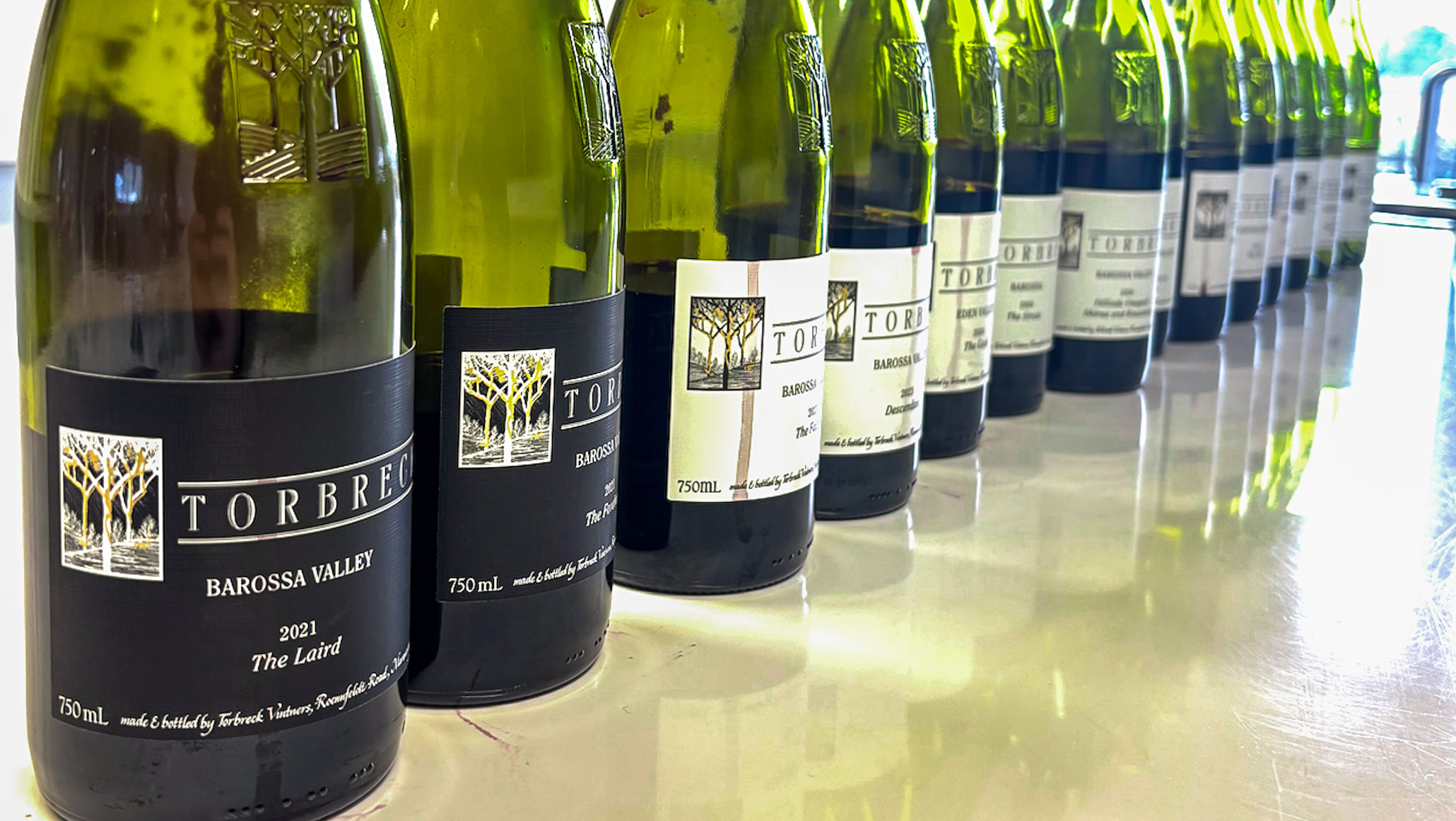
Torbreck is a serious operation focused on a wide range of Rhône varieties. The annual snapshot is always a highlight, with quality particularly high this year.
Luckily, the weather settled down, with Clare receiving average temperatures and rainfall during summer. Solid rains in November and December delivered adequate soil moisture for the season. Dry conditions continued into autumn, giving winemakers free rein on picking dates and the opportunity for extended hangtime. For vineyards that made it through the hail and the frost, 2024 is an exceptional year for Clare, with expressions of Riesling, Cabernet Sauvignon and Shiraz displaying both power and subtlety. However, quality is variable due to the extent of frost and hail damage.
The Barossa began summer with cooler-than-average temperatures, but the effects of a warmer February and March were further exacerbated by very low rainfall from February until April. While total summer rainfall was only 11% less than average, combined with a generally dry 2023 (down 26% on average), this delivered a significantly lower-yielding vintage with winemakers able to pick at will.
There is an impressive generosity and natural drinkability to the 2024 Barossa Shirazes. These wines are immediately captivating but not overwrought, with the structure to hold over the medium term. Due to the effects of a long, dry summer, this is a vintage where old-vine Grenache is a leading light, again illustrating its ability to flourish in Barossa’s Mediterranean climate.
Early Impressions of 2025
After the frost and hail during the 2024 growing season, and the very dry harvest, grape growers and winemakers in the Clare and Barossa were hoping for a reprieve. However, it did not come. Very dry conditions in winter and early spring led to an early budburst, which was two to three weeks earlier than normal, with increased frost risk. Between September 13 and 18, icy conditions across South-East Australia, with temperatures of -4°C in the Barossa, led to widespread frosts, some of the worst in recent memory. There were significant losses across both Clare Valley and Barossa; even frost fans were unable to cope in some areas.
Damage was quite widespread in the Barossa, hitting select vineyards in lower-lying areas across Nuriootpa, Northern and Western Barossa and into the Eden Valley. Early growth allowed for the development of secondary buds. For the remainder of the growing season, the weather remained relatively constant, with daytime temperatures above average across the board. Judicious irrigation where possible helped to offset the lack of rain and retain fruit quality. Eden Valley, with limited water retention capacity in the soils, was most affected by these drought conditions. The result was a challenging year and one of the earliest vintages on record across Clare and Barossa. The wines I’ve tasted so far are largely approachable and open-knit, in line with the less-than-optimal growing season.
I tasted the wines for this report in Clare Valley and Barossa Valley in June 2026, with follow-up tastings in my Sydney office.
© 2026, Vinous. No portion of this article may be copied, shared or redistributed without prior consent from Vinous. Doing so is not only a violation of our copyright but also threatens the survival of independent wine criticism.
You Might Also Enjoy
Barossa and Clare Valley: The Champion and the Contender, August 2025
The Second Coming of Australian Chardonnay, Angus Hughson, June 2025
Barossa 2022: Run, Don’t Walk, Angus Hughshon, August 2024
Show all the wines (sorted by score)
- Adelina
- Agricola
- Arila Gardens
- Auld Family Wines
- Barossa Boy
- Bethany Wines
- Bosward Wines
- Calabria Family Wines
- Chaffey Bros. Wine Co
- Chateau Tanunda
- Chris Ringland
- Cimicky WInes
- Cirillo
- Corryton Burge
- Crabtree Wines
- Dewey Station Wines
- Eden Hall
- Eisenstone
- Elderton
- Frederick Stevenson
- Gatt Wines
- Gertie Wines
- Gibson
- Glaetzer Wines
- Golden Amrita
- Grant Burge
- Greenock Creek Wines
- Grosset Wines
- Hare's Chase
- Hart of the Barossa
- Hayes Family Wines
- HEAD Wines
- Heathvale Wines
- Henschke
- Hentley Farm
- Hewitson
- Hobbs Wines
- Jim Barry Wines
- John Duval Wines
- Kaesler Wines
- Kalleske Wines
- Kenny Wine
- Kies Family Wines
- Kilikanoon
- Kirrihill Wines
- Knappstein Wines
- Koerner Wine
- Lambert Estate
- Langmeil
- Langmeil Winery
- Leo Buring
- Matriarch and Rogue Wines
- Miss Zilm Wines
- Mount Horrocks Wines
- Ms. L Wines
- Orlando
- Paulett Wines
- Penfolds
- Pewsey Vale
- Phase Three Wines
- Pikes
- Purple Hands
- Rieslingfreak
- Saltram
- Schubert Estate
- Schwarz Wine Company
- Seppeltsfield Wines
- Setiono
- Sevenhill Cellars
- Shut the Gate Wines
- Skillogalee
- Sons of Eden
- Sorby Adams Wines
- Spinifex Wines
- St Hallett
- Sussex Squire Wines
- Taylors Wines
- Tenafeate Creek Wines
- The Cutting
- The Wilson Vineyard
- Thistledown Wines
- Thorn-Clarke Wines
- Tim McNeil Wines
- Tope Wines
- Torbreck
- Turkey Flat Vineyards
- Two Hands
- Vanguarist
- Vickery Wines
- Welland
- Whistler Wines
- Wines by KT
- Yalumba
- Yelland & Papps