
Browse using the new Vinous website now. Launch →
Printed by, and for the sole use of . All rights reserved © 2015 Vinous Media
Greece: Xinomavro in the Spotlight
BY NICOLAS GREINACHER | NOVEMBER 12, 2026
Ask wine lovers to picture Greek wine, and many will imagine a chilled glass of Assyrtiko on a terrace overlooking the Aegean Sea. This year’s report takes us somewhere rather different: Macedonia, the vast region spanning much of northern Greece, where the character and reputation of the red Xinomavro variety have been shaped over generations.
This report begins with the journey north and a first impression of Naoussa. It explores the region’s geography and its two leading Protected Designation of Origin (PDO) appellations for varietal Xinomavro — Naoussa and Amynteo — before taking a closer look at Xinomavro itself: its distinctive flavour profile, aging potential and the reasons behind its frequent comparisons to Nebbiolo.
As in last year’s Greece report, the accompanying tasting notes and producer commentaries extend well beyond the regional focus, featuring wines from 51 producers across Greece, including Santorini and the Peloponnese. The selection spans 17 vintages, reaching as far back as 1956, and encompasses a broad range of styles. Together, these wines offer a wide-ranging snapshot of contemporary Greek wine.
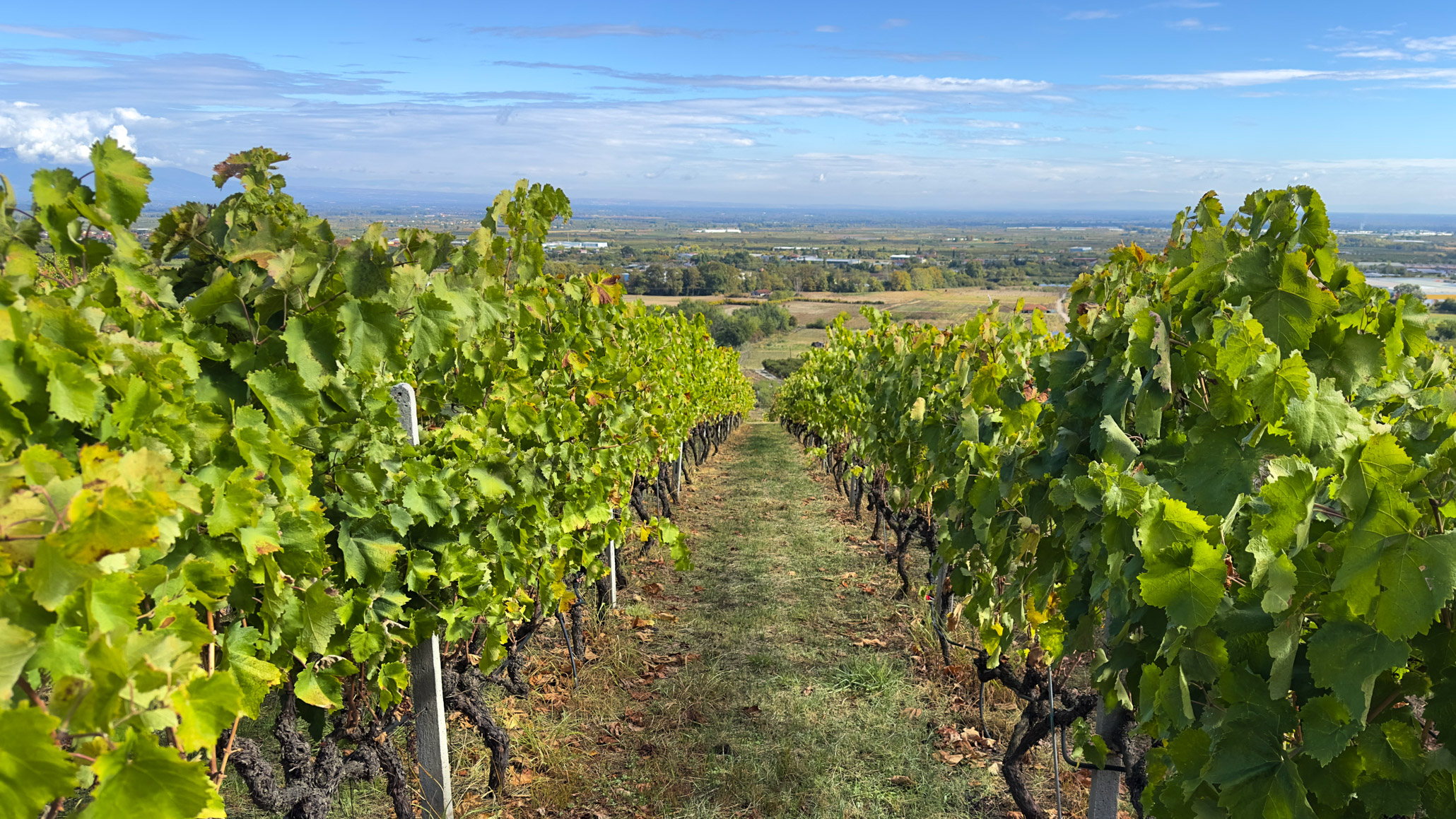
Autumn colors emerge among the vineyards of Naoussa, overlooking the vast Macedonian plain.
Macedonia: Mountains, Lakes and Plains
Macedonia covers much of northern Greece, stretching from rugged mountains to broad agricultural plains. This varied landscape gives rise to equally diverse growing conditions and wine styles. In the mountains, conditions are continental, with cooling influences from high elevation. Naoussa and Amynteo both lie around this mountainous zone.
Red wine is central to Macedonia’s identity, particularly in Naoussa, whose PDO is reserved for red wines made exclusively from Xinomavro. Amynteo also requires 100% Xinomavro, but its PDO also encompasses still and sparkling Rosé. Nearby Goumenissa’s red-only PDO offers a softer, rounder expression of Xinomavro, blended with at least 20% of the local Negoska variety. Further east, in the warmer and drier Drama Valley, producers have earned a name for Bordeaux blends. The whites are not to be overlooked either: Chardonnay and Sauvignon Blanc do well in higher elevations, while Drama and Kavala deliver noteworthy interpretations of Greek favorites such as Assyrtiko and Malagousia.
Naoussa: Xinomavro’s Heartland
Naoussa lies around a 90-minute drive from Thessaloniki, Greece’s second-largest city and a natural gateway to Macedonia. Visitors expecting an endless sea of vines on arrival may be surprised. Vineyards are scattered across the landscape, interspersed with patches of wild vegetation. At first glance, there is little to suggest that Naoussa is one of Greece’s most famous wine appellations.
Naoussa is relatively modest in size, with roughly 600 hectares under vine. The town of Naoussa itself is small and has an authentic, lived-in character. It feels like a real, working Greek town rather than a polished tourist destination. Some parts may look a little worn or dated, but that’s part of its charm.
Many of the surrounding wineries welcome visitors. Some, such as Kir-Yianni, have well-developed facilities where guests can also enjoy a bite to eat, while at smaller estates, it is advisable to arrange a visit in advance.
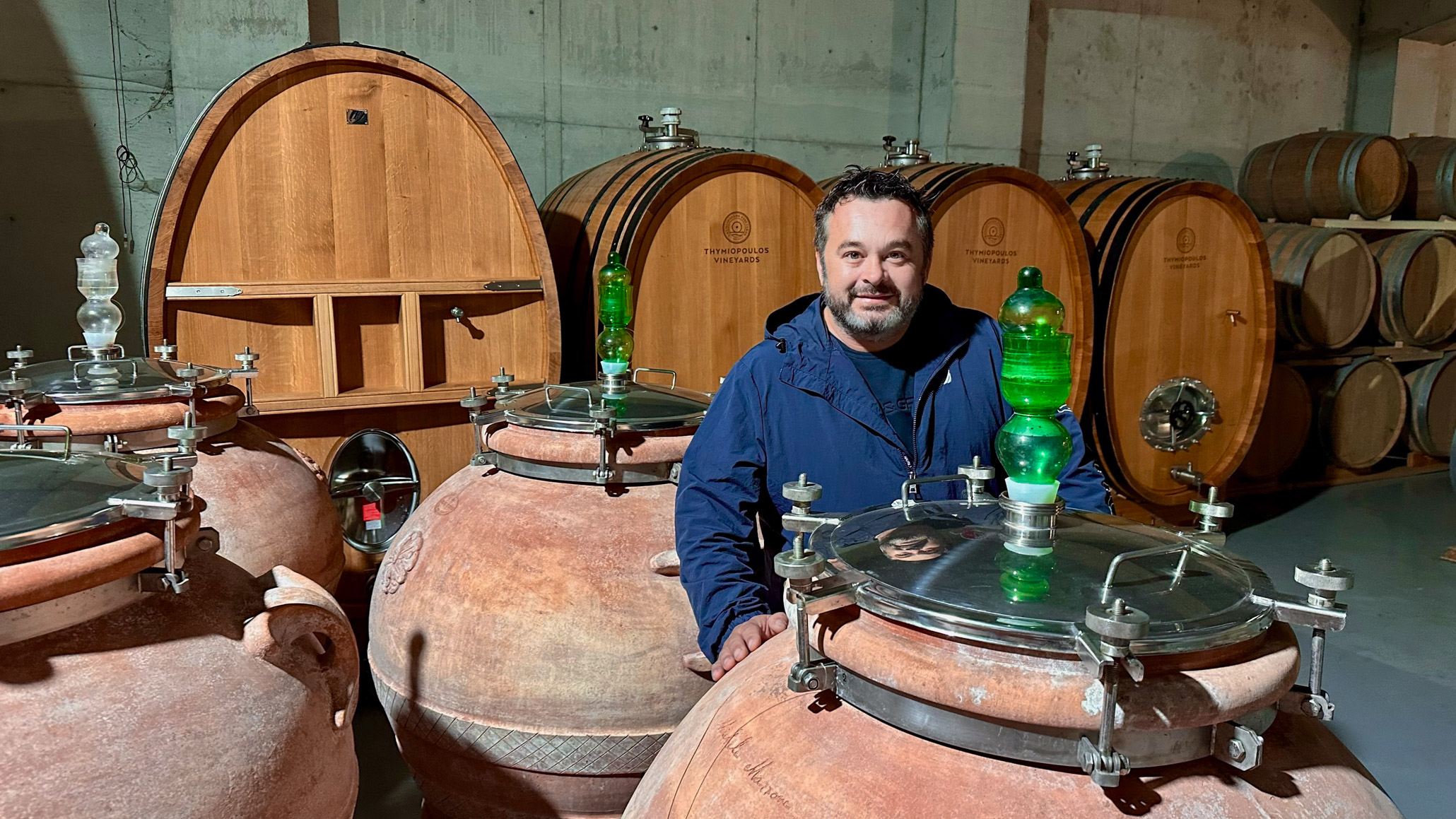
Apostolos Thymiopoulos ranks among Greece’s most accomplished winemakers, championing a refined, gently extracted expression of Xinomavro that stands among the country’s finest reds.
Naoussa occupies the southeastern slopes of Mount Vermio, with vineyards planted at elevations ranging from 150 to 400 meters. While the most favored sites enjoy some shelter from the strong, cold winds arriving from the north and west, the overall climate remains temperate. A patchwork of soils, exposures and local climatic conditions creates considerable variation between sites. Aspect and topography often play a greater role than elevation alone, meaning that even neighboring vineyards can yield wines of markedly different character.
PDO Naoussa Xinomavros typically possess firm tannins, bright acids and complex aromas, with the ability to improve in bottle. Prices are generally moderate, a handful of premium bottlings aside. Outside the PDO, producers also make distinctive Rosés and softer, more approachable reds, often blending Xinomavro with Merlot. These may be labeled PGI Imathia or PGI Macedonia, for example.
Visitors discovering Naoussa’s wines for the first time are likely to encounter three broad stylistic expressions of Xinomavro, each reflecting a different chapter in the region’s winemaking history. Traditionally, wines were matured in large, seasoned oak casks, producing savory, spice-driven expressions in which earthy and meaty nuances often took precedence over fruit. The 1990s saw a shift towards new French oak barriques, bringing greater structure, weight and more pronounced oak influence, although many producers have since adopted a more restrained approach. More recently, a new generation of winemakers has embraced riper fruit and techniques such as infusion extraction, crafting wines with softer tannins and a more perfumed fruit profile.
One of the most encouraging developments is a growing interest in the importance of site. Several producers now bottle wines from individual vineyards, bringing out the contrasts between different corners of the appellation. Tasting such wines side by side is an instructive experience, as it shows how many shades of character Xinomavro can express when each site is allowed its own voice. For a grape so closely tied to its home, this focus on individual sites feels like a natural next step.

Georgia Foundi at her winery in the Naoussa appellation, where her family’s Xinomavro winemaking heritage dates back to the planting of their first vineyard in 1930.
Amynteo: The Cooler Side of the Mountain
To the northwest of Naoussa, on the opposite side of Mount Vermio, lies Amynteo, also known as Amyndeon or Amyndeo. Here, vineyards occupy considerably higher ground at elevations of 570 to 750 meters, where northerly exposures leave them vulnerable to cold winds.
The presence of several lakes helps temper an otherwise challenging continental climate, but proximity to water is not without its drawbacks. Higher humidity near the lakes increases the risk of fungal diseases, while fertile soils can encourage excessive vine vigor and yields, potentially compromising ripening if left unchecked.
The Amynteo PDO requires 100% Xinomavro, with one notable difference from Naoussa: Rosé — both still and sparkling — is permitted here. Thanks to the cooler climate, Amynteo reds are generally lighter than those from Naoussa, and the finest of them carry an elegant perfume. Phylloxera, the vine pest that devastated vineyards across much of Europe, rarely took hold in sandy parts of the appellation, so plenty of old, ungrafted vines remain.
Amynteo’s high-elevation vineyards and cool growing conditions make it particularly well suited to the production of Xinomavro-based sparkling wines — both tank and traditional method. Xinomavro is also blended with international varieties, including Merlot, but these wines fall outside the appellation’s regulations and therefore cannot bear the Amynteo PDO designation.
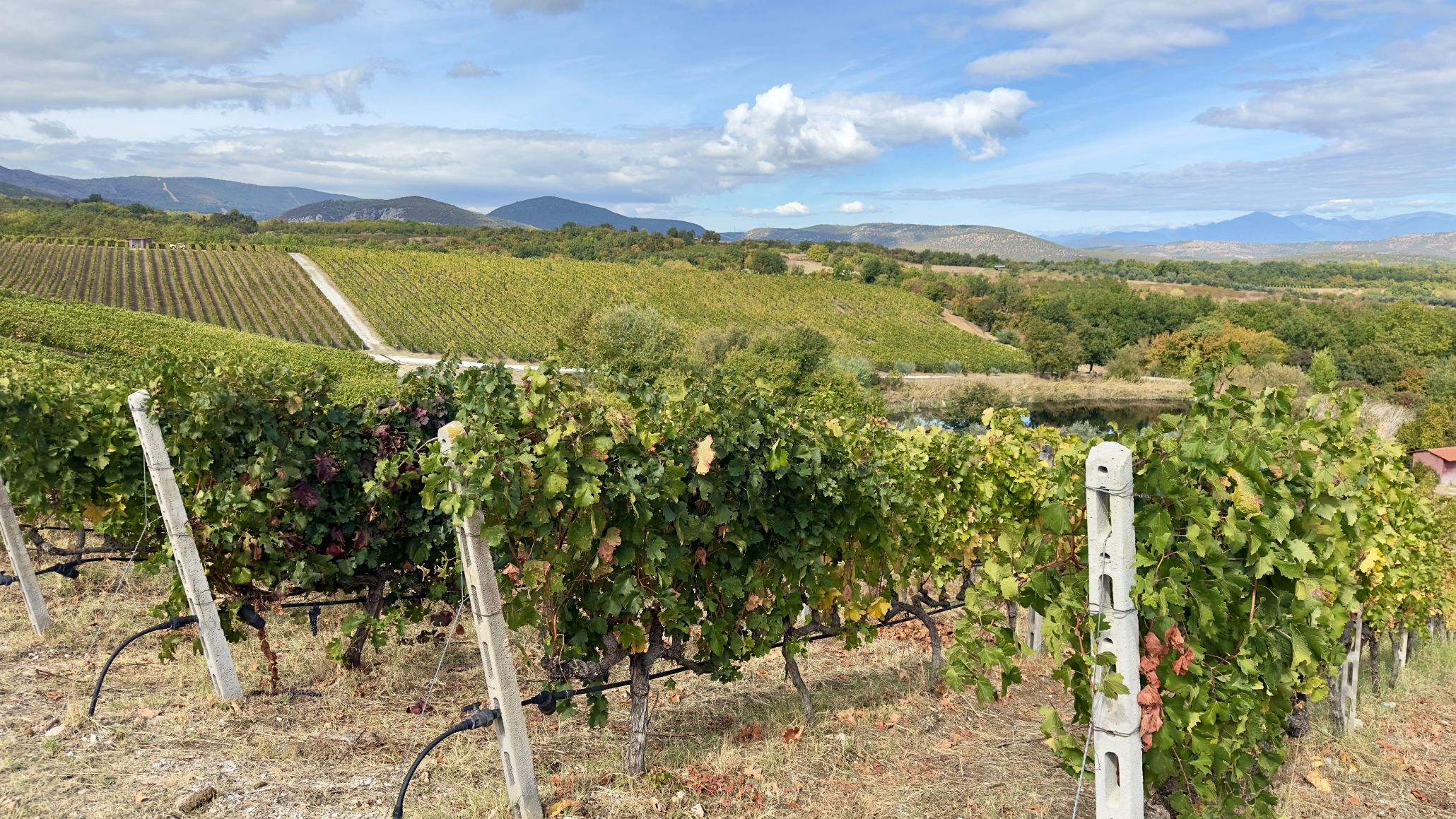
The rolling vineyards of Ramnista at Kir-Yianni Estate in Naoussa.
Getting to Know Xinomavro
No indigenous Greek red variety enjoys the same standing as Xinomavro. Although its roughly 2,200 hectares of plantings are distributed across northern Greece, this late-ripening variety’s reputation has been built largely on the wines of Naoussa. The name “Xinomavro,” loosely translated as “sour black,” offers a clue to the grape’s uncompromising character. Xinomavro wines are usually high in acid, with assertive tannins and an aromatic profile in which tomato and other vegetal notes sometimes overshadow the fruit. Achieving full phenolic ripeness is not always straightforward either, particularly in challenging vintages, making Xinomavro a more demanding proposition than many of Greece’s other native varieties.
Xinomavro’s greatest strength lies in its ability to age. The finest examples — particularly those sourced from low-yielding vineyards and carefully matured in oak — can develop positively over decades. While Xinomavro’s color tends to fade relatively early, its aromatic complexity deepens with time, revealing layers of increasingly nuanced tertiary notes such as dried herbs and fruits, earth and tobacco. Several mature bottles I tasted for this report, some over 20 years old, offer compelling evidence of the variety’s longevity.
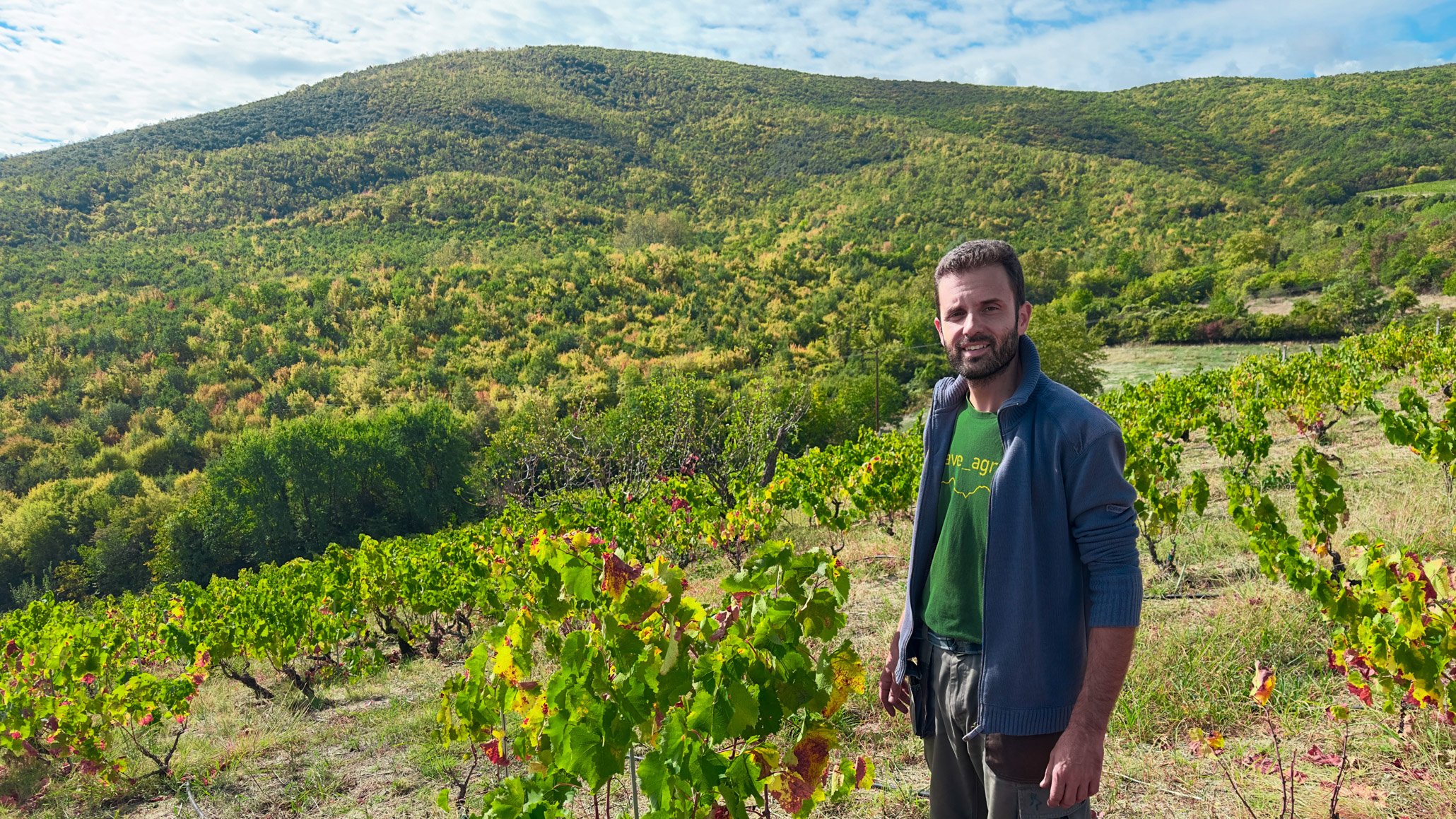
Sixth-generation winemaker Kostis Dalamaras in his hillside vineyards in Naoussa. Dalamaras produces exceptional Xinomavro wines; his cult Vieilles Vignes is the finest Greek red I have ever tasted.
Alongside these traditional expressions, an increasing number of producers, such as Apostolos Thymiopoulos, are pursuing a more approachable style of Xinomavro intended for earlier enjoyment. Harvesting at full phenolic ripeness and employing gentler extraction techniques like infusion helps emphasize ripe fruit and soften the variety’s tannins. Blending offers another means of moderating Xinomavro’s naturally assertive character; Merlot contributes roundness and suppleness, while Syrah brings additional spice and color. Both approaches make Xinomavro more international in style and more accessible to newcomers, although varietal interpretations remain the most compelling expressions.
Comparisons with Nebbiolo are inevitable, and given the similar color, acidity and tannic frame of the two grapes, those comparisons hold up. In my view, however, Xinomavro misses the airy, flowery perfume that Nebbiolo can show, and its tannins tend to make themselves felt a little more. This is also what sets the finest Xinomavros apart: tannins lend backbone without ever taking center stage. The best Xinomavro-based reds in this report lean as much on their racy acidity as on their tannic structure.
What I find most appealing about Xinomavro is how closely it is linked to its home. This is not a grape that arrived recently to follow some trend. It has been cultivated by the people of this region for generations, refined over time and preserved through different clones (mostly V3 and V6), and it remains inseparable from its origins. In that sense, Xinomavro has everything it needs to earn a lasting place on the global wine scene, fine wine most certainly included.
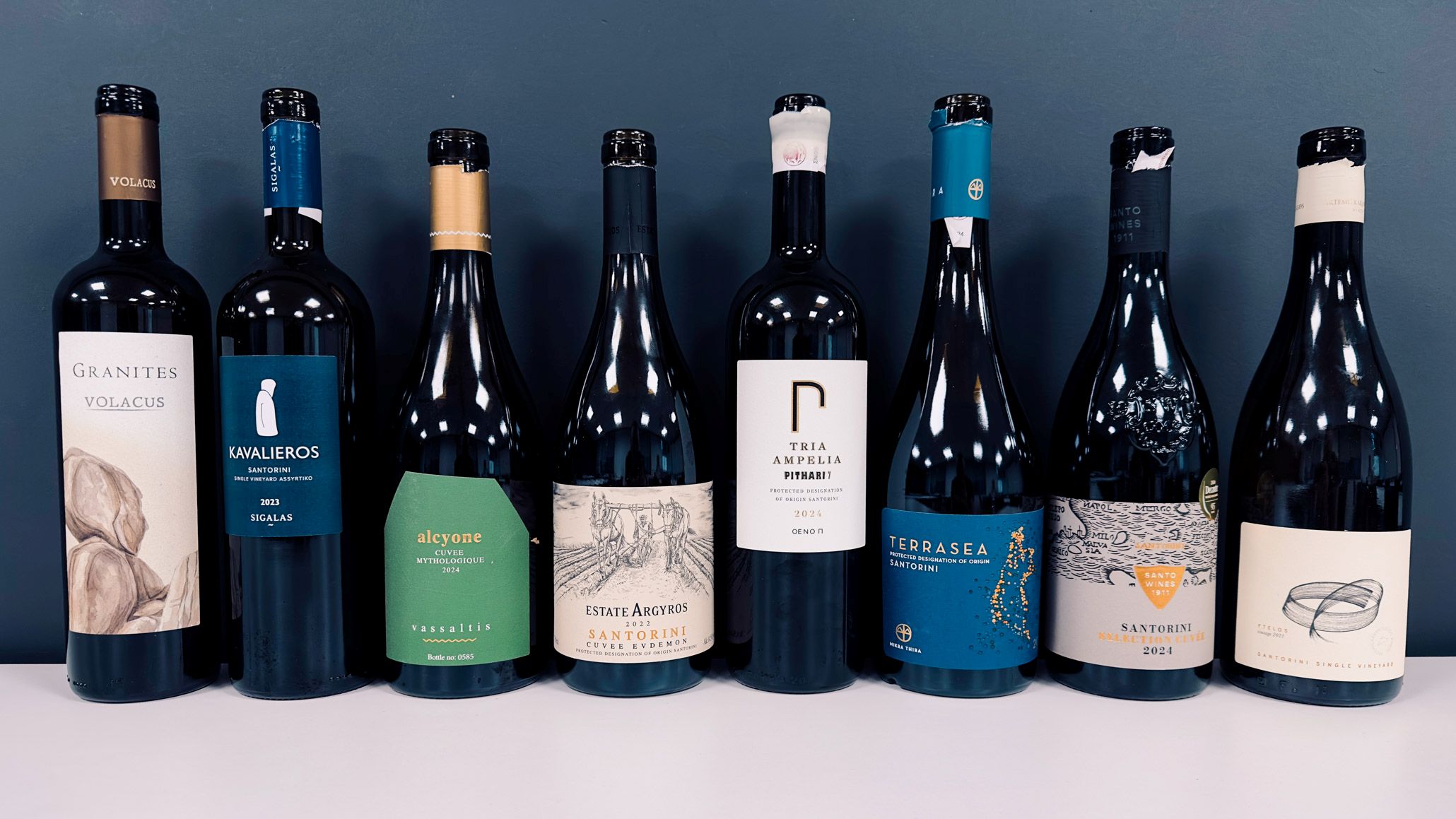
A stellar lineup of dry Assyrtikos from my Athens tastings, in which Oeno P’s Santorini Tria Ampelia (fourth from right) shone brightest.
Final Thoughts
For readers curious about Greek wine beyond the islands, Macedonia is a great place to start, both in the glass and on the ground. Naoussa offers an authentic setting unmarred by mass tourism, with excellent local food and talented winemakers keen to share their work. Even one or two days in Macedonia leaves a lasting impression.
Those wishing to explore Greek wine in Greece itself might consider combining Macedonia with the Cyclades. During high season, daily flights connect Thessaloniki with some of the main islands, allowing travelers to easily enjoy two sides of Greek wine on one trip: still reds, Rosés and sparkling wines in the north, and both dry and sweet whites on the islands. The most difficult decision is how many shirts to leave behind to make room in your luggage for wine on the flight home.
I tasted the wines for this report during a trip to Greece in October 2026.
© 2026, Vinous. No portion of this article may be copied, shared or redistributed without prior consent from Vinous. Doing so is not only a violation of our copyright but also threatens the survival of independent wine criticism.
You Might Also Enjoy
Greece: From Ancient Roots to Modern Glory, Nicolas Greinacher, December 2025
A Shard of Greek Sunshine, Neal Martin, June 2021
Show all the wines (sorted by score)
- Alpha Estate
- Amoenos Vineyards
- Apostolos Thymiopoulos
- Arktos Elevation Vineyards
- Artemis Karamolegos Winery
- Boubas Wines
- Boutari
- Dalamára
- Domaine Glinavos
- Domaine Hatzimichalis
- Estate Argyros
- Foundi
- Gai'a Wines
- Gioinos
- Idaia
- Karanika
- Kechris
- Kir-Yianni
- Ktima Avantis
- Ktima Biblia Chora
- Ktima Dio Ipsi
- Ktima Gerovassiliou
- Ktima Pavlidis
- Ktima Zafeirakis
- Lacules Estate
- Mega Spileo
- Methymnaeos
- Mikra Thira
- Mikro Ktima Titos
- Monemvasia Winery Tsimbidi
- Monsieur Nicolas by G. Karamitros
- Nico Lazaridi
- Oeno P
- Oenops Wines
- Orealios Gaea
- Ousyra
- Papantonis Winery
- Paros Farming Community
- Santo Wines
- Scaperdas Frères
- Seméli
- Sigalas
- Skouras
- Thera Terra
- Troupis Winery
- Vaptistis
- Vasiliki Koumarela
- Vassaltis Vineyards
- Vegoritis Winery
- Volacus
- Wine Art Estate