
Browse using the new Vinous website now. Launch →
Printed by, and for the sole use of . All rights reserved © 2015 Vinous Media
Mas Jullien: A Languedoc Tale
BY ANTONIO GALLONI | APRIL 1, 2026
Olivier Jullien is one of the trailblazers in the Languedoc. Jullien founded his domaine in 1985 with just three hectares of vineyards. At the time, Languedoc was known mostly for turning out volumes of largely undistinguished wines. But Jullien had a different vision, a vision of an estate focused on sustainable farming, low yields and minimalist winemaking. It was a radical departure from the world Jullien grew up in, where vignerons like his father sold grapes to the local cooperative. This collection of mini-verticals provided a terrific opportunity to taste new releases as well as revisit many older vintages.
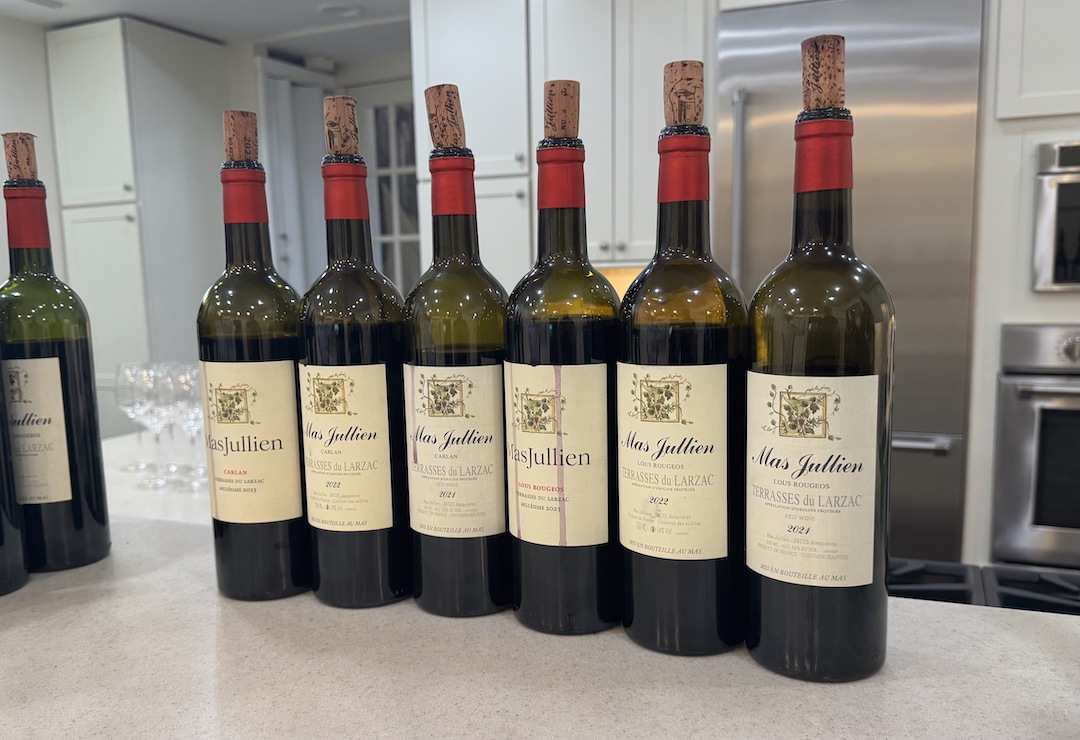
Mini-verticals of the Carlan and Lous Rougeos bottlings.
Exploring Terres du Larzac
Mas Jullien is in Joncquières, on the Terres du Larzac plateau, an area that has started to receive some attention as of late. The appellation lies on the foothills of the Causse du Larzac mountain range, nestled between the Hérault and Lergue Rivers. Rocky, alluvial soils, elevation and a relatively cool micro-climate with strong diurnal shifts yield wines of extreme complexity and nuance that age exceptionally well. Early reds were labeled as Coteaux du Languedoc Rouge. Terres du Larzac became a separate region within Coteaux du Languedoc in 2004, and was established as an AOC (Appellation d'Origine Contrôlée) in 2014.
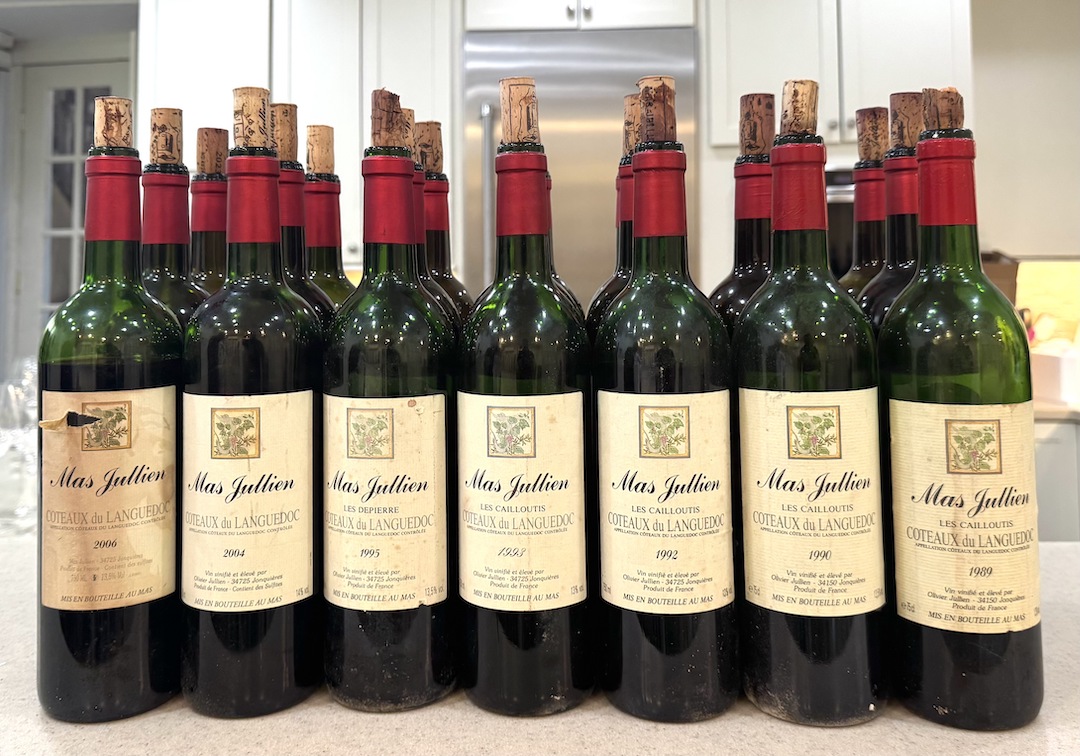
A stellar collection of older wines going back to the 1989 Coteaux du Languedoc.
Full Circle: Diving into the Range
Today, Olivier Jullien farms approximately 15 hectares of vineyards. Vineyards are farmed sustainably, although Jullien has eschewed formal certifications since the mid-2000s so that he has the flexibility to adapt to the needs of each vintage.
There are presently three reds in the Mas Jullien portfolio. The Terrasses du Larzac Autour de Jonquières (previously labeled as Coteaux du Languedoc) is the core wine, a blend of Mourvèdre, Carignan and Syrah taken from a collection of parcels that spends two years in large-format wood. Prior to 2017, the Autour de Jonquières included some Grenache and Cinsault, which Jullien gradually phased out in favor of Mourvèdre.
The Carlan, first bottled in 2009, is somewhat of a stylistic outlier in the range, as it is the only wine in the lineup from sites planted on sand and schist, whereas most of the other vineyards feature clay/limestone soils. This Grenache- and Carignan-driven blend from old vines offers a distinctive aromatic and flavor profile, along with a silkier texture vis-à-vis the other reds. In 2018, Olivier Jullien expanded his range with the Lous Rougeos, a Carignan- and Syrah-based blend aged in foudre. Elevation of 400 to 450 meters (Jullien’s highest-elevation site) and western exposure yield a wine of notable complexity. This article also includes a few notes on the Coteaux du Languedoc Rouges Les Depierre and Cailloutis, which Jullien made until the late 1990s, when he decided to start blending them into a single red wine.
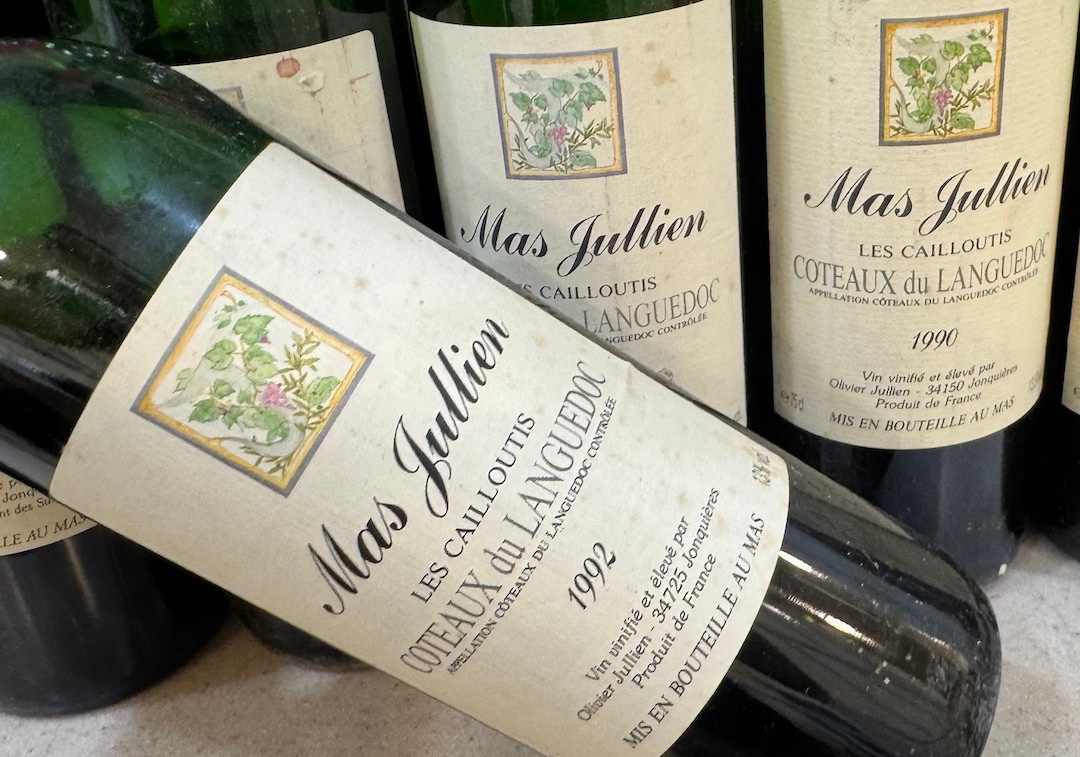
Mas Jullien’s wines from the estate’s early days have aged exquisitely.
The Vin de Pays de l'Herault Blanc is an old-vine blend of Clairette, Carignan Blanc, Chenin Blanc, Roussanne and Grenache Blanc aged in large-format wood, with a composition that varies from year to year. The Blanc can be enjoyed young for its freshness and vivacity, but the real magic happens with a few years in bottle, when the wine starts to gain textural richness and phenolic intensity while retaining its essential minerality. Readers who can find the Blanc are in for a treat, as it is very clearly one of the most pedigreed whites in the world. Pricing remains mystifyingly low considering its quality, personality and ability to gain notable complexity in bottle. I can’t think of too many whites that offer this much sheer character and age-worthiness for the money.
I first discovered Languedoc in the 1990s as a young wine lover on a budget. I have written about the wines from time to time, but not as much as I would have liked. I am pleased to report that my colleague Nicolas Greinacher will be adding Languedoc to his tasting and writing beat. The wines might not be the screaming buys they were a few decades ago, but they still offer tremendous value and character along with the ability to age effortlessly for years, and, in some cases, decades.
I tasted all the wines in this report in New York in August 2025.
© 2026, Vinous. No portion of this article may be copied, shared or redistributed without prior consent from Vinous. Doing so is not only a violation of our copyright but also threatens the survival of independent wine criticism.
You Might Also Enjoy
The Mighty Ducks: 2023 Loire Valley Reds, Rebecca Gibb MW, July 2025
Digging up a Languedoc Treasure: Mas de Daumas Gassac 1978-2022, Nicolas Greinacher, July 2024
Northern Rhône 2024: One Hill Rises, Nicolas Greinacher, January 2026
Châteauneuf-du-Pape 2024: Dark Elegance, Nicolas Greinacher, October 2025