
Browse using the new Vinous website now. Launch →
Printed by, and for the sole use of . All rights reserved © 2015 Vinous Media
Gamayzing: Beaujolais New Releases
BY NEAL MARTIN | MAY 5, 2026
I am indebted to the co-owner of Château du Moulin-à-Vent for the title to this year’s Beaujolais article. As soon as Edouard Parinet uttered the word, I wondered, “How has nobody thought of this before?” That was my first appointment of an intense few days traversing this picturesque region, a place that resembles an alien landscape with its ochre earth covered in twisted vines. Over the following days, whenever my taste buds were lit up by a scrumptious Beaujolais, Parinet’s neologism popped into my mind. “Wow, that’s Gamayzing.”
The 2024 Growing Season
The 2024 growing season lobbed various obstacles at winemakers. As in the rest of France, Mother Nature avowed to make things as difficult as possible. Of course, the major difference is that in Beaujolais readers do not have to pay a king’s ransom to find out which wines overcame the challenges and which hit the hurdles. Nothing is worse than a poor wine except an expensive poor wine. Beaujolais, thank goodness, continues to offer Gamayzing value.
Given Beaujolais’ proximity to the Côte d’Or, one might assume that Beaujolais’s growing season is the same, but conditions can differ significantly between the two. Beaujolais has a more intricate and dramatic topography, and localised weather systems hold sway over ripeness and fruit health. For example, Beaujolais is less prone to frost and, as we saw in 2024, more susceptible to hailstorms. At least the risk of frost abates after May. Hail is a constant threat all the way through harvest. I spotted several vineyards with protective netting, though it is expensive to install and can only be used for trellised parcels.
The winter was mild and wet. The first leaves began to unfold towards the end of March, setting the growth cycle on a similar path to 2017 and 2020. Budbreak was early. Cool and inclement weather during April and May disrupted growth, and flowering was not until early June. Flowering was uneven due to constant rain, as much as every other day in the wettest weeks. Mildew pressure was high, and winemakers had to use sporadic dry windows to treat their vines. As in the Côte d’Or, some vignerons had to conduct up to 20 treatments to keep on top of mildew, particularly those who eschew non-organic sprays and rely upon sulphur or copper, which can easily wash away. July saw some improvement, and véraison took place in early August, a little later than the previous year. Unfortunately, hailstorms acutely affected areas such as Fleurie, Lantignié, Morgon, Chiroubles, Chénas, Moulin-à-Vent, Juliénas and Saint-Amour. As Justin Dutraive explained, winemakers then had to counter outbreaks of black rot. Like in the Côte d’Or, hot and dry conditions in the latter half of August enabled grapes to nudge towards full ripeness, although this slowed in the first days of September. But this crucial period means that 2024 should not be considered a write-off.
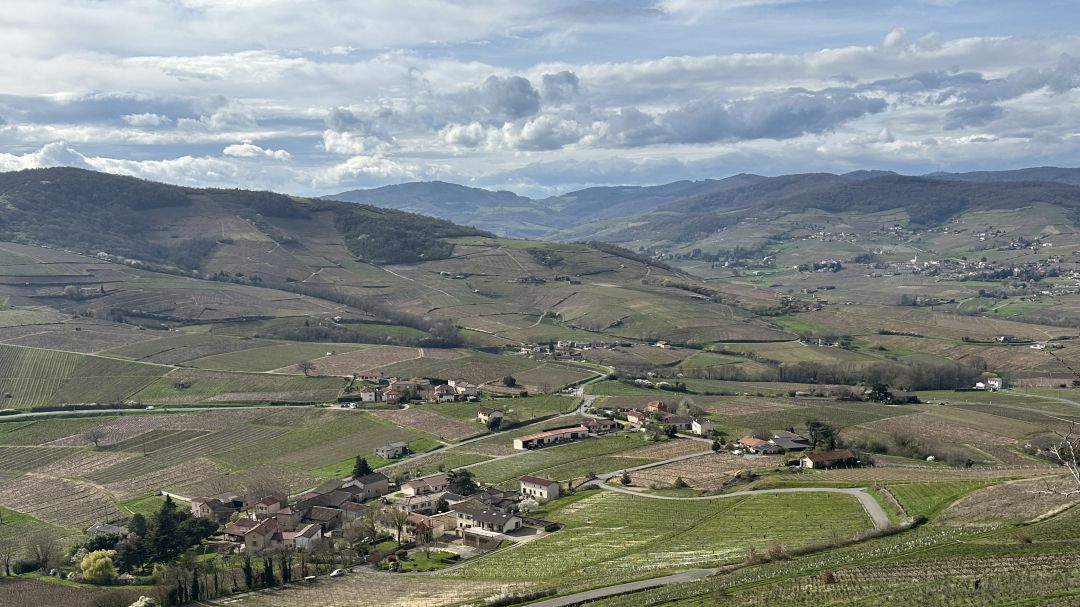
It is always worth driving up to the top of the Côte de Brouilly for a spectacular panorama of the region.
The Wines
Though I am passionate about Beaujolais, it would be a disservice to look past difficult vintages beset by under-performing wines. There is no escaping the fact that 2024 tested every winemaker’s mettle. The InterBeaujolais tastings highlighted inconsistencies across the region, making clear who overcame the manifold challenges and who did not.
Many 2024s feel meagre, besmirched by a vegetal streak. Alternatively, they ended up muddled because winemakers tried to apply cosmetics in the winery. Part of the problem is that carbonic or semi-carbonic maceration, methods that utilise stems, were greater gambles than normal, as detailed in my Burgundy report. One could not guarantee that the stems were fully lignified. Consequently, there is a higher-than-usual percentage of green and raw wines across all the Beaujolais crus. To say that you must tread carefully with the 2024s is an understatement. Clusters of scores in the mid-80s and lower are not necessarily indicative of poor winemaking, but more often reflective of a growing season that precluded quality and highlighted faults.
Now let us turn to the positives. Firstly, there are producers who rolled up their sleeves and produced classical, less alcoholic and more nuanced takes on Gamay. These wines retain the variety’s intrinsic brightness and channel it into more streamlined, less opulent wines than those from the previous two (hotter) vintages. At their best, these are exquisite wines that shimmer with nascent energy. Cooler temperatures help avert the bacterial spoilage and/or volatility that can potentially ruin wines burdened by excessive sugar and alcohol levels. The cooler conditions in 2024 translate the vagaries of each cru and the nuances of individual terroirs more accurately than other growing seasons. As a result, the 2024s can exude typicity, whether in the lighter, “transparent” style of say, Julien Sunier or Dufaitre (more on them later), or the more modern, fruit-forward style of Domaine Anita or Des Nugues. The 2024s are almost unilaterally approachable and do not require cellaring, though the best will mature well in bottle.
There does not seem to be any one Beaujolais cru that stands out from the others in 2024. Everyone was in the same boat. Again, quality is more producer-dependent. On the negative side, Saint-Amour seems a bit adrift and misses star names. Morgon and Moulin-à-Vent continue to lead the way, and there are some interesting developments in the likes of Régnié, Juliénas and Chiroubles. I still generally prefer the higher-quality terroir of Côte de Brouilly to Brouilly. Of course, at present, the hierarchy has three tiers: Beaujolais, Beaujolais-Villages and the ten individual crus. Moves to differentiate the latter are underway.
Premier Crus
Each year, I track the region’s progress in applying for Premier Cru status. Winemaker Sylvain Paturaux of Domaine des Deux Fontaines, who is involved in the proposal, remarked that five to ten years is a realistic timeframe. Fleurie is further along in the process than the two other crus, Brouilly and Moulin-à-Vent, who together with the INAO will decide which lieux-dits to put forward to the CRINAO (Comité Régional de l'Institut National de l'Origine et de la Qualité). In effect, Fleurie is the canary in the coalmine, testing the waters in terms of how their initial proposal is received by authorities. If they succeed, other districts may pass through the system more smoothly. Think how quickly the choicest cuts of Pouilly-Vinzelles and Pouilly-Loché were granted promotion just a couple of years after Pouilly-Fuissé’s protracted negotiations.
Promotion is a big deal, primarily for winemakers and certified wine nerds like me. It would put Beaujolais on an equal footing with the rest of Burgundy and, over time, hopefully illuminate the superiority of certain vineyards as their pedigree becomes evident in bottle. That said, consumers still tend to gravitate towards winemakers rather than terroirs.
Since common wisdom says that Morgon is the apex of Beaujolais due to its size, variety of soils (pink granite, blue diorite, schists, et cetera) and reputed winemakers, one would expect it to be at the front of the queue, not Fleurie. However, Morgon did not seize the opportunity to tighten legislation in the past, when it was a less pressing matter. Historically, winemakers were allowed to label wines with the most well-known lieu-dit within the respective climat, regardless of precise origin. The likes of Corcelette and Côte du Py thus gained recognition. With an eye on other appellations applying for Premier Cru status, the INAO imposed stricter rules from the 2024 vintage onwards. Henceforth, the precise lieu-dit must be used, albeit with a short grace period for winemakers to discuss changes with importers, who in turn must explain to customers why their favourite cuvée has suddenly changed names. Cuvées from multiple lieux-dits may well oblige either, split them up or use a fantasy name. This has ramifications for this report, since the bulk of reviews focus upon 2024s. The biggest impact will be in Côte du Py. Up until the new regulations, some 250 hectares (encompassing six lieux-dits) could legitimately be sold as Morgon Côte du Py. Now, only cuvées originating from the lieu-dit of Côte du Py can use that name, cutting the area down to 59 hectares. Other climats in Morgon are undergoing similar reconfigurations. I have done my utmost to indicate any changes in my tasting notes. It is far too premature to speculate which lieux-dits will eventually be promoted, and I will only broach that subject once it is confirmed. Given the slow crawl of France’s bureaucracy, do not hold your breath.
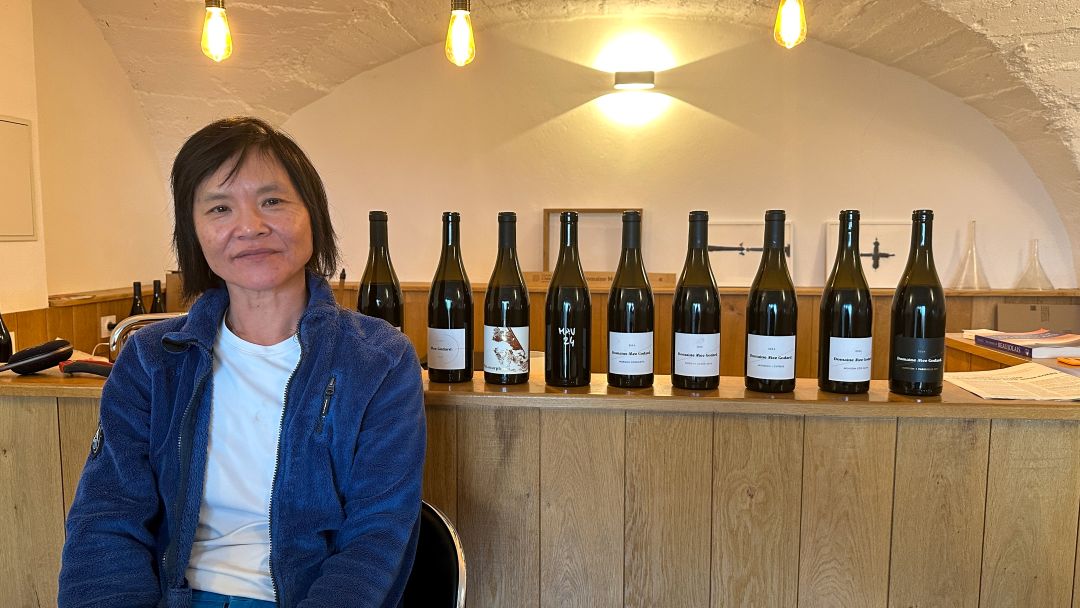
Winemaker Mee Godard overcame the difficult 2024 vintage to produce another set of wonderful wines from her base in Villié-Morgon.
As Beaujolais dreams of Premier status, its total area under vine contracts. The figures are shocking. From 2000 to 2025, the number of hectares under vine has decreased from 22,959 to 11,580—virtually halved. Owners often abandon parcels that become uneconomical to farm. That can be a low tipping point. Land in Beaujolais sells for tuppence compared to the Côte d’Or, and some parcels, in Chiroubles for example, are expensive to farm because manually tending goblet vines is labour-intensive. The tight contour lines can preclude the use of tractors, thereby increasing costs dramatically. These abandoned parcels can soon become diseased, particularly afflicted by flavescence dorée and powdery/downy mildew. Because they can pose a fire hazard and blight the landscape, vines must be pulled out as soon as possible.
Though the area dedicated to vines might be shrinking, at least the cost of land is not prohibitive for young winemakers, among whom I noticed a growing sentiment of Beaujolais pride. Beaujolais is cool. It’s edgy. It is certainly dynamic as new blood enters the landscape with new experiences, ideas and ambitions. Unlike the Côte d’Or, Beaujolais is not a place to become a winemaker if you’re after wealth or fame. It is a place for vrai vignerons—people in this business for the love of it.
New Kids on the Block
The region’s comparatively low entry fee has made it an incubator for new talent, be it through new projects or young winemakers taking the helm at established domaines. Here are a handful that caught my eye.
Domaine Julien Aucagne – As I remarked earlier, the InterBeaujolais tasting will always uncover promising new talents, and this year, the three wines from Julien Aucagne shone brightly. The 2024s represent Aucagne’s sixth vintage. The domaine comprises 10.3 hectares in Juliénas, Chénas and Beaujolais-Villages Blanc, with a further expansion in 2024 that includes parcels in Morgon Côte du Py. The vines are 60 to 90 years old and planted with southern exposure, situated around the lieu-dit of Les Chers. Around one-quarter of the vines are on such a steep incline that they must be worked manually. All fruit is hand-picked and vinified with 100% whole bunch, undergoing semi-carbonic maceration for around 14 days with one remontage per day and a little pigeage towards the end. The wines then age for several months in concrete. Stylistically, the offerings I tasted veer towards the riper and more opulent side, more akin to Mee Godard than Domaine Anita, but with remarkable purity of fruit and complexity.
Domaine Azzara – Having enjoyed the two Domaine Azzara 2023s I tasted at InterBeaujolais last year, I met with Italian-French winemaker Benjamin Azzara, who previously worked at Château Latour, Thomas Boudignon in Anjou, Domaine de la Vougerie with Pierre Vincent and Yann Charlopin in the Côte d’Or. Azzara organically farms five hectares in Chiroubles, parcels in Morgon and Beaujolais-Villages, and a new half-hectare parcel in Brouilly. His approach in the winery errs on the side of low-intervention, with wines matured in used 500-litre barrels. I also appreciate his minimalist labels (which are not unlike Duncan Savage’s in South Africa). The three 2024s show that Azzara can still produce the goods in strong headwinds. Definitely a name to watch.
Domaine Le Bourlay – Founded in 1895, this domaine is located at Château Le Thil in the village of Vauxrenard, just north of the Beaujolais crus. Being outside allows for a little more variety within their portfolio. Nine-and-a-half hectares lie under vine, including parcels in Juliénas and Brouilly. Fifth-generation winemaker Yann Bourlay, (son of Patrick and Odile, whose names adorn the label) explained that, unlike most Beaujolais producers, he vinifies five grape varieties: Gamay, Pinot Noir, Chardonnay, Marsanne and Gamaret, a Swiss variety. I also tasted a special cuvée from Brouilly named 1895, sourced from a century-old parcel and aged for 30 months in a 500-litre barrel. It is a tiny production but well worth hunting down.
Domaine Raphaël Chopin – Chopin joined me during one of my evenings in Beaujolais. Several generations of his family have farmed their eight hectares of vine, half located in Régnié, but it was Raphaël Chopin who set up his own domaine in 2009. His wines undergo a semi-carbonic maceration, and he prefers to ferment at slightly higher temperatures so as not to stress the yeast population. The highlight for me is the Archambault cuvée, sourced from a small plot of century-old vines and matured in demi-muids. The 2023 Régnié La Ronze developed commendable complexity as it opened in the glass.
Domaine Laurence et Rémi Dufaitre – I met Rémi Dufaitre at his food shop/kitchen (check out the delicious butternut velouté). Dufaitre has the build of a French rugby scrum-half: beard overdue effeuillage, brightly coloured shirt and arms inked with tattoos. He speaks in a growling voice at a hundred miles per hour. “I prefer wines with low alcohol,” he mused, “because I like drinking.” Dufaitre began his domaine in 2012 and currently farms 16 hectares in Brouilly and Côte de Brouilly. His wines are certified organic, made with 100% carbonic maceration and whole bunch, then matured entirely in concrete with minimal SO2. Dufaitre barely survived the 2024 vintage and cropped at just 5 hl/ha, resulting in what he hopes is a one-off multi-vineyard cuvée, the aptly named Quel Temps. Thankfully, yields were back up to 32 hl/ha in 2025. These are personality-driven, low-intervention wines in the mould of, say, the Sunier brothers: bright fruit, bright acids, brimming with charm.
Domaine de la Grosse Pierre – Based in Chiroubles, winemaker Pauline Passot took over the domaine established by her grandfather, Georges Passot. The domaine’s vineyards were certified organic in 2019. Passot’s nine hectares span Chiroubles (Grosse Pierre, Aux Craz and Grille-Midi), Morgon and Fleurie. The wines undergo a natural whole-bunch ferment using indigenous yeast without sulfur, with some pumping over but mainly infusion over around 12 days at relatively low temperatures. I particularly like Passot’s Fleurie Bel-Air this year, also the Chiroubles from Aux Craz and especially the Grosse Pierre.
Domaine Christophe Savoye – Philippe Viet recommended Savoye when I asked who else made a great Régnié. During my visit to Savoye’s tasting room, what caught my eye was not his Régnié but a splendid Chiroubles Vieilles Vignes that epitomises everything great about Gamay. The domaine has passed through six generations of the Savoye family. They currently preside over 15 hectares that are certified HVE (Haute Valeur Environnementale). Given the quality of Savoye’s Chiroubles, I will make sure they are included in future reports.
Les Vignes En M – Winemaker Maxime Malard exchanged a career in flowers for a career in vines. He currently farms around four hectares, including parcels rented from Julien Sunier; Sunier saw a kindred spirit in young Malard in terms of low-intervention techniques, sustainability, minimal sulphur, biodynamics and so forth. In meeting Malard, he comes across as a passionate and principled winemaker who would like to expand but keep things artisan. His 2024 Régnié Vernus boasts wonderful purity of fruit and lace-like tannins, an impressive feat in such a challenging vintage. This is a name to watch.
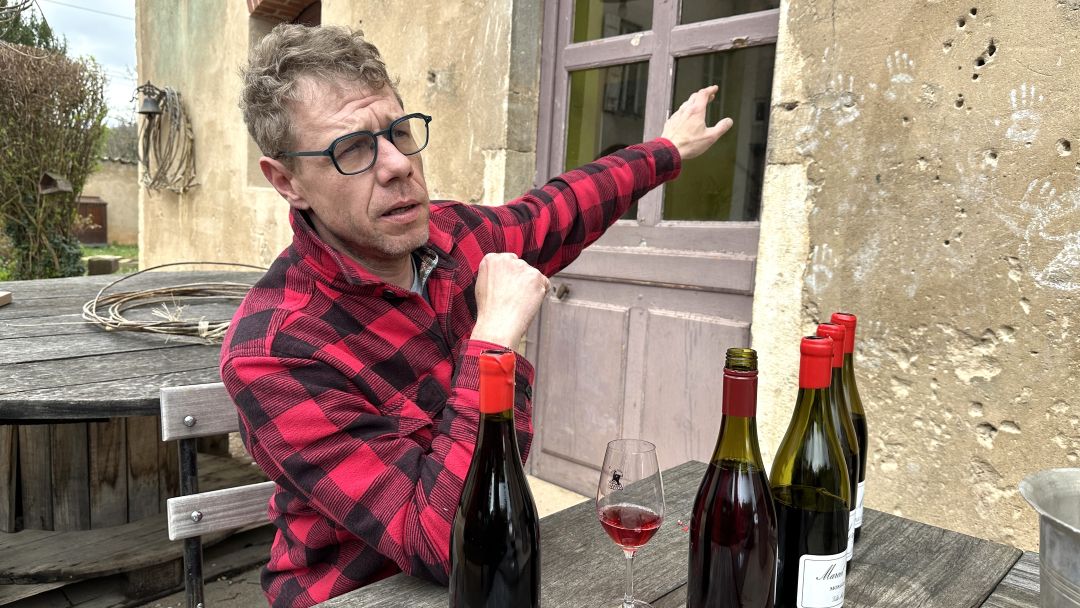
Mathieu Lapierre, son of Marcel Lapierre, has what I consider a rational take on natural winemaking. He produces two versions of the same cuvée, one with and one without sulfur.
Conventional vs. Organic
Beaujolais is synonymous with low-intervention, sulphur-free or natural winemaking—the proud birthplace of the “Gang of Four” (Marcel Lapierre, Jean-Paul Thévenet, Guy Breton and Jean Foillard), a phrase coined by importer Kermit Lynch. I have covered this topic in previous reports. Certainly, there are many winemakers for whom organic viticulture is at the core of their beliefs and practices. I suggested that in 2024, some producers might have found organic viticulture unviable, opting to continue organic but henceforth without certification so that they could apply chemical treatments as a last resort, to which Raphäel Saint-Cyr and Julien Sunier replied in animated fashion.
I understand their skepticism. It is easy to feign organic credentials and misuse them as a marketing ruse, which is completely unfair to those who never use chemicals. Many young winemakers adhere to organic principles, influenced by Jules Chauvet, Beaujolais’ godfather of organic/low intervention viticulture. On the other hand, observing the Beaujolais landscape in early March, I noticed swathes of barren, brown hillsides devoid of life. You could argue that those who are organic/biodynamic, certified or not, tend to produce the best wines simply because the rigorous standards demand it.
The rainy 2024 vintage obviously posed challenges, but the philosophy of organic viticulture is so ingrained that a depleted crop is accepted as part and parcel of that choice. That is partly because winemakers in Beaujolais are a close-knit community, with several unofficial associations and collectives that encourage organic viticulture and provide a supportive network. Friends come to each other’s aid or offer a shoulder to cry on when seasons like 2024 come around.
Not All Red
White Beaujolais accounts for just 4% to 5% of total production in the region, so it is still a niche category, unknown to or simply dismissed by some oenophiles. Regardless, southern Beaujolais, with its gold-tinged limestone soils—Les Pierres Dorées—is the foundation of many worthy whites. Why else would producers in the Côte d’Or quite legitimately buy Chardonnay at bargain basement prices and sell it as either Crémant de Bourgogne or Bourgogne Blanc, prompting the INAO to introduce the Bourgogne Côte d’Or category to distinguish it from Beaujolais Blanc?
From the few dozen examples I tasted, the 2024 whites are clearly more consistent than the reds. It is rare to find one that does not pass muster, but I also have not encountered one that transcends its class. Never say never. Doubtlessly, Beaujolais Blanc is a hard sell in the general market, especially because it does not offer anything radically different. This will upset a few friends, but from a marketing perspective, perhaps consumers would be more enticed if white wines were labelled as “Bourgogne Pierre Dorées”? At least they are becoming more popular amongst the Lyonnais bouchons, whose allegiance has traditionally looked south towards the Rhône.
The Market
According to the latest figures, around 30% of Beaujolais wine is currently exported, 47% of which is Beaujolais and Beaujolais-Villages, while 25% is Beaujolais crus. Beaujolais Nouveau represents 28%, which must be smaller than historical figures but is actually greater than I estimated. Given currency fluctuations, tariffs and the unpredictable global economy, several winemakers have pivoted towards domestic distributors. The escalation of prices in the Côte d’Or has created a desire for affordable alternatives, and though it is a different terroir and variety, Beaujolais fills that void.
The Art of the Label
I will broach a subject that is often omitted from reports but plays a fundamental role in buying choices, especially at this price level: the label. An eye-catching label can persuade many consumers to open their wallets. It is part of the enjoyment, analogous to the cover art of an album. Beaujolais winemakers could show their cousins in the Côte d’Or and Mâconnais a thing or two about the art of a label. Nowadays, particularly amongst the new wave of young producers, Beaujolais can boast some eye-catching and innovative label designs, my favourites including those from Domaine Anita, Dufaitre and Château Thivin. However, useful information such as the vintage and in some cases even the wine name is oft consigned to the back label. I had to keep turning round bottles at InterBeaujolais to check the cuvée and vintage. Making this information more visible might help consumers recall and repurchase these wines in the future.
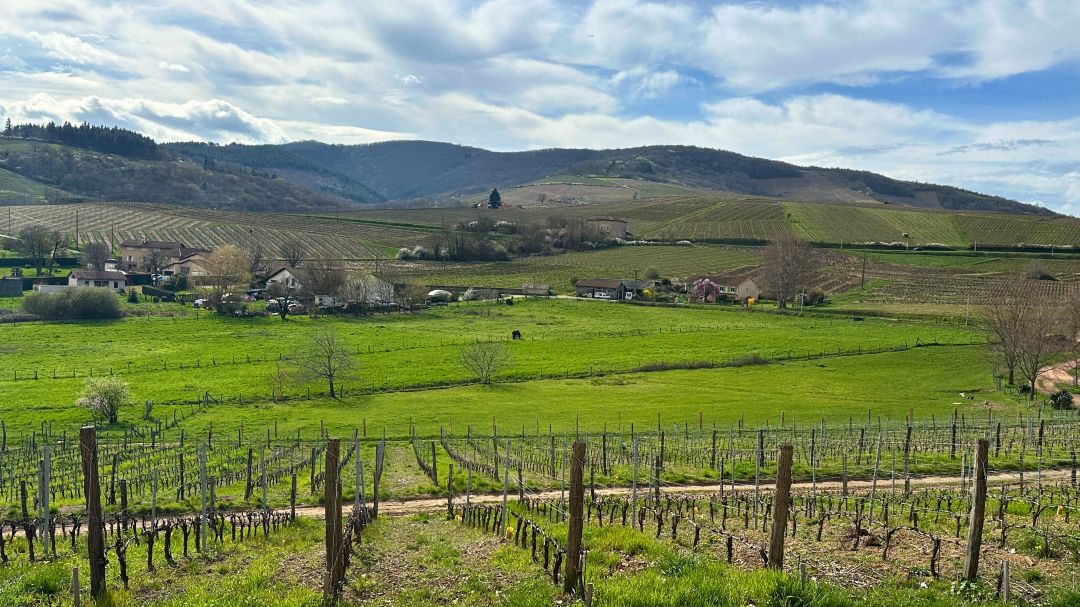
Le Crêt de Bine’s Chardonnay vines in southern Beaujolais.
About This Report
This year’s report focuses on the 2024 vintage, with some early-bottled 2025s and a smattering of 2023s that underwent longer élevage. My itinerary combined morning tastings at the InterBeaujolais offices in Villefranche with winery visits during the afternoons. Limiting oneself to top producers gives a skewed picture of a region where co-operatives are still important players. Some are better than others, but they should not be ignored. Furthermore, the InterBeaujolais tasting casts the net as wide as possible and always leads to new discoveries. There are a couple of well-known names missing from this report, but my notes are up to date with current releases. Thillardon and Beaupère will also be back for next year’s report. In some cases, 2024’s depleted volumes meant that cuvées bit the dust or were blended into single wines. Finally, some Beaujolais wines made by winemakers based in the Côte d’Or were stowaways in January’s Burgundy report.
Final Thoughts
Driving through Beaujolais, I found myself musing upon the fact that so many Burgundy lovers continue to overlook this region. If I turned up to a well-to-do Burgundy dinner with a fine Fleurie or a majestic Morgon, would I be shown the door for bringing such a frivolous wine? Sometimes, yes.
The best Beaujolais can deliver as much sensory and intellectual pleasure as a Pinot Noir. Nobody will dispute that Gamay offers a different drinking experience, and broadly speaking, it does not yield the nobility of a well-made Pinot Noir. Still, Beaujolais’ elite producers now conjure wines with impressive finesse and complexity. Do not forget that, in the nineteenth century, Beaujolais wines were just as prized as Burgundy. I came across a brilliant piece written by Tim Sykes, a buyer at The Wine Society, recounting how in 1932, Henri Mommessin had been hoping to acquire a parcel in Moulin-à-Vent. The auction price was too high, so he bought a vineyard in the Côte d’Or instead…Clos de Tart.
Beaujolais is cool. It’s edgy. Even if the 2024 vintage had its ups and downs, show me a French wine region that didn’t.
So, try some top Beaujolais for yourself. Choose carefully and you might be Gamayzed.
© 2026, Vinous. No portion of this article may be copied, shared or redistributed without prior consent from Vinous. Doing so is not only a violation of our copyright,but also threatens the survival of independent wine criticism.
You Might Also Enjoy
Buy Some, Try Some: Beaujolais 2022-2024, Neal Martin, April 2025
But Seriously: Beaujolais 2021-2023, Neal Martin, April 2024
The Future Is Beaujolais: 2020-2022 Releases, Neal Martin, May 2023
Back For More Beaujolais, Neal Martin, August 2021
Show all the wines (sorted by score)
- Alex Foillard
- Anthony Thévenet
- Antoine Sunier
- Arnaud Combier
- Château Bellevue
- Château Bonnet
- Château de Corcelles
- Château de Javernand
- Château de la Chaize
- Château de la Greffière
- Château de la Terrière
- Château de Lavernette
- Château de l'Eclair
- Château de Nevers
- Château de Pierreux
- Château de Poncié
- Château de Pougelon
- Château de Raousset
- Château de Rougeon
- Château des Bachelards
- Château des Jacques
- Château des Moriers
- Château des Ravatys
- Château des Tours
- Château du Durette
- Château du Moulin-à-Vent
- Château Gaillard
- Château Grand'Grange
- Château Thivin
- Claudie Salignon
- Collin Bourisset
- Cyril Coperet
- Domaine André Colonge et Fils
- Domaine Anita
- Domaine Azzara
- Domaine Berthier
- Domaine Bertrand
- Domaine Cheysson
- Domaine Christophe Savoye
- Domaine Corsin
- Domaine d'Argenson
- Domaine de Bel-Air
- Domaine de Colette/Jacky Gauthier
- Domaine de la Bêche
- Domaine de la Chaponne
- Domaine de la Grand'Cour/Jean-Louis Dutraive
- Domaine de la Grosse Pierre
- Domaine de la Laveuse
- Domaine de la Madone
- Domaine de la Rochelle
- Domaine de la Vieille Eglise
- Domaine de la Voûte des Crozes
- Domaine de Roche-Guillon
- Domaine de Romarand
- Domaine des 6 Moulins
- Domaine des Chaffangeons
- Domaine des Chers
- Domaine des Deux Fontaines
- Domaine des Fournelles
- Domaine des Marrans
- Domaine des Nugues
- Domaine des Roches du Py (Guénal Jambon)
- Domaine de Vernus
- Domaine du Clos du Fief
- Domaine du Jonchay
- Domaine du Leyre-Loup
- Domaine du Moulin Berger
- Domaine du Penlois
- Domaine du Prieré Saint-Romain
- Domaine du Sallerin
- Domaine du VieuxBourg
- Domaine Gaget
- Domaine Gilles Paris
- Domaine Guy Breton
- Domaine Joncy
- Domaine JP Rivière
- Domaine Julien Aucagne
- Domaine Lagneau
- Domaine Laurence et Rémi Dufaitre
- Domaine Le Bourlay
- Domaine Le Cotoyon
- Domaine Les Capéroles
- Domaine Longère
- Domaine Mee Godard
- Domaine Passot Collonge
- Domaine Perroud
- Domaine Philippe Viet
- Domaine Poulard
- Domaine Raphaël Chopin
- Domaine Rochette
- Domaine Ruet
- Domaine Saint-Cyr
- Domaine Striffling
- Domaine Victor Sornin
- Domaine Zéphyr
- Dominique et Rémy Passot
- Du Vin à L'Âme
- Emmanuel Follet
- Famille Chasselay
- Famille Coperet
- Famille Descombe
- Famille Dutraive
- Famille Gauthier
- Famille Girin
- Famille Mélinon
- Famille Renard
- Frédéric Berne
- Georges Descombes
- Georges Duboeuf
- Héritiers Loron
- Jean Foillard
- Jean-Marc Burgaud
- Jean-Michel Dupré
- Jean-Pierre Large
- Julien Sunier
- La Grange Bourbon
- Laurent Gauthier
- Laurent Perrachon et Fils
- Le Crêt de Bine
- Les Vignes en M
- Louis-Claude Desvignes
- Louis Tête
- Lucien Lardy
- Ludovic Montginot
- Maison Le Nid
- Manoir de Carra
- Marcel Lapierre
- Mommessin
- Nathalie et Bernard Remuet
- Nicolas Boudeau
- Olivier & Alexis Depardon
- Olivier Pezenneau
- Pascal Aufranc
- Patrick Tranchand
- P. Ferraud & Fils
- Thierry Janin
- Trenel
- Yohan Lardy