
Browse using the new Vinous website now. Launch →
Printed by, and for the sole use of . All rights reserved © 2015 Vinous Media
Come Hell or High Water: Trentino-Alto Adige’s 2023 and 2024 Vintages
BY ERIC GUIDO | DECEMBER 4, 2025
Trentino-Alto Adige is far from your typical Italian wine region. Its geography is as dramatic as its culture—steep valleys, craggy rock outcroppings and high alpine peaks define a landscape lined with forgotten ruins and ancient castles, some of which are still in use. I like to compare the area to a tuning fork, with the Adige Valley forming its base in Trentino before morphing into two prongs, the Val d'Adige and Valle Isarco. While Trentino in the south maintains a distinctly Italian feel, the more northern Alto Adige (Südtirol) has strong Austrian influences, with a German-speaking majority and architecture out of a Grimm’s fairytale. The wines from this region are also quite different from those in most of Italy, with pure, crisp, mineral-driven whites and alpine-inspired reds.
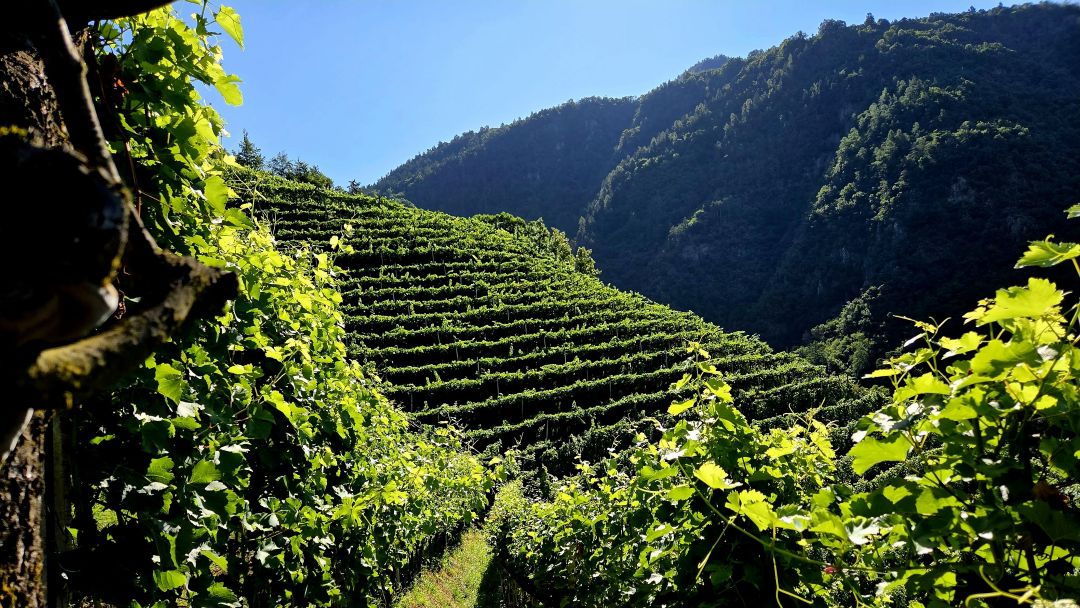
High-elevation vineyards in the Adige Valley.
Mother Nature has not been kind to Italy over the last two years, but Trentino-Alto Adige weathered the storm with resilience and determination. Surprisingly, the locals don’t seem to express any defeatism, which is more than I can say for some other Italian regions. Instead, in a very stoic way, these winemakers pick themselves back up after a challenging year, having made the best of what the season offered, and approach the future optimistically.
The complete list of grape varieties in the region is extensive. There’s a dizzying array of whites, such as Pinot Grigio, Chardonnay, Pinot Bianco, Sauvignon Blanc, Müller-Thurgau, Sylvaner, Kerner, Riesling and Gewürztraminer. There are also PIWI varieties, i.e., disease- and drought-resistant hybrids that create wild wines. On the red side, Pinot Noir has seen a surge in quality as a new single-vineyard approach spreads throughout the region, while Merlot, Carménère, Cabernet Sauvignon and Cabernet Franc continue to excel. Moreover, indigenous varieties like Teroldego, Lagrein and Schiava have never been better. Call it global warming working in their favor, or maybe just a positive result of updated standards and a new sense of local pride, but I can’t help but feel that the region is experiencing a renaissance.
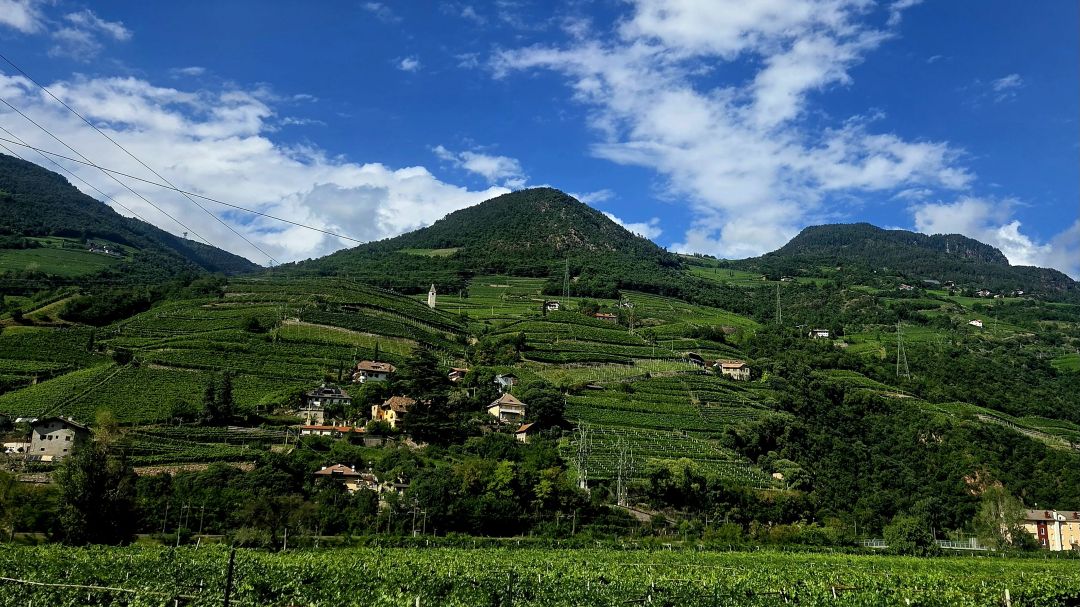
The sprawling hillside vineyards of the St. Magdalener DOC.
Established as of the 2024 vintage, the 86 new UGAs (Unità Geografica Aggiuntiva) continue to gain popularity throughout Alto Adige. As a result, I’m encountering more single-vineyard wines, which can be explored while viewing the new maps designed by the Consorzio Vini Alto Adige. While many producers were already harvesting throughout the assigned vineyards, in order to use the new UGAs on their labels, they must establish a 25% reduction in yield compared to standard DOC regulations. Moreover, each UGA set a maximum of five designated grape varieties ideally suited for that location's specific soils and microclimate. This is a big step forward for Alto Adige, and I’m sure we’ll witness a further uptick in quality as more producers begin to take advantage of it.
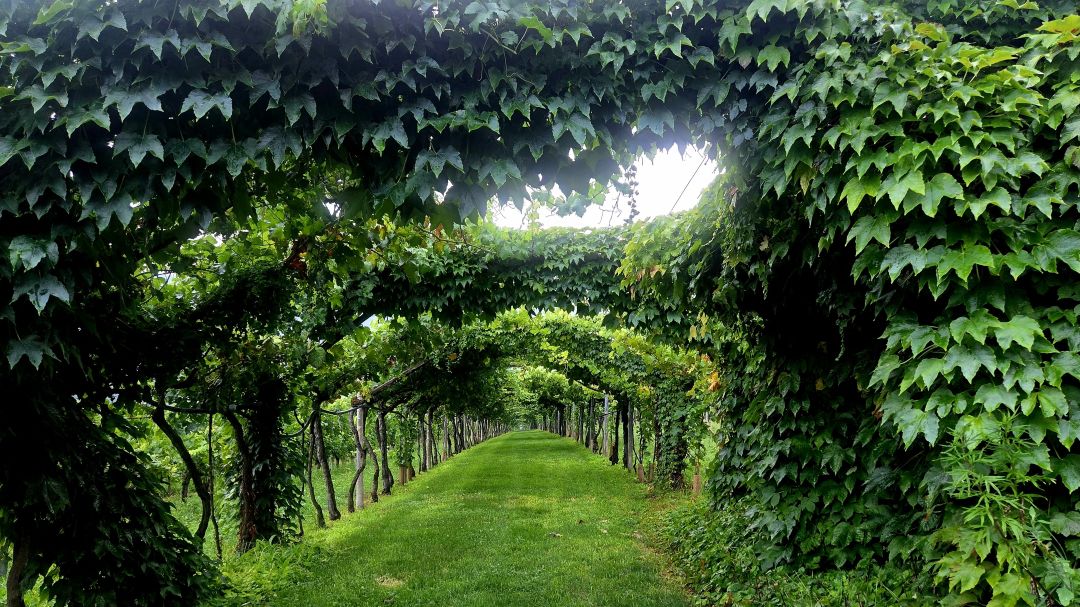
Pergola vine training remains paramount to the success of San Leonard in Trentino.
A Tale of Two Vintages
One of the most interesting things about vintages in Trentino-Alto Adige is how remarkably different they are from the rest of Italy. With regard to Trentino in the southern part of the region, this has much to do with Lake Garda. One might presume that Trentino would have similar vintages to neighboring Veneto, but Lake Garda’s moderating influence and the mountains arcing across both sides create a different set of conditions. Standing at the northernmost beaches of Lake Garda puts this into perspective; intense air currents make this area ideal for windsurfing, which many Italians take advantage of each morning throughout the warmer months.
Alto-Adige is a dramatic mountain landscape. The mountains not only block the weather, but also trap the heat between them. The convergence of two valleys—the Val d'Adige from the west and the Valle Isarco from the northeast—pulls warming air currents from the south up toward the city of Bolzano by day, and cooling currents from the north at night. In most cases, there is little similarity between vintages in Trentino-Alto Adige and vintages in the rest of Italy.
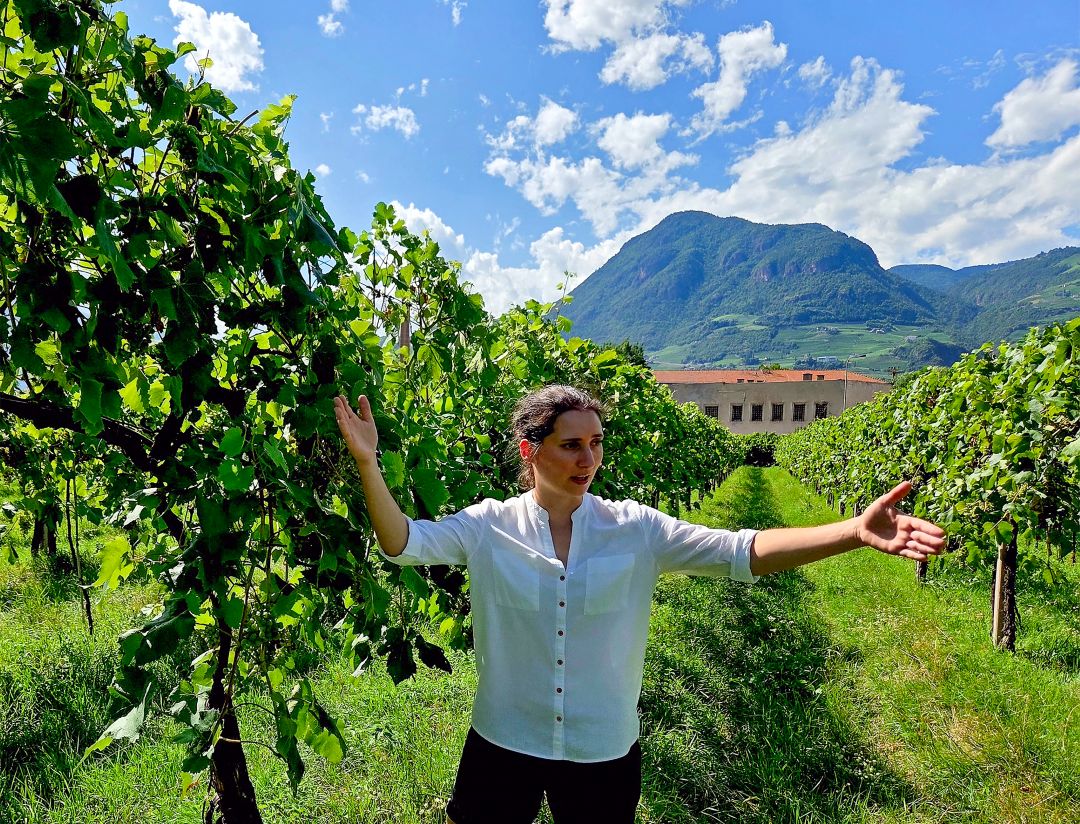
Gloria Mayr of Nusserhof, pictured here in her vineyards within the city of Bolzano.
A Near Miss: The 2023 Vintage
The 2023 vintage in Trentino-Alto Adige was a challenging season with high disease pressure and multiple heatwaves, but it was ultimately successful, particularly for red varieties. These reds have aromatic lift and energy I’ve rarely seen. They are fruit-forward, crisp and precise, with juicy acidity and balanced structure. I expect many of the larger-framed, late-release wines to show finesse and minerality over power. Pinot Noir, Schiava, Lagrein and Bordeaux varieties all show tremendous potential. I do have my concerns about Trento DOC, as winemakers there would have picked for sparkling wines during or near one of the season’s heatwaves. I will report on those wines in an upcoming report. The heat also had negative effects on Pinot Grigio, Pinot Blanc, and Müller-Thurgau, which growers typically harvest at the end of August. Chardonnay and Gewürztraminer turned out noteworthy successes in 2023.
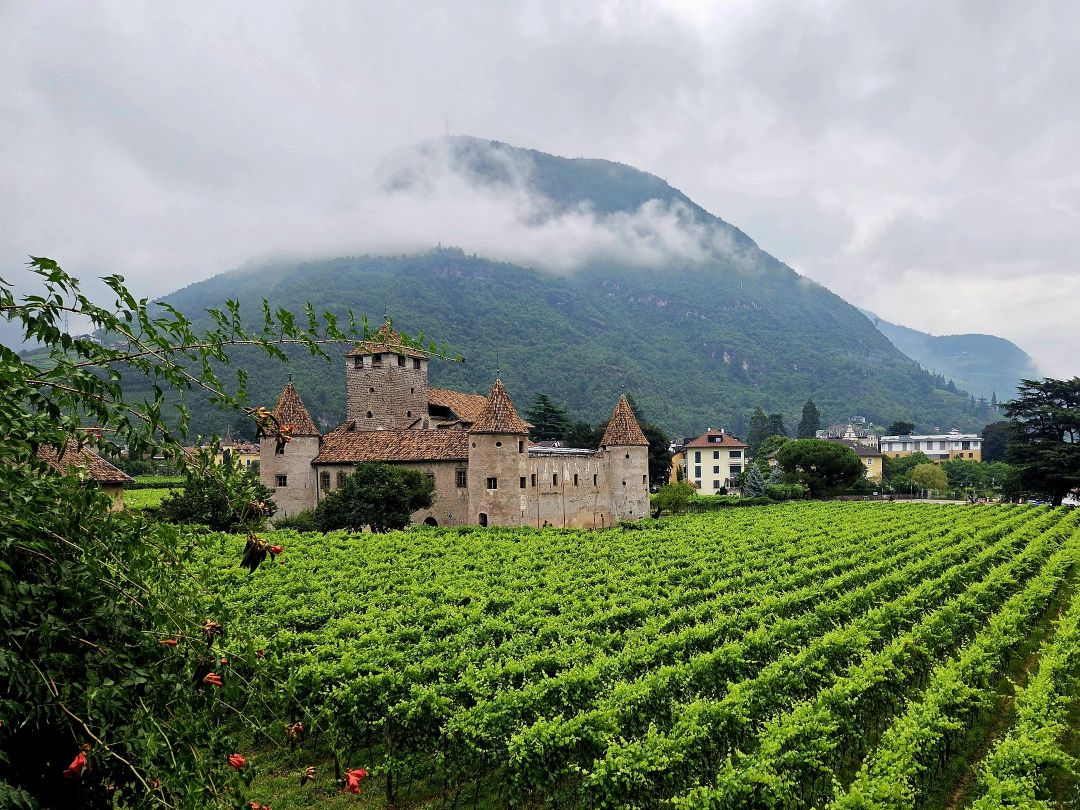
Despite being the capital of Alto Adige, Bolzano is a city of vines.
Like much of Italy, the region contended with a wet and overcast spring. However, producers were better equipped than some of their counterparts elsewhere in Italy to handle diseases like Peronospora (downy mildew), which are more common here. The region's diverse landscape meant vineyards at lower elevations experienced different outcomes than those in the well-draining mountainous areas. Although vine disease initially affected red varieties, the impact was less severe than in central and southern Italy. The more significant issue for Trentino-Alto Adige came in the form of three heatwaves, two in July and a third in late August.
Fortunately, temperatures normalized through September and October, with clear skies and dry conditions. This period allowed later-ripening white and red varieties to regain balance closer to harvest. The deciding factors for success were careful harvest timing and selective picking of healthy bunches. Overall, producers were happy with the harvest, and unlike much of Italy, yields were close to normal.
Better Late than Never: The 2024 Vintage
After a nail-biting 2023 season, winemakers in Trentino-Alto Adige did not find any relief in 2024. It was a cool and rainy year that favored white varieties over reds. The white wines display a textural richness that, when acidity remains balanced, adds remarkable depth and concentration. Soaring aromatics and a distinct saline character make the 2024s irresistible and gastronomic. Sylvaner and Kerner, two varieties that typically ripen early, had extended hang-time through this cool season, which helped them gain further richness and complexity. The bad news is that red varieties suffered drastically due to naturally reduced yields, disease pressure and occasionally the inability to achieve physiological ripeness. As a result, many producers will not bottle their top reds in 2024.
The 2024 growing season started with a mild winter and budbreak in mid-to-late March. The vintage seemed on track until a killing frost in April decimated lower-elevation vineyards. Reported losses ranged from 10% to 70% for both red and white varieties, particularly Lagrein and Pinot Grigio. To make matters worse, cool and wet conditions persisted through the spring and into June, leading to poor flowering and high disease pressure. These factors resulted in poorly formed bunches that reduced yields even further. With July came sunny skies and warmer conditions, one of the year’s few silver linings. However, winemakers already knew that the harvest would be delayed. September remained cool but brought sporadic rains, causing fits and starts with harvest. Timing and severe selection of bunches were essential to bring in healthy fruit.
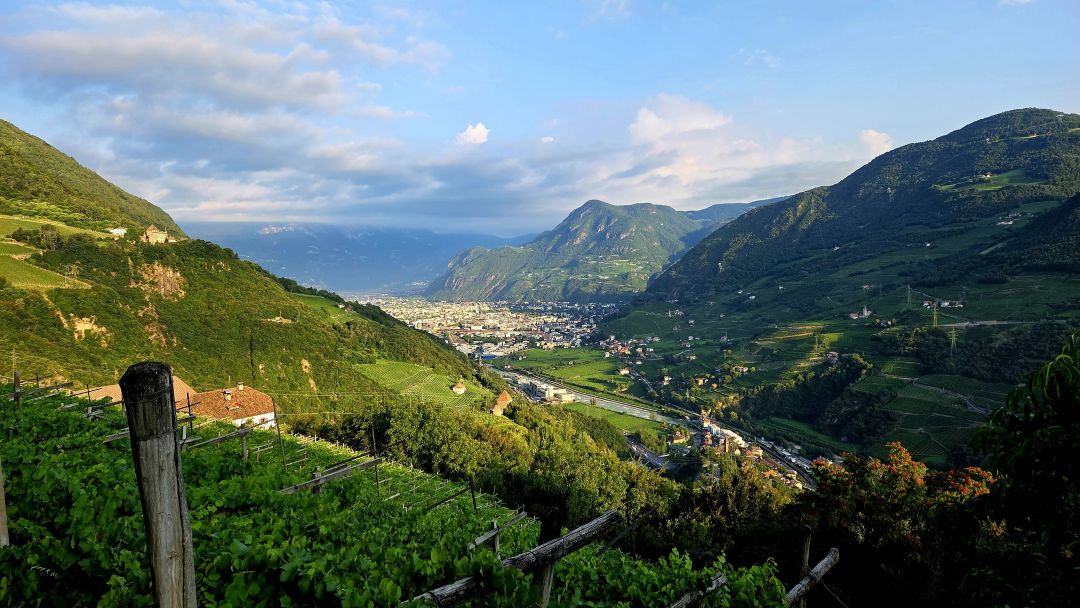
Three valleys connect at Bolzano, creating a heat sink by day and a cold climate at night.
The extreme diversity of terroir throughout Trentino-Alto Adige means that some estates fared significantly better than others. Producers like Köfererhof or Castel Juval Unterortl, deep in the northern mountains at higher elevations, weathered the conditions well. The same cannot be said for producers at lower elevations further south. That said, larger cooperatives have more fruit to work with thanks to the vast holdings of their grower partners and can make decisions at the blending table to bolster their entry-level or prestige-tier wines, depending upon quality and need. At San Leonardo, in Trentino, Peronospora in the spring was more impactful, reducing yields by 30%, but the team was happy with the health of the fruit they brought in. Having tasted two of the young 2024s during my visit to the estate, I can say that the results are very promising. When I taste the 2024s in the coming year, I expect to find many happy surprises and probably just as many letdowns. Only time will tell, but I can assure readers that there will be far less wine to go around than usual.
I tasted the wines for this article in Trentino-Alto Adige in July 2025 through organized tastings and winery visits.
© 2025, Vinous. No portion of this article may be copied, shared or redistributed without prior consent from Vinous. Doing so is not only a violation of our copyright but also threatens the survival of independent wine criticism.
You Might Also Enjoy
Trentino-Alto Adige: Pushing the Limits, Eric Guido, March 2024
Trentino-Alto Adige: Knocking on Heaven’s Door, Eric Guido, May 2023
Trentino & Alto Adige: The Sky’s the Limit, Eric Guido, June 2022
Trentino & Alto Adige: Worlds Apart, Eric Guido, November 2020
Show all the wines (sorted by score)
- Abbazia di Novacella
- Alois Lageder
- Ansitz Waldgries
- Cantina Andriano
- Cantina Bozen
- Cantina di Cortaccia - Kellerei Kurtatsch
- Cantina Kaltern
- Cantina Sankt Pauls
- Cantina Terlano
- Cantina Tramin
- Cantina Valle Isarco
- Castelfeder
- Castel Juval Unterortl
- Cinta
- Colterenzio
- Elena Walch
- Erste+Neue
- Falkenstein
- Foradori
- Franz Gojer - Glögglhof
- Franz Haas
- Gaierhof
- Girlan
- Gump Hof - Markus Prackwieser
- Ignaz Niedrist
- J. Hofstätter
- Kettmeir
- Köfererhof
- Kuenhof - Pliger Peter
- Larcherhof
- Leya
- Manincor
- Manni Nössing
- Maso Poli
- Muri-Gries
- Nals Margreid
- Nusserhof
- Pacherhof
- Paltis
- Peter Dipoli
- Peter Zemmer
- Pfannenstielhof
- Pfitscher
- Pojer e Sandri
- San Leonardo
- St. Michael-Eppan Winery
- Strassherhof
- Tenuta Hans Rottensteiner
- Thomas Niedermayr
- Tiefenbrunner - Schlosskellerei Turmhof
- Torre di Luna
- Weingut Gottardi Der G.E.M.