
Browse using the new Vinous website now. Launch →
Printed by, and for the sole use of . All rights reserved © 2015 Vinous Media
Sassicaia from Magnum at Vinous Icons: Italy
BY ANTONIO GALLONI | MAY 13, 2026
I have tasted Sassicaia from magnum a few times over the years. But never ten vintages at once. This vertical of tasting Tenuta San Guido’s Sassicaia held at the inaugural edition of Vinous Icons: Italy provided an incredible opportunity to do just that. The selection of vintages spanned many of the classics, with some lesser-known vintages sprinkled into the mix. And of course, in Vinous style, we finished with the 1985, the wine that put Sassicaia and Bolgheri on the map.
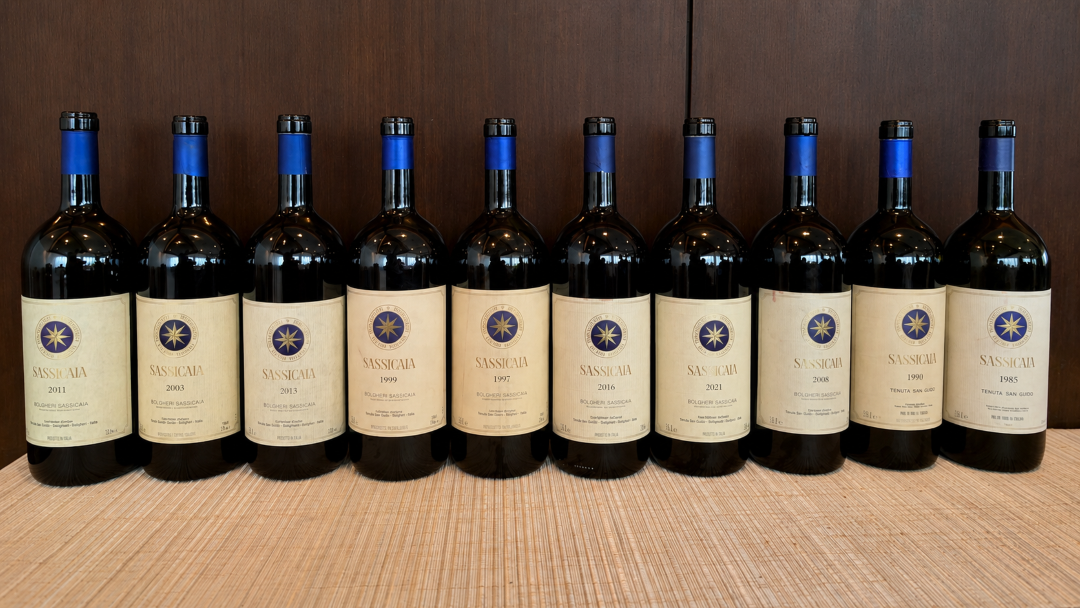
Tasting Sassicaia from magnum is a rare occurrence; tasting ten vintages from magnum was a truly rare and exceptional experience.
From Simple Beginnings to a True Tuscan Thoroughbred
Tenuta San Guido’s Sassicaia is arguably Italy’s first truly iconic wine. It was the first Italian wine to capture the attention of the international press and consumers around the world in a big way, thereby broadening the appeal of wines that had previously only been of interest to Italian wine cognoscenti, a relatively small slice of the wine market at the time.
Mario Incisa della Rochetta, an aristocrat and avid francophile of Piedmontese origins, planted Cabernet Sauvignon and other native varieties at his Maremma estate in 1944. Inspired by the French wines he loved, Incisa della Rochetta set out to make a wine for his personal home consumption, nothing more. In those days, the Maremma coast was a disease-infested swamp that was considered unhabitable. Noble families all lived in the hillsides. By the 1970s, Incisa della Rocchetta fully shifted his focus to Cabernets. A few years later, he decided to sell some wine.
First released in 1971 with the 1968 vintage, Sassicaia was an instant sensation. These were heady early days in the modern history of Italian wine. Piero Antinori, Incisa della Rochetta’s nephew, was busy at Tignanello creating iconic wines of his own. Antinori bottled and sod the first vintages of Sassicaia, one of many links between these two very influential families. Both men were advised by oenologist Giacomo Tachis, a disciple of Émile Peynaud, the highly influential Bordeaux oenologist who developed many of the concepts that remain the foundation of modern winemaking, including hygiene and temperature-controlled fermentation.
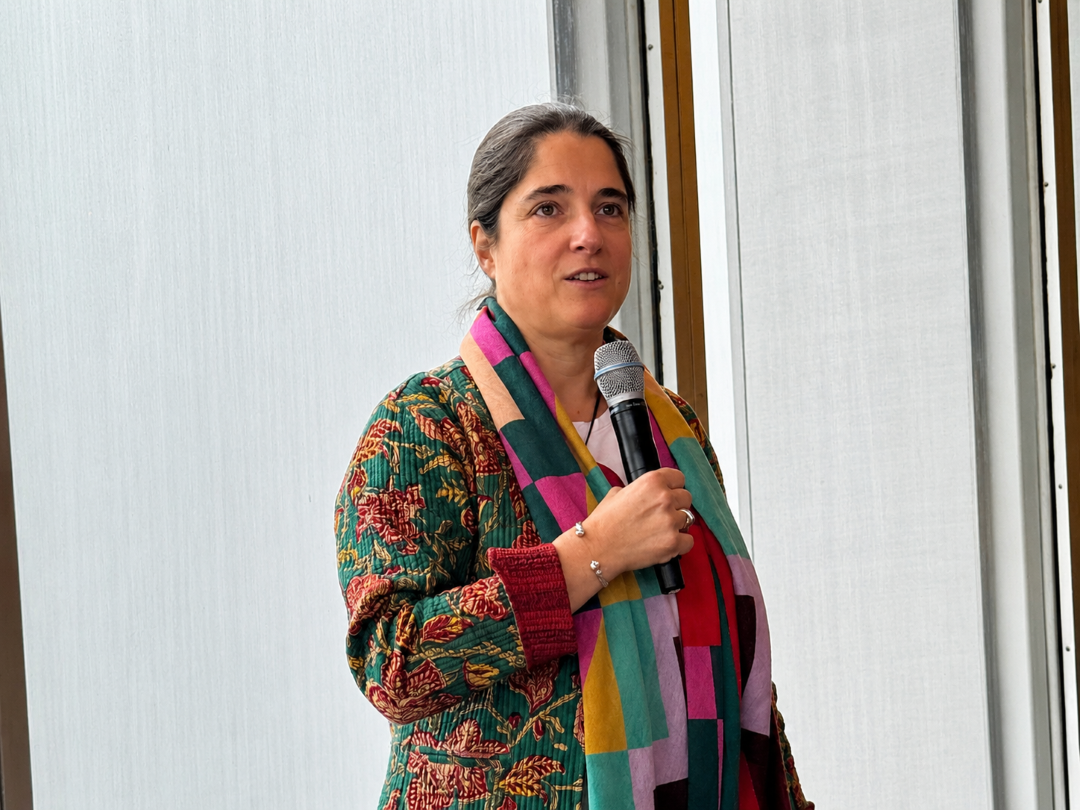
Proprietor Priscilla Incisa della Rocchetta guides guests through a stunning collection of vintages.
Sassicaia was one of the so-called “Super Tuscans”—wines that bucked all conventions in that they were made from international grapes and produced outside of Italy’s formal appellation system. The 1985 Sassicaia was another watershed. It was the first Italian wine to earn a perfect 100-point score from Robert Parker. Sassicaia spurred the development of the Tuscan Coast and inspired many notable wines that followed in its footsteps. Sassicaia has since cemented its well-deserved reputation as one of Italy’s most historically significant wines. This tasting was one of the most popular we have ever organized, a testament to the audience Sassicaia has built over the decades. Today, Mario’s son, Nicolò, and his daughter, Priscilla, continue their family’s tradition of excellence at Tenuta San Guido.
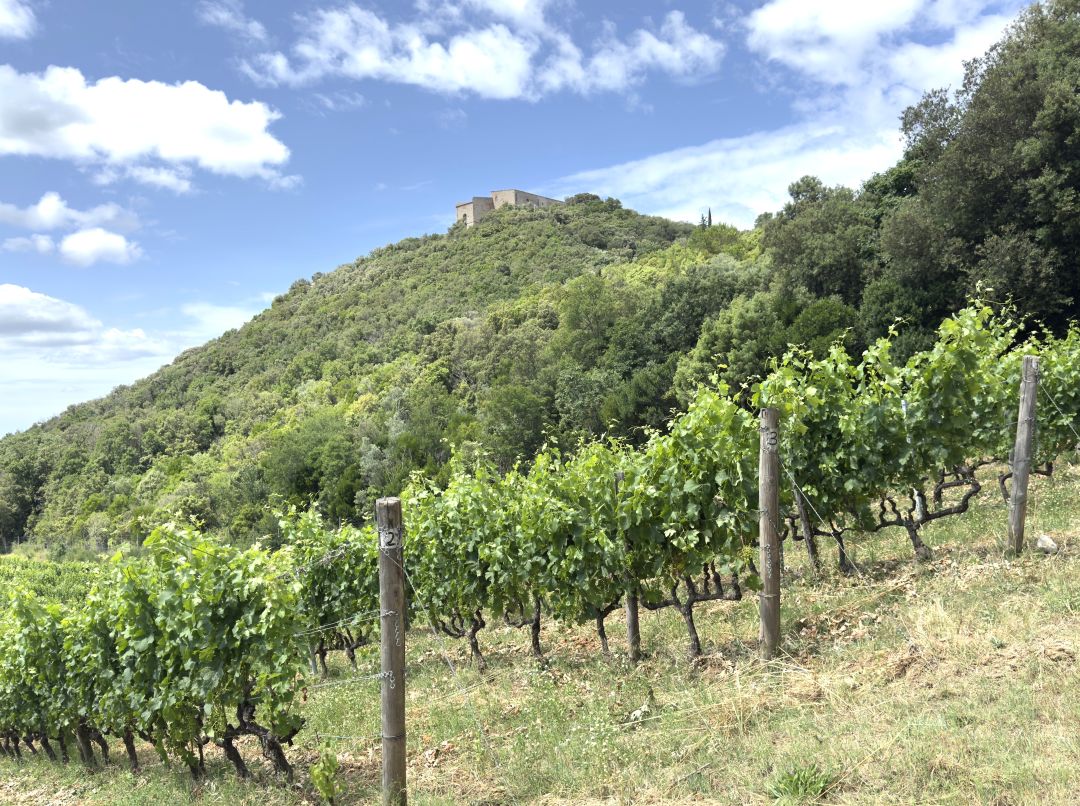
Cabernet Sauvignon at Castiglioncello, where Mario Incisa della Rocchetta first planted vines in 1944.
In the Vineyards and Cellar
One of the most fascinating aspects of Sassicaia is that it is a blend made from many vineyards with wildly different elevations, exposures and soil types, some of them quite small. Castiglioncello is one of the estate’s historic sites. Perched at 360 meters in elevation in the middle of a forest, this rugged site measures just 1.2 hectares and is south-to southwest-facing. Its clay/rocky soils are planted with Cabernet Sauvignon. This is where Mario Incisa della Rochetta first planted vineyards. A few rows of the original 1944 plantings remain. These are used today mostly as a nursery for further plantings. Docino is one hectare of Cabernet Sauvignon on a north-facing site. Quercione is just under 10 hectares of Cabernet Sauvignon and one of Franc at 240-260 meters in elevation. Its upper section is mostly clay and gravel, while the lower section features more limestone, an example of notable diversity within a single site. Mandrioli is seven hectares of Cabernet Sauvignon and 1.5 of Cabernet Franc planted on fine clays with some limestone and sand. La Sassicaia di Sotto, which looks over to the ocean, is home to the estate’s oldest Cabernet Franc, just under two hectares planted in 1961, while La Sassicaia di Sopra consists of 12 hectares of Cabernet Sauvignon on clay and limestone. Vigne dell’Aia Nuova is a smaller site planted with 1.5 hectares of Cabernet Sauvignon and 0.5 hectares of Cabernet Franc on clay-rich soils with some gravel and small rocks. Readers who want to explore these nuances further will want to check out Alessandro Masnaghetti’s stunning maps, in this specific case, a special edition that includes three detailed maps of Tenuta San Guido.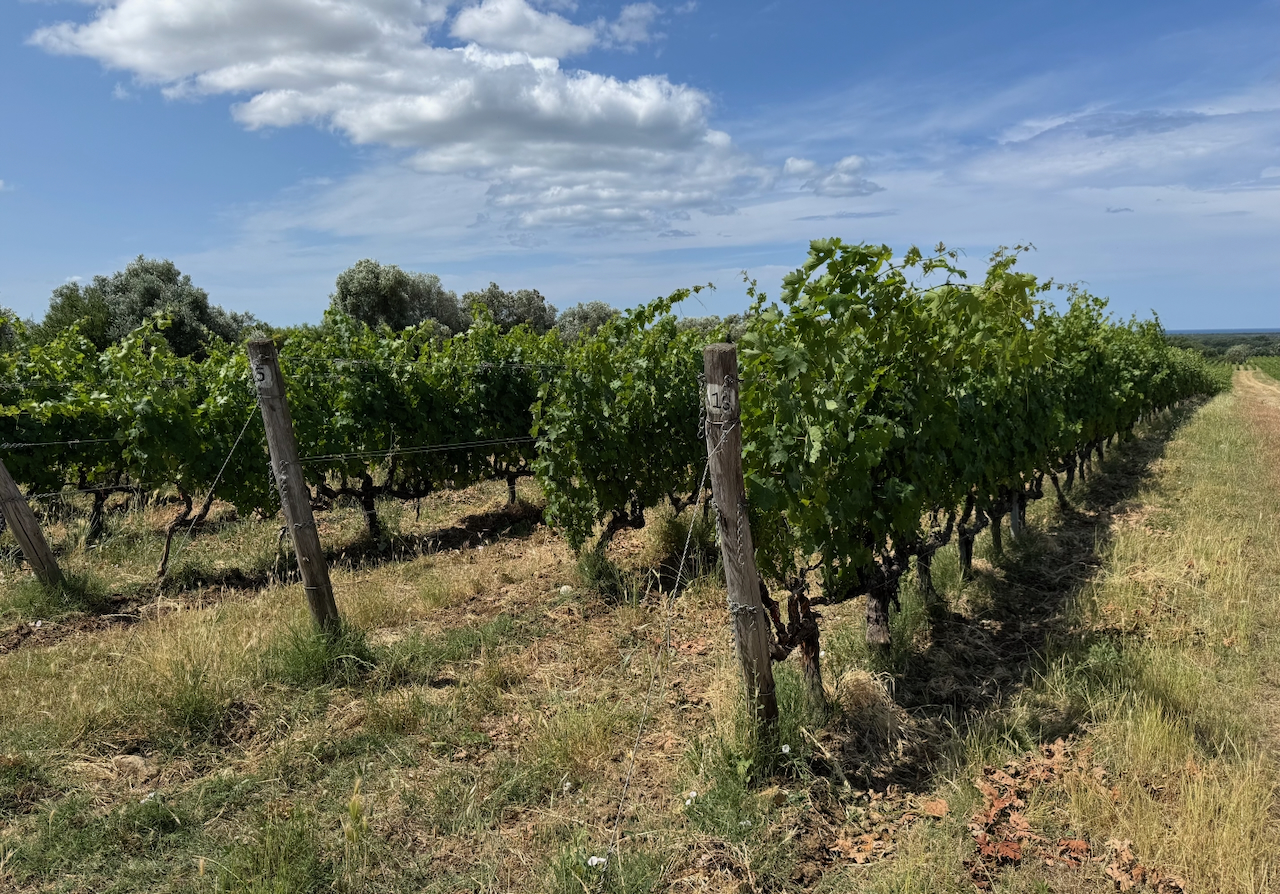
Cabernet Sauvignon at Vigne dell'Aia Nuova, a southwest-facing site planted on clay with some gravel and small rocks.
Stylistically, Sassicaia has long been quite different from most Bolgheri wines. Picking earlier for freshness and following mostly classic lines in vinification and cellaring yield a wine that can seem a bit light next to most Bolgheri reds. That has started to change somewhat, now that many estates have started to pursue a more vibrant, less extracted style. On release, most of the vintages in this vertical would have struck tasters as quite restrained relative to the norm in Bolgheri and Italy at the time.
The blend is always stated as 85% Cabernet Sauvignon and 15% Cabernet Franc, although Cabernet Sauvignon is a bit higher. The Bolgheri Sassicaia DOC, created in 1994 just for Sassicaia, stipulates that Cabernet Sauvignon must be at least 80% of the blend. Tenuta San Guido’s Guidalberto is entirely from vineyards in the DOC, but its Merlot-heavy blend requires labeling as an IGT, while the third wine, Le Difese, is made predominantly from purchased fruit.
Harvest usually starts in early September and lasts about a month, although that, of course, varies from year to year. Vinification is done in stainless steel. Most vintages see about two weeks on the skins, with malolactic fermentations that follow relatively quickly. Aging is two years in French oak, with about a third new barrels, although that also shifts from year to year and is not easy to calculate with total precision. In some cases, lots might start their aging in new barrels but then get racked to more neutral barrels if the team, led by Estate Manager Carlo Paoli, thinks the oak imprint might be too strong. San Guido works with many coopers, which creates a rich palette for the winemaking team to work with in blending. One of the most fascinating tastings here is sampling young wines across many different coopers, something I do every time I visit.
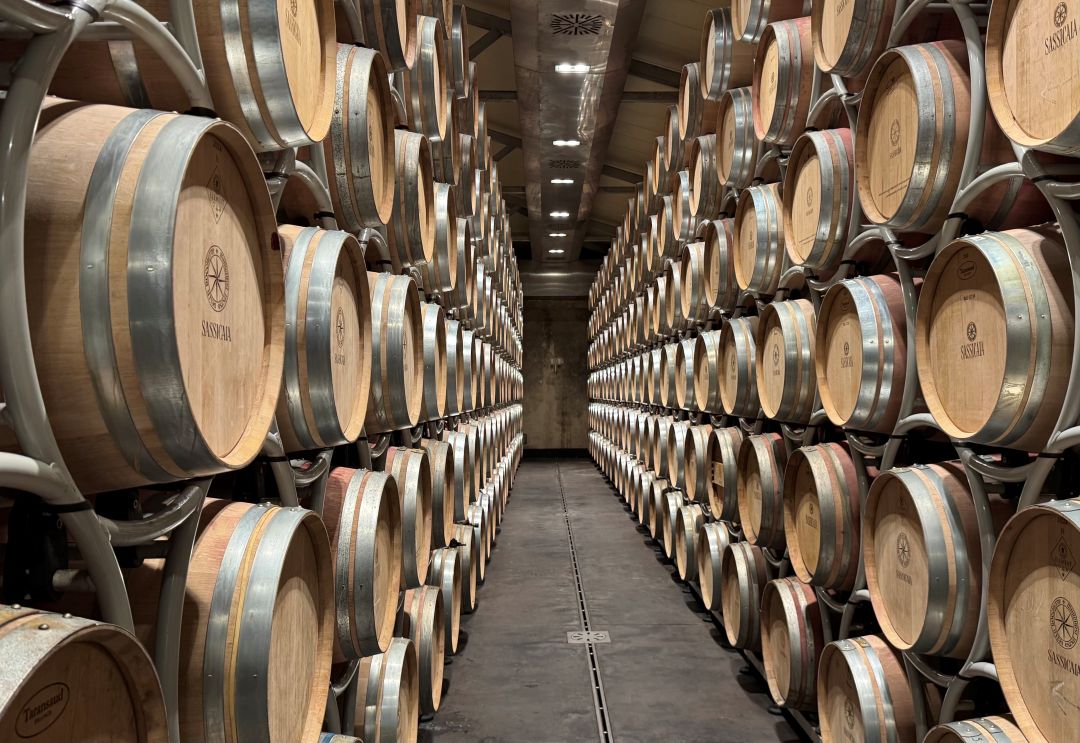
The barrel room at Tenuta San Guido.
The Program
As is our custom, I arranged the wines in thematic flights rather than in chronological order, as I think this approach keeps the palate fresh and allows the taster to assess each wine on its own rather than making the inevitable comparisons that are natural when wines are presented in a more conventional manner.
First Course
Spring Panzanella; House-Made Focaccia, Peas, Fava Beans, Zucchini Blossoms and Radish
Flight One: To Start
2011 Sassicaia 1.5L, 2003 Sassicaia 1.5L
I picked two vintages I thought would be quite approachable for current drinking, both from very warm seasons. I was very pleasantly surprised to see how well the 2011 and 2003 have held up.
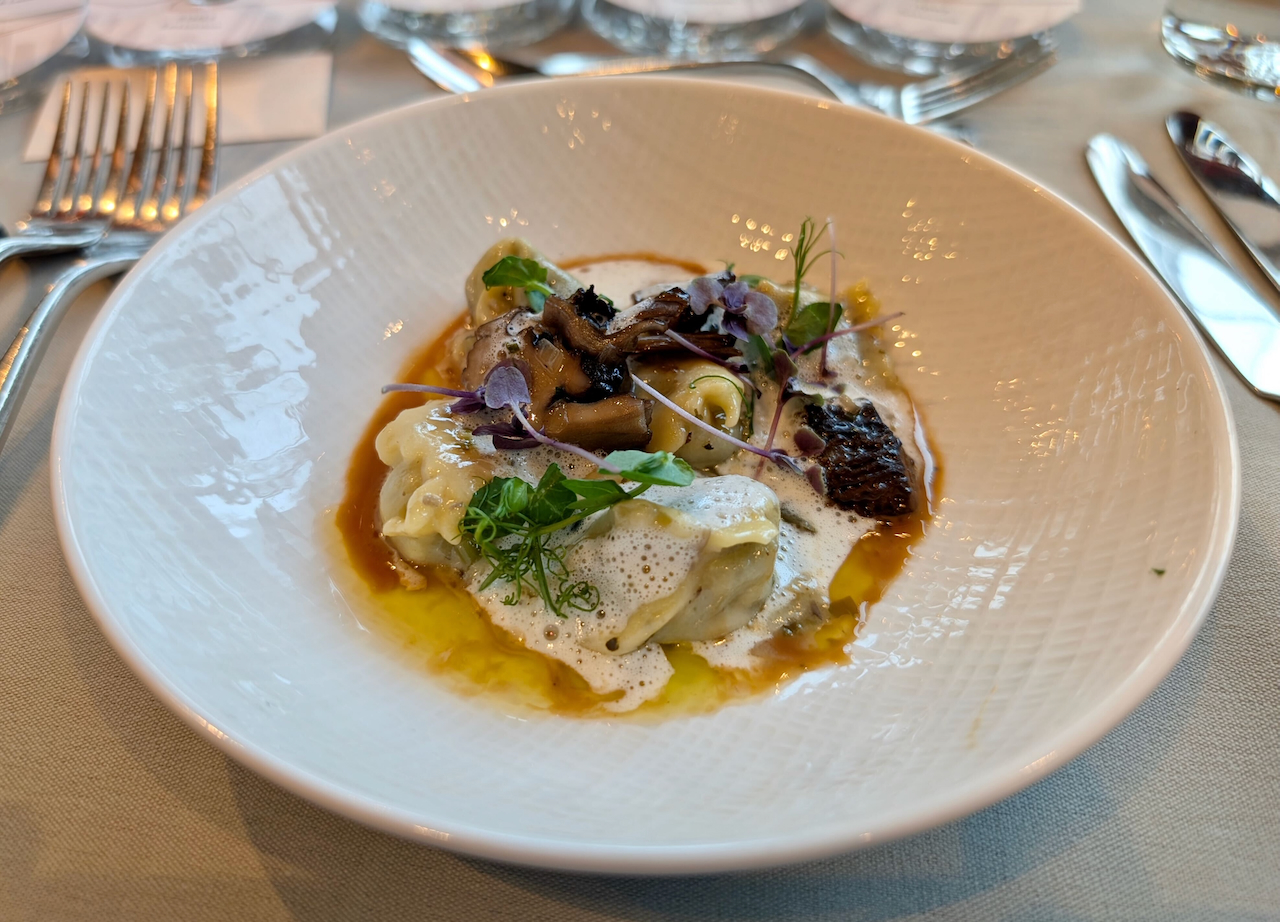
Manhatta's Porcini Agnolotti; Mushroom Conserva, Pecorino Toscano was an inspired choice for the wines in this flight.
Second Course
Porcini Agnolotti; Mushroom Conserva, Pecorino Toscano
Fight Two: The Many Facets of Sassicaia
2013 Sassicaia 1.5L, 1999 Sassicaia 1.5L, 1997 Sassicaia 1.5L
For this flight, I chose transitional vintages that could form a bridge to the more structured vintages that followed. Of these, the 2013 was the most surprising. I tasted the wine as I remembered it from barrel many years ago, as opposed to how it showed from bottle.
Third Course
New England Black Sea Bass; Razor Clams, Geoduck, Fennel-Stuffed Mussels, Ocean Herbal Sauce
or
Colorado Lamb Saddle; Maitake Mushroom Terrine, Salt-Baked Spring Onion, Lamb Jus
Flight Three: Modern Day Classics
2021 Sassicaia 1.5L, 2016 Sassicaia 1.5L, 2008 Sassicaia 1.5L
Here, the goal was to taste three classic vintages side by side. The 2021 and 2016 are modern-day legends. Although the 2008 doesn't quite reach that stratospheric level, its gracious, mid-weight style is so compelling.
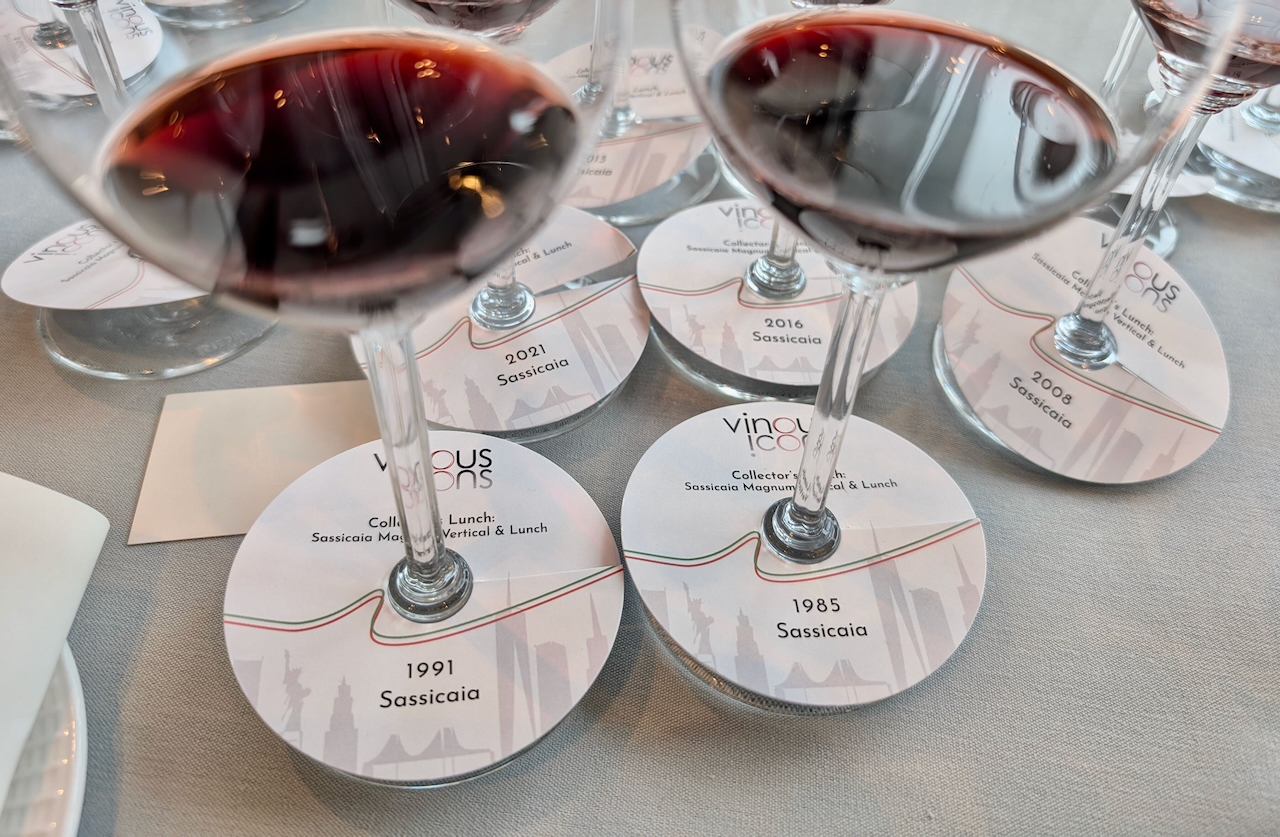
All I can say is I hope to have another opportunity to taste the 1991 and 1985 Sassicaia from magnum again at some point in the future.
Fourth Course
Chef’s Selection of Three Italian Cheeses; Pecorino Toscano, Quattro Portoni Casatica, Gorgonzola Cremificato, Served with Rhubarb Jam
Flight Four: Going Way Back
1991 Sassicaia 1.5L, 1985 Sassicaia 1.5L
Two older vintages make for a stunning conclusion to this lunch. I don't think I have ever tasted the 1991 before. It is a true revelation. The 1985 remains as monumental and iconic as ever. That's not always the case. Eventually, even the best wines start to fade. That has not happened yet here. We opened three magnums. They were all exceptional.
Many thanks to the teams at Manhatta for helping make this such a spectacular lunch and tasting.
© 2026, Vinous. No portion of this article may be copied, shared or redistributed without prior consent from Vinous. Doing so is not only a violation of our copyright but also threatens the survival of independent wine criticism.
You Might Also Enjoy
2026 Tuscany Preview, Antonio Galloni, April 2026
2025 Tuscany Preview, Antonio Galloni, February 2025
New Releases from the Tuscan Maremma, Antonio Galloni, December 2024
2024 Tuscany Preview, Antonio Galloni, February 2024
Exploring New Releases from Coastal Tuscany, Antonio Galloni, August 2023