
Browse using the new Vinous website now. Launch →
Printed by, and for the sole use of . All rights reserved © 2015 Vinous Media
Salt of the Earth: Voliero Brunello di Montalcino 2006-2021
BY ERIC GUIDO | FEBRUARY 4, 2026
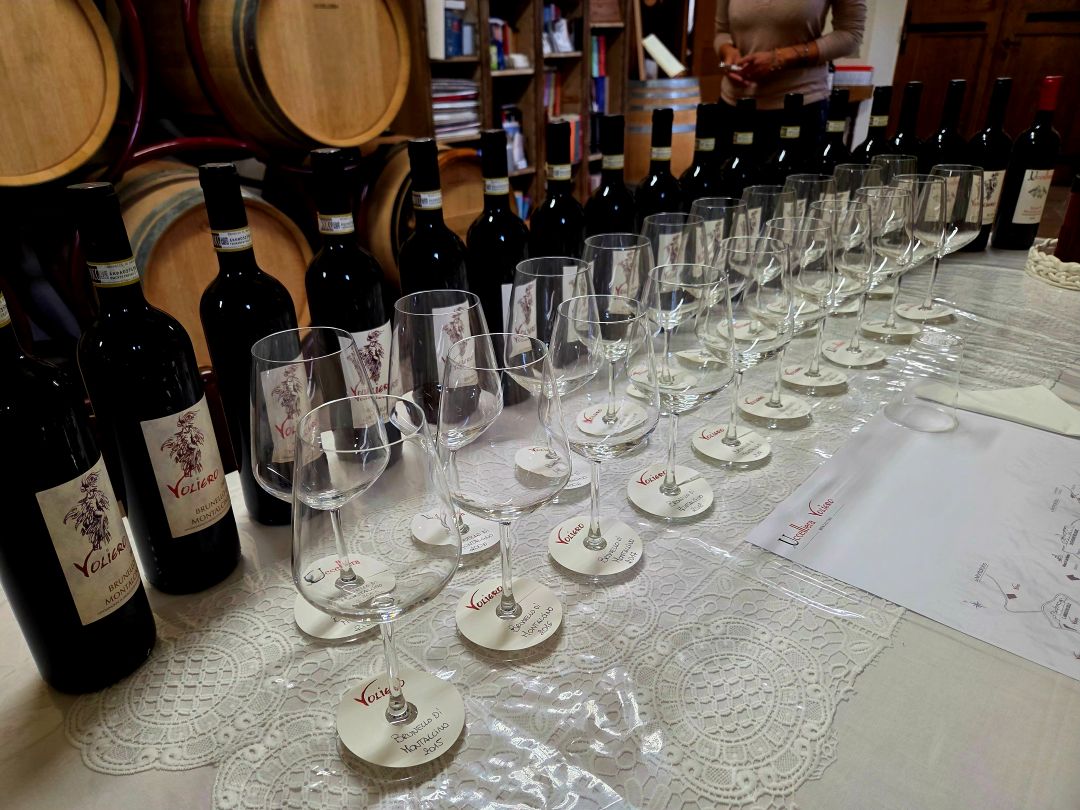
As a wine lover, I can think of no greater pleasure than following a wine from its inception. Tracking the Voliero Brunello di Montalcino since its first release in 2012 has been one such experience. It’s not just the wine that is notable; the story behind Andrea Cortonesi’s rise to become one of the leading figures in Montalcino is every bit as inspiring. Cortonesi organized a tasting of all 15 vintages, spanning from the debut 2006 to the current-release 2021 during my most recent visit to Montalcino in late 2025,
Andrea Cortonesi: A Brief Background
To fully understand Voliero, it’s essential to understand the person who crafts them. The phrase "salt of the earth" resonates in my mind. Cortonesi is a farmer at heart, raising olives, vegetables, cereals and livestock in addition to grapes. The first time I met Cortonesi, I watched him groom his vegetable garden while carefully harvesting zucchini flowers. He seemed almost oblivious to my presence until he completed his task, at which point all of his attention shifted to me and to wine. Cortonesi is a lover of history and the culture of Montalcino, taking great pride in the region’s achievements across generations. He is also one of the most respected figures in Montalcino today. That respect stems from an entire lifetime of experience that began when he was a young boy. He has been deeply involved in all facets of vineyard management and winemaking throughout the region, culminating in his current position as Vice President of the Consorzio del Vino Brunello di Montalcino, as well as the success of his two brands, Uccelliera and Voliero. Cortonesi’s story is a truly inspirational tale.
Andrea Cortonesi was born into a family of sharecroppers (mezzadri) in Castelnuovo dell’Abate, in the southeast of Montalcino, an upbringing that instilled in him a love for the land and a profound understanding of rural culture. It also inspired Cortonesi to begin his career in the wine business at the age of 14 (in 1978), when Giuseppe Bianchini (administrator of Ciacci Piccolomini d’Aragona and Tenuta San Giorgio), took Cortonesi on as an extra hand in the vineyards and cellar. In those days, professional relationships in Montalcino were more fluid, and it wasn’t uncommon to work with more than one winery at a time. Cortonesi took full advantage of this, working with multiple estates like La Torre, Poggio degli Ulivi, and La Poderina. His team planted vineyards that would later be purchased by Poggio di Sotto. Eventually, Cortonesi’s expertise led to his appointment as cellar master at Ciacci Piccolomini d’Aragona and as a consultant to the Consorzio. It was at this time that he met Giulio Gambelli, one of Italy’s most highly regarded oenologists. Gambelli was particularly focused on Sangiovese and ultimately inspired Cortonesi to develop his own winery. Uccelliera released their first wine with the 1991 vintage.
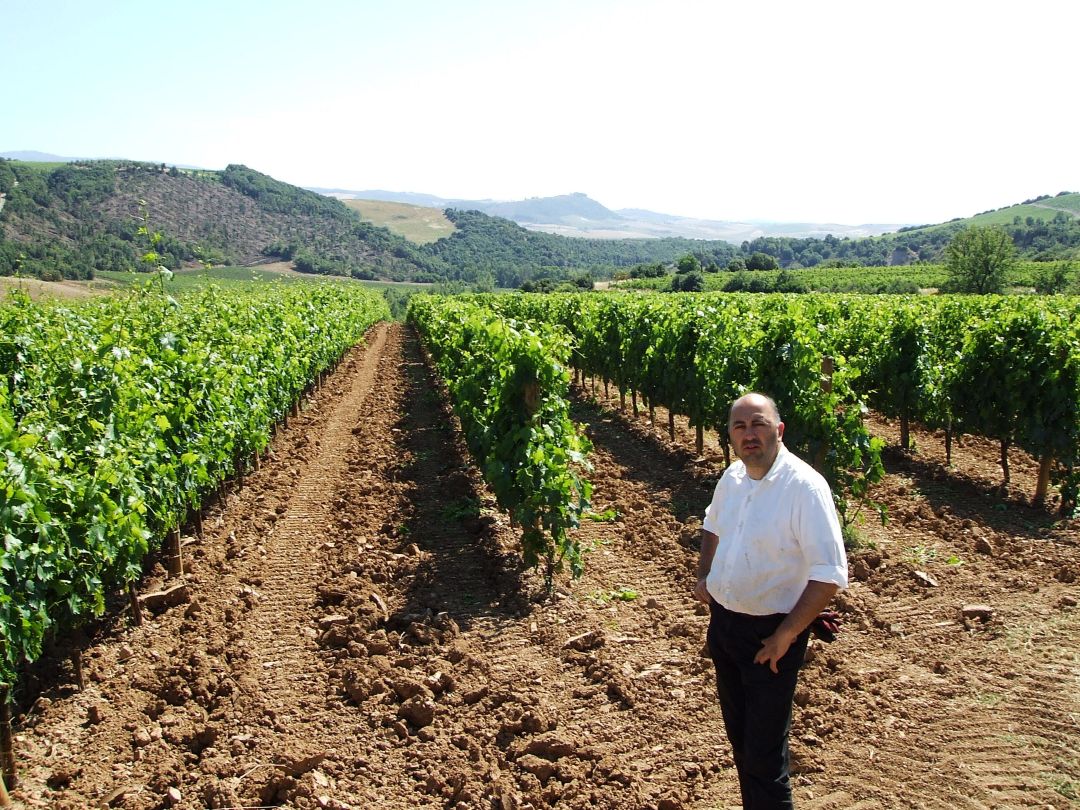
Andrea Cortonesi in 2006, at Vigna Sondrolone.
From 1991 to 1998, Cortonesi also collaborated with Mastrojanni in the development of wineries such as Podere Salicutti and Sesta di Sopra, offering guidance on vineyard layouts, planting choices and cellar operations. Meanwhile, Uccelliera continued to grow. Cortonesi's vision for Uccelliera was to produce a wine that conveyed a sense of place, centered on Castelnuovo dell’Abate and sourced from vineyards spanning 180 to 400 meters in elevation. Uccelliera became a true village wine, conceptualized and crafted by one of the most knowledgeable sources on the subject.
Voliero: From Inception to Today
After 28 years as a successful winemaker and consultant in Montalcino, Cortonesi decided to take his passion for agriculture and traditions to the next level by opening Il Casato Restaurant in Siena in 2006. His philosophy was to focus on high-quality, artisanal, local products. At the same time, Cortonesi was offered a lease on a parcel in the Canalicchio di Sotto Lombardi area of northeastern Montalcino. Driven by a desire to craft an exclusive Brunello for Il Casato's patrons, he created Voliero (which translates to “large birdcage” or “aviary”). At its inception, Voliero was 80% from the vineyards in the Canalicchio area and 20% from vineyards around Castelnuovo dell’Abate. Cortonesi chose to further distinguish Voliero from Uccelliera by employing different techniques in the winemaking process. Voliero underwent a short maceration of 20-25 days. It was also refined entirely in large French and Slavonian oak casks for 30 months, whereas Uccelliera uses Slavonian oak casks and French barriques.
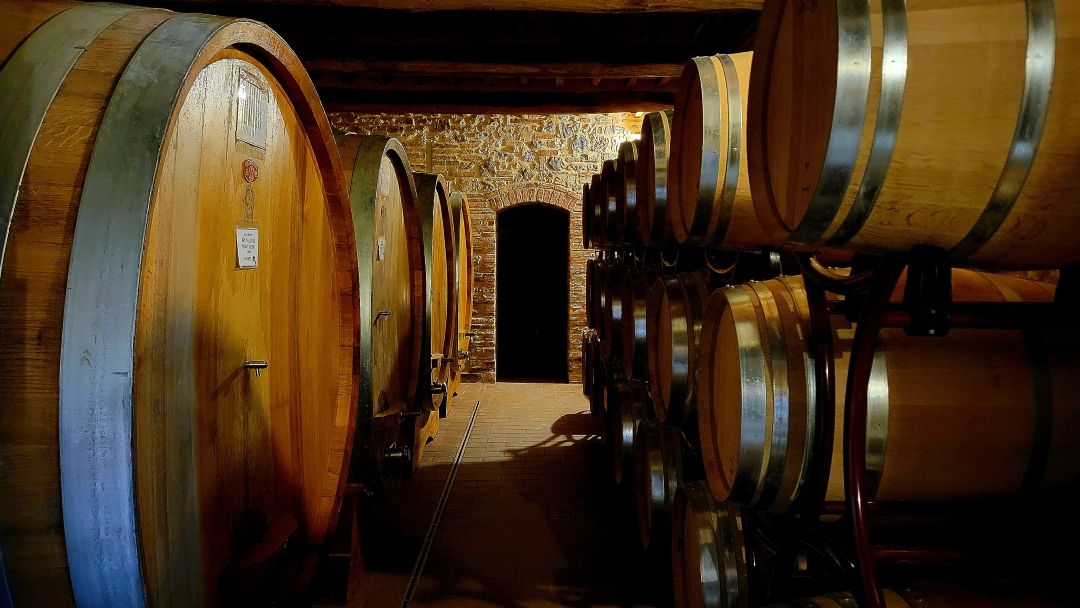
The barrel-aging cellar for Voliero and Uccelliera.
Voliero caught on quickly following its release. It wasn’t long before customers at Il Casato began asking to purchase the wine outside of the restaurant. In 2011, Cortonesi formally released the 2006 Brunello di Montalcino in the Italian market, with a small amount making it to the United States. The official international release (also the 2006 vintage) took place in 2012. I vividly recall tasting the 2006 at the time. I was deeply impressed.
While the blending of fruit from Montalcino’s northeast with a small percentage from Castelnuovo dell’Abate continued through the 2009 vintage, Cortonesi eventually decided to change course. As of the 2010 vintage, Voliero evolved into a southern-Montalcino Brunello while remaining distinctly different from Uccelliera. For Voliero, Cortonesi selected higher-elevation parcels between Castelnuovo dell’Abate and Sant'Angelo in Colle, situated between 350 and 430 meters in elevation on calcareous/sandy soils. Areas with soils rich in minerals, especially iron compounds, became key to defining Voliero's unique character. Today, a total of four parcels—all leased but entirely under Cortonesi’s management—go into both the Brunello and Rosso. Despite this significant change, Voliero continues to exhibit the same mineral-rich, refined profile that has long appealed to its fans, though the 2010 simply does not live up to the expectations of the vintage or the brand.
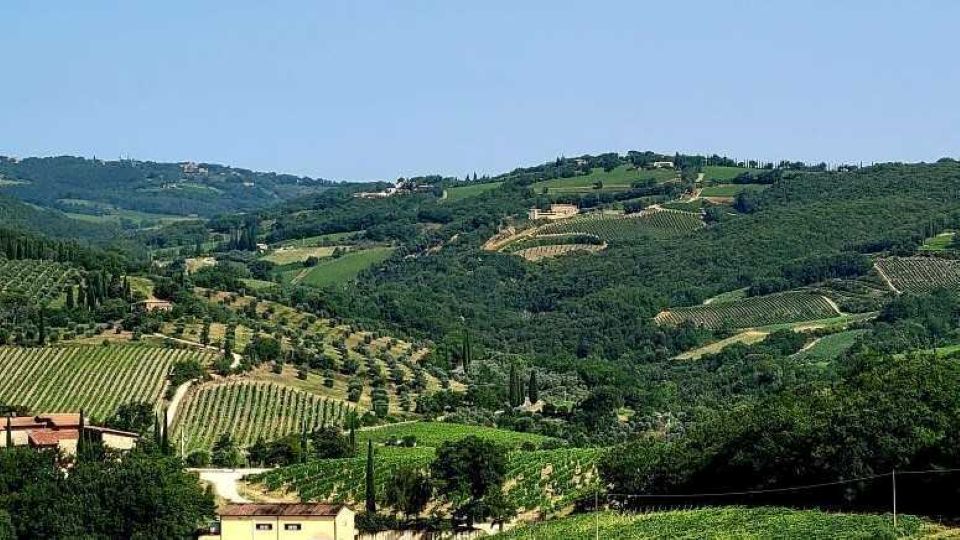
The view from Andrea Cortonesi's high-elevation vineyards
in Castelnuovo dell’Abate.
Voliero has since become the perfect yin to the Uccelliera’s yang. Winemaking remains largely the same, with slight variations from vintage to vintage to accommodate the conditions of each season. From 2006 to 2021, the only vintage Cortonesi chose not to produce was 2014. There has never been a Riserva, nor is there a plan to create one. As for Il Casato, Cortonesi decided to sell the restaurant in 2015 due to its distance from Montalcino, the growth of his two wineries and the birth of his daughter, Annarita, in 2011.
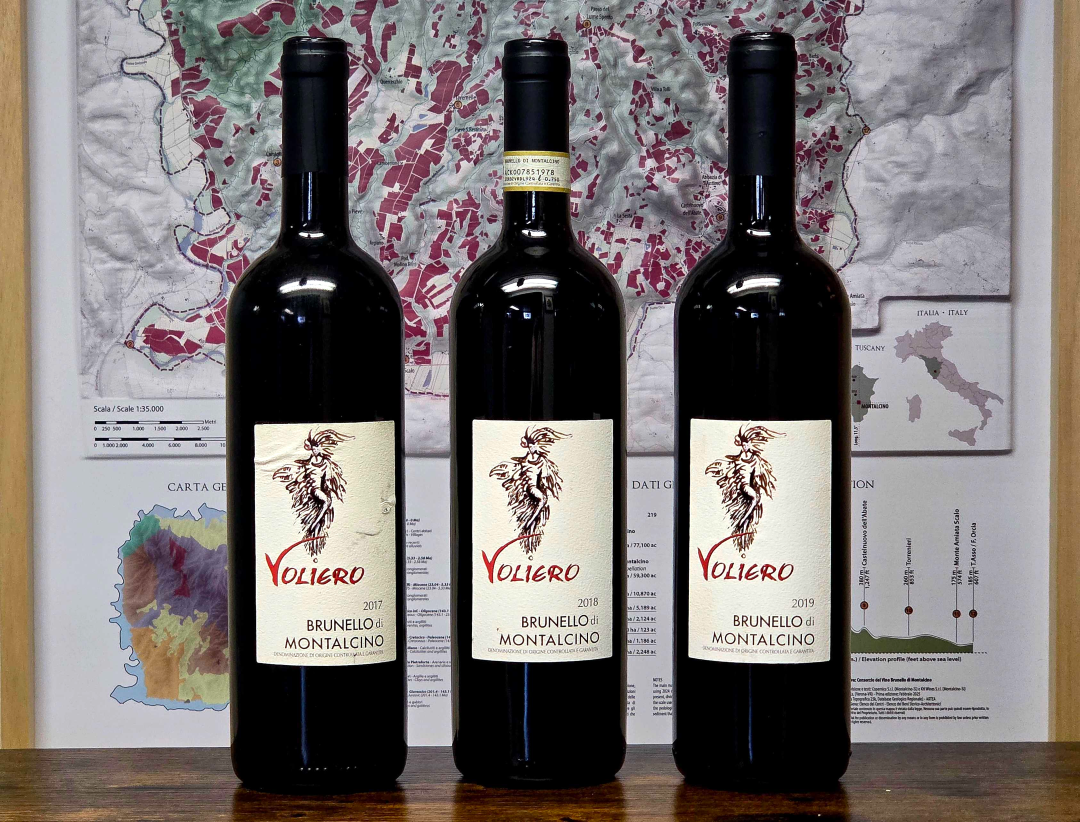
Voliero’s potential was largely underestimated during the
first few years following its commercial debut, but the earliest vintages
continue to age beautifully. The transition from northeastern to southern
vineyards only enhanced the wine’s consistency, while also establishing a contrast
with Uccelliera’s richer style. I often taste these wines side by side, and I
take great satisfaction in comparing their unique qualities. As for recent
vintages, Voliero continues to improve as Cortonesi continues to obsess over
his vineyards and techniques. The Voliero Bruello di Montalcino represents what
southern Montalcino is capable of. It’s a wine of place with a track record of
excellence and balanced maturity, all at tremendous relative value.
I tasted this 15-year Voliero vertical with Andrea Cortonesi in Montalcino in November 2025.
© 2026, Vinous. No portion of this article may be copied, shared or redistributed without prior consent from Vinous. Doing so is not only a violation of our copyright but also threatens the survival of independent wine criticism.
You Might Also Enjoy
The Exquisite 2021 Brunellos, Eric Guido, November 2025
A Tale of Two Extremes: The 2020 Brunellos and 2019 Riservas, Eric Guido, November 2024
The Magic of 2022 Rosso di Montalcino, Eric Guido, September 2024
2013 Brunello di Montalcino: The Throwback Vintage, Eric Guido, February 2024
Buckle Your Seatbelts: 2019 Brunello and 2021 Rosso di Montalcino, Eric Guido, December 2023