
Browse using the new Vinous website now. Launch →
Printed by, and for the sole use of . All rights reserved © 2015 Vinous Media
Philip Togni Cabernet Sauvignon Estate: 1983-2014
BY ANTONIO GALLONI | DECEMBER 23, 2025
Philip Togni’s long, distinguished career stretches across eight decades, during which he has turned out some of the most brilliant wines in Napa Valley. This unforgettable vertical tasting and dinner at Union Square Café surveyed a vast number of vintages all the way back to 1983, Togni’s debut from his estate vineyard on Spring Mountain. The audience, which included several fellow winemakers who traveled to New York for this tasting and many consumers with deep cellars, left no doubt as to where Togni stands among the greatest estates in Napa Valley and the world.
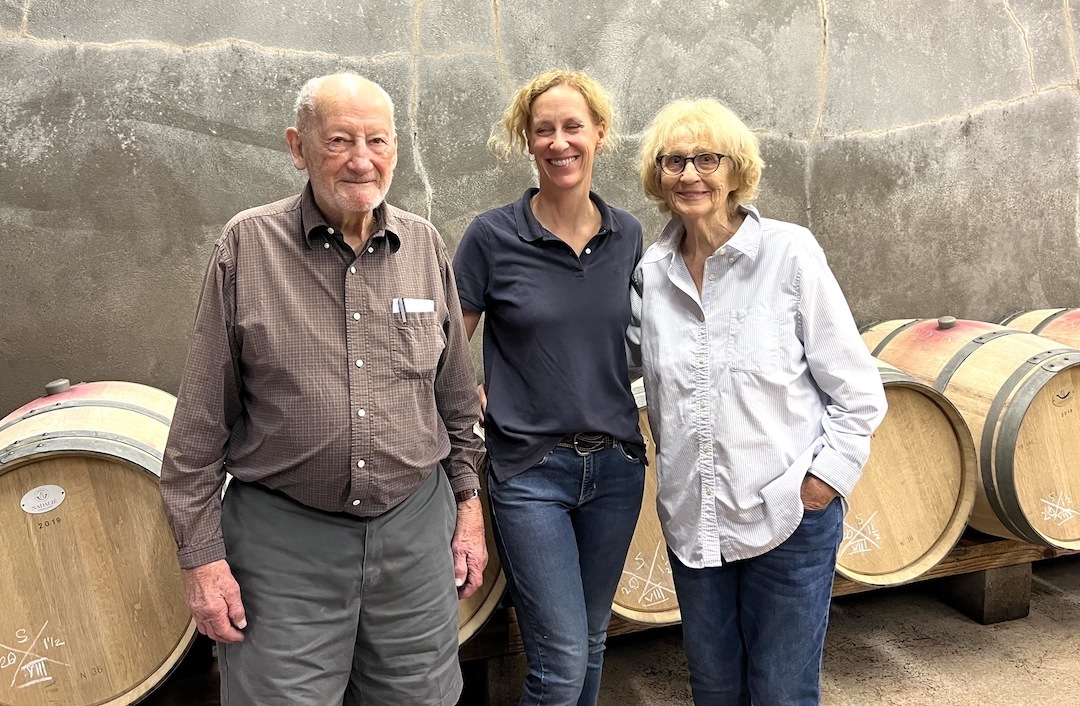
Philip, Lisa and Birgitta Togni in the winery on Spring Mountain.
Our Togni dinner kicked off the second edition of Napa in the City, which took place in March 2023. I hope readers will forgive my tardiness in publishing these reviews. The sheer number of new wines that I (and our other critics) taste and must review on a timely basis continues to grow and leaves precious little time for reporting on retrospectives such as this one. “Better late than never,” the saying goes. I hope readers agree.
Deeply classic and often forbidding when young, Philip Togni’s Cabernets make no concessions to modern-day fashions. The wines often require a decade or more to start drinking well, but don’t really hit their stride until they are 15-20 years old. Daughter Lisa Togni joined the fold in the 2000s, building on the rich legacy first established by her parents in the 1980s.
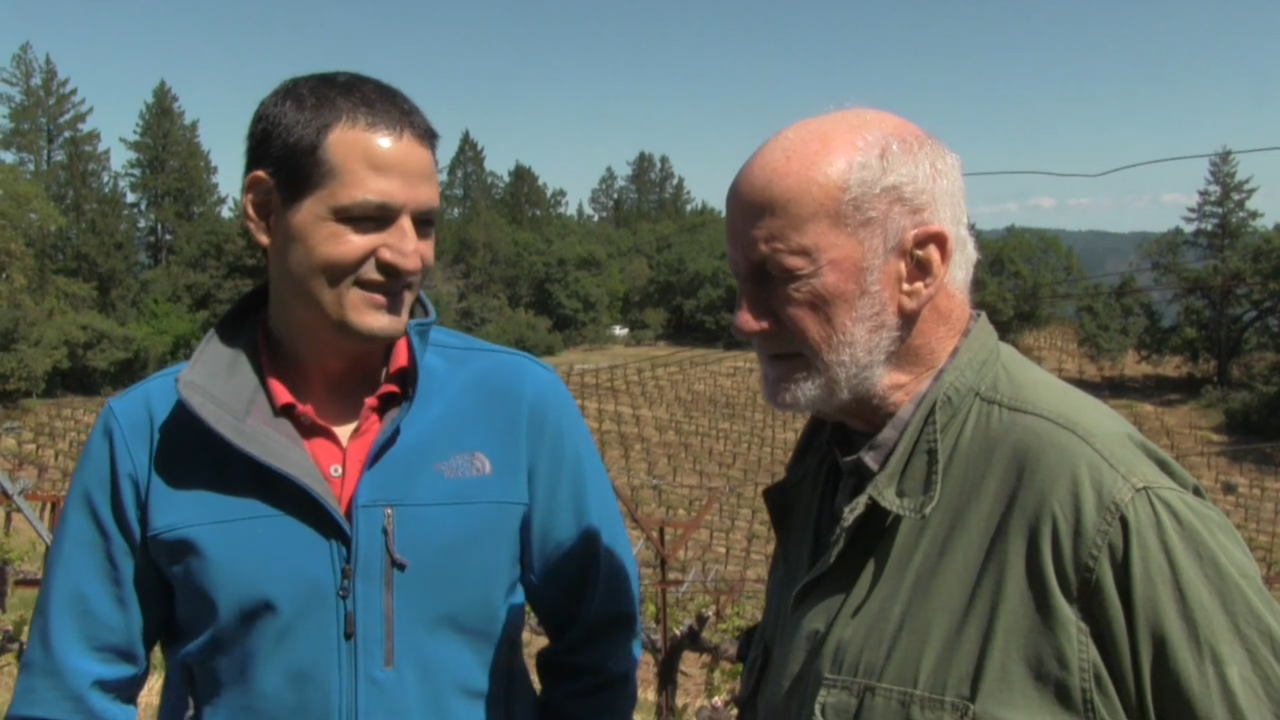
Philip Togni discusses the legendary 1969 Chappellet Cabernet Sauvignon (Click Image to Play Video)
“What are your top five Napa Valley Cabernets of all time?” a highly respected collector asked me a few years ago. I only had to think of four Cabernets, as the top spot could only be occupied by one wine: The 1969 Chappellet Cabernet Sauvignon made by Philip Togni. The 1969 Chappellet Cabernet remains one of the greatest and most singular wines ever made in Napa Valley.
A native of England, Philip Togni began his wine career as a student under Emile Peynaud at the University of Bordeaux, where he earned the Diplôme National d’Oenologie while working at Château Lascombes in Margaux. Togni arrived in Napa Valley in 1959. Early stints included time at Mayacamas, Chalone, Gallo and Inglenook, in what were the early days of Napa Valley in the post-Prohibition era. In the mid-1960s, Togni helped found Chappellet, where he made some of his first iconic wines.
Togni spent seven years at Chappellet before moving to Cuvaison, where his achievements include the stellar 1975 Cabernet Sauvignon, made from Spring Mountain fruit. Around this time, the Tognis answered an advertisement in the St. Helena Star in their search for a home with a bit of land. That led them to a property hidden off Spring Mountain Road that had been on the market for six months. They purchased the land immediately. The estate was in the same family for more than three generations before the Tognis acquired it.
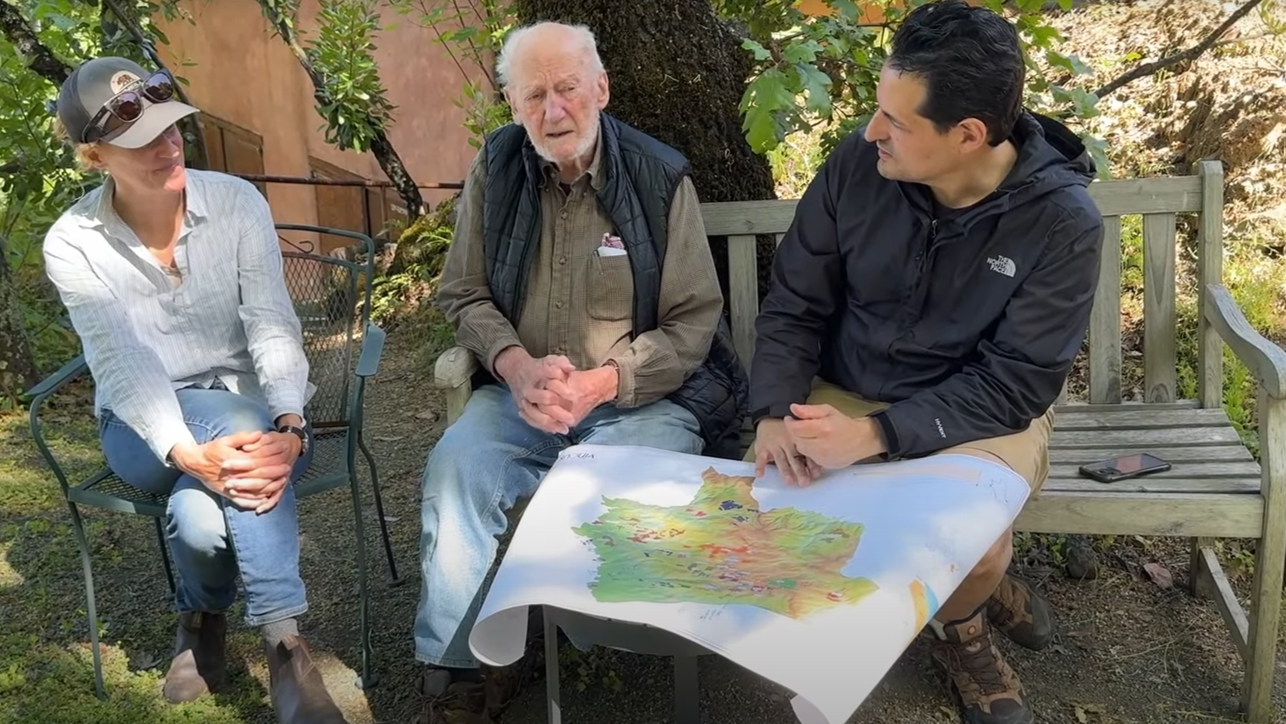
Showing Lisa and Philip Togni the forthcoming Vinous map of Spring Mountain. (Click Image to Play Video)
Vines were planted there previously, but the land was essentially abandoned. The Tognis planted their first 4.5 acres (one acre of Cabernet Sauvignon and three of Sauvignon Blanc) in 1981 using cuttings they took from Jerome Draper’s La Perla, which later became part of Spring Mountain Vineyard.
The Tognis released their first wine with the 1983 vintage. Those early days were not easy. The spread of phylloxera and virus required pretty extensive replanting in the early 1990s.
Since then, the Tognis have gone on to craft a remarkable series of Cabernets that are now modern-day benchmarks for Napa Valley. Many of their recent releases have been positively stellar.
These days, Lisa Togni leads the charge, although her parents are still very much present at all my tastings. Lisa cuts a very laid-back figure, but she has quietly been responsible for many of the positive developments here. Among her many achievements, she transitioned the vineyard to organic farming in the 2010s, installed solar panels and refined winemaking, all while exalting the qualities that make these wines so unique. That may sound like an easy thing to do, but it is not. “There’s so much that we know technically about growing grapes and making wine, but there is still so much we don’t know, and so many variables we don’t control,” she told me recently. “Why are some wines great and others not? Sometimes we know why, but in other cases, the stars just align in a good way,” she continued, in her typically understated fashion.
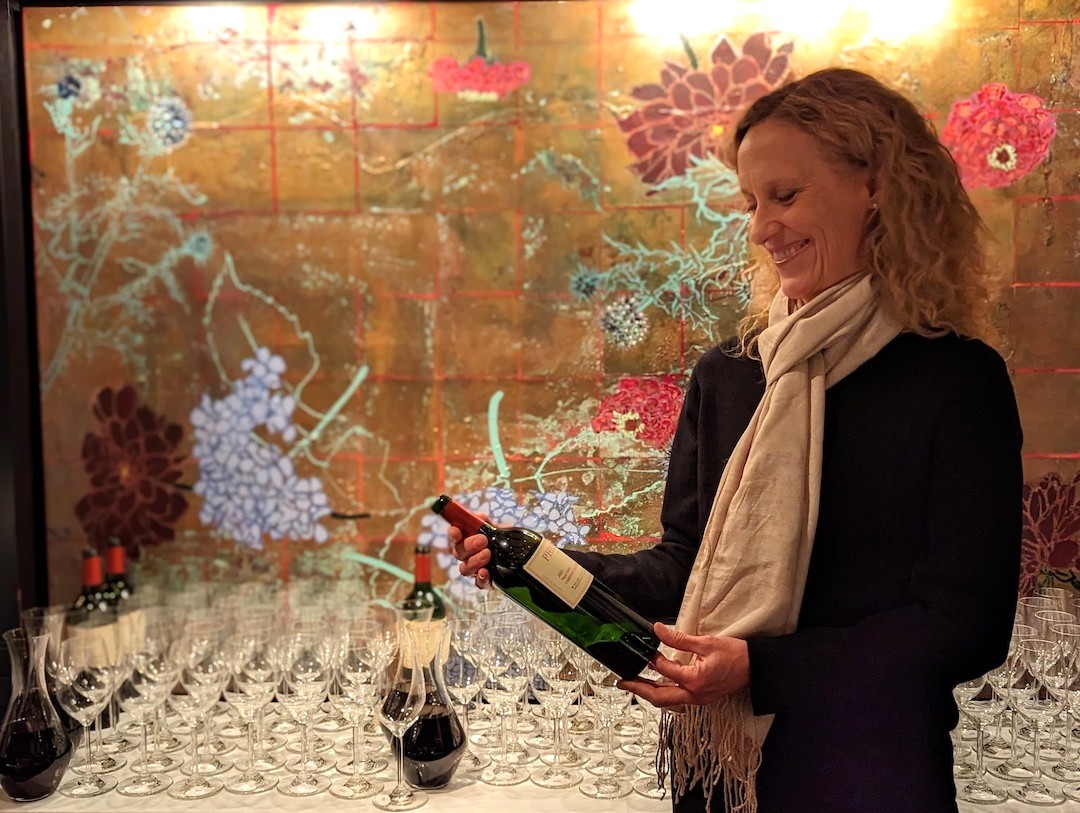
Lisa Togni tasting through the wines before our dinner at Union Square Café.
Philip Togni Vineyard – The Heart & Soul of Spring Mountain
Arriving at the vineyard today, it is not hard to envisage how things looked in the early 1980s. Most of the property is still very wild. There is no sign or elaborate driveway, none of the fancy trappings seen throughout Napa Valley. The entrance, reached through the winding turns of Spring Mountain Road, is very easy to miss. A simple chain-link fence gate secured with a combination lock is the only sign that visitors have arrived at the correct address.
The Togni estate vineyard sits at the crest of Spring Mountain, at about 2,000 feet in elevation. Spring Mountain is defined largely by elevation, which results in cooler daytime temperatures and warmer nighttime temperatures than the valley floor. In other words, there is less of a diurnal shift here than there is in many parts of Napa Valley. Spring Mountain is one of the coolest AVAs within Napa Valley and also receives more rainfall.
Today, the Togni estate spans 10.5 acres under vine. Cabernet Sauvignon accounts for a little more than half of the planted acreage. Most of the Cabernet is the Draper selection from La Perla. Smaller pieces of Cabernet Franc, Merlot and Petit Verdot round out the holdings.
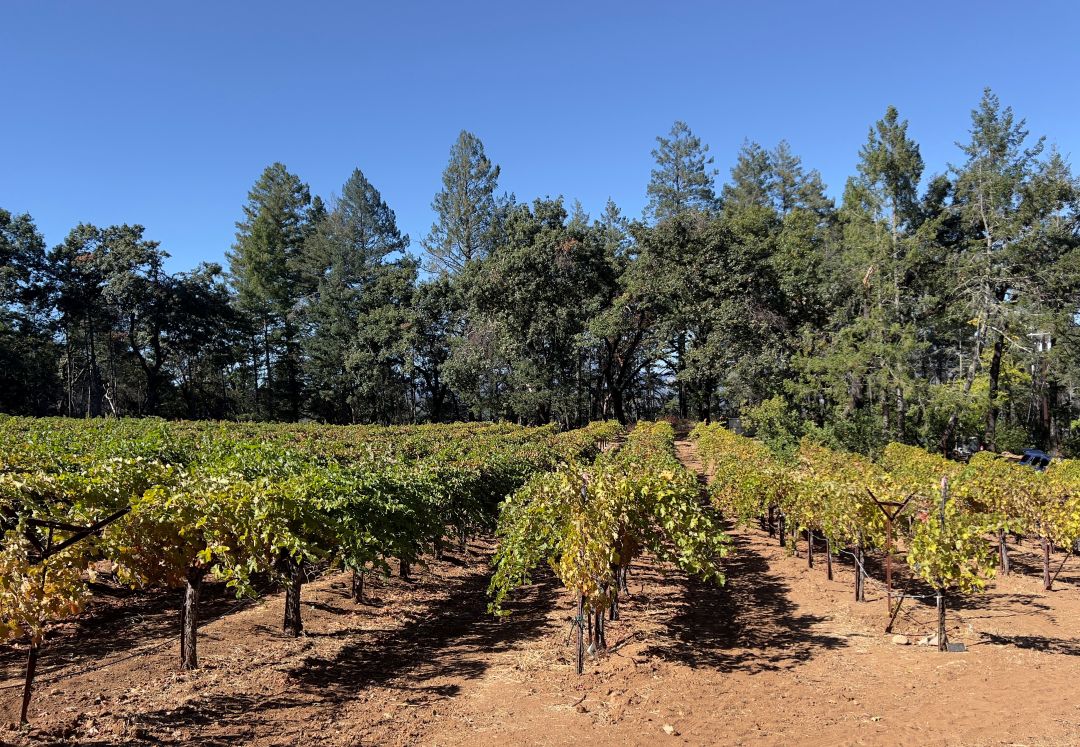
All of the parcels that are used in the Cabernet Sauvignon Estate, often referred to here as the “main label,” are east-facing, on well-drained, rocky clay/andesite volcanic soils. Tanbark Hill, the second wine, emerges from the middle section of the vineyard, about three acres, where heavier soils, shade in some blocks and east-to-northeast exposure contribute to fruit that naturally offers less structure and overall complexity. This is where the Tognis originally planted Sauvignon Blanc when they first developed the property in the early 1980s. Pruning is sequenced such that most of the fruit is harvested in consecutive days over about a week.
The Wines – The Essence of Classicism
The Togni Cabernets reflect the same artisan aesthetic and mountain character that has defined them since the early 1980s. The wines spend ten days on skins and are then drained off and pressed. Free-run and press lots are settled in tank and then racked off gross lees in a warm room. Wines are then barreled down and inoculated for malolactic fermentation, which started with the 2003 vintage. Free-run and press fractions are aged separately and racked every three months. Free-run juice is aged mostly in once-filled barrels, while press lots are aged in 100% new wood, which makes for a total of about 40% new wood. Blending is done just prior to bottling. Any barrels that don’t meet Philip and Lisa Togni’s exacting standards get blended into the Tanbark Hill.
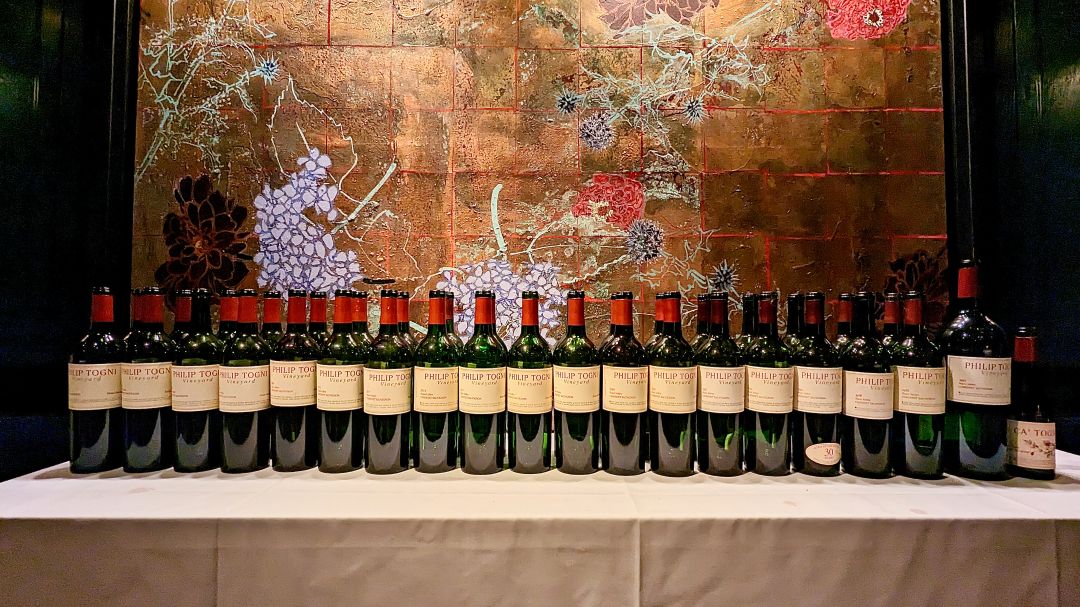
The Tasting & Dinner
As is our custom at Vinous, we organized the wines in thematic flights as opposed to sequentially, which I feel provides a more instructive experience. All the wines were opened a few hours in advance and decanted for sediment. We started with the sturdiest vintages first and opened some of the lighter vintages last. Executive Chef Lena Ciardullo prepared a fabulous menu, while Beverage Director Michael Beck and his team took care of the wines with exceptional care.
Reception
Chef’s Seasonal Selection of Passed Canapés
Chartogne-Taillet Cuvée Ste. Anne
Dinner Menu
To Get Started…
Bibb Salad; Gruyere, Garlic Croutons, Dijon Vinaigrette
2000, 2003 & 2008 Cabernet Sauvignon Estate
Our first flight features wines in three very different styles, from the gracious 2000 to the bolder, fruit-driven 2003, to the decidedly nervy 2008. The 2000 is especially fine on this night, as it has reached a very attractive peak of maturity where all its finest qualities are on display.
Exploring Pairs
Alla Bolognese; Pork Bolognese, Grana Padano
2005, 2004, 2012 & 2011 Cabernet Sauvignon Estate
This flight explores pairs of consecutive vintages. More than anything else, I am reminded of how much time these wines need to be at their most expressive. I usually say 10-15 years, but it is closer to 20!
Epic Vintages
Celery Root Bourguignon; Maitake, Smoked Shitake, Pearl Onions
2014, 2013, 2010 & 2001 Cabernet Sauvignon Estate
This flight certainly lives up to its billing. All four wines are extraordinary. It’s impossible to pick a favorite, but looking at the wines within the context of their respective vintages makes for a fascinating discussion. The 2013 and 2010 have always been magnificent, while the 2014 and 2001 are wines that really blossomed with time in bottle.
A Look Back at the 1990s
Choice of: Roasted Beef Tenderloin; Crispy Fingerling Potatoes, Melted Shallot, Truffle Jusor Olive Oil Poached Cod; Gigante Beans, Tomatoes, Olives
1999, 1995 & 1994 Cabernet Sauvignon Estate
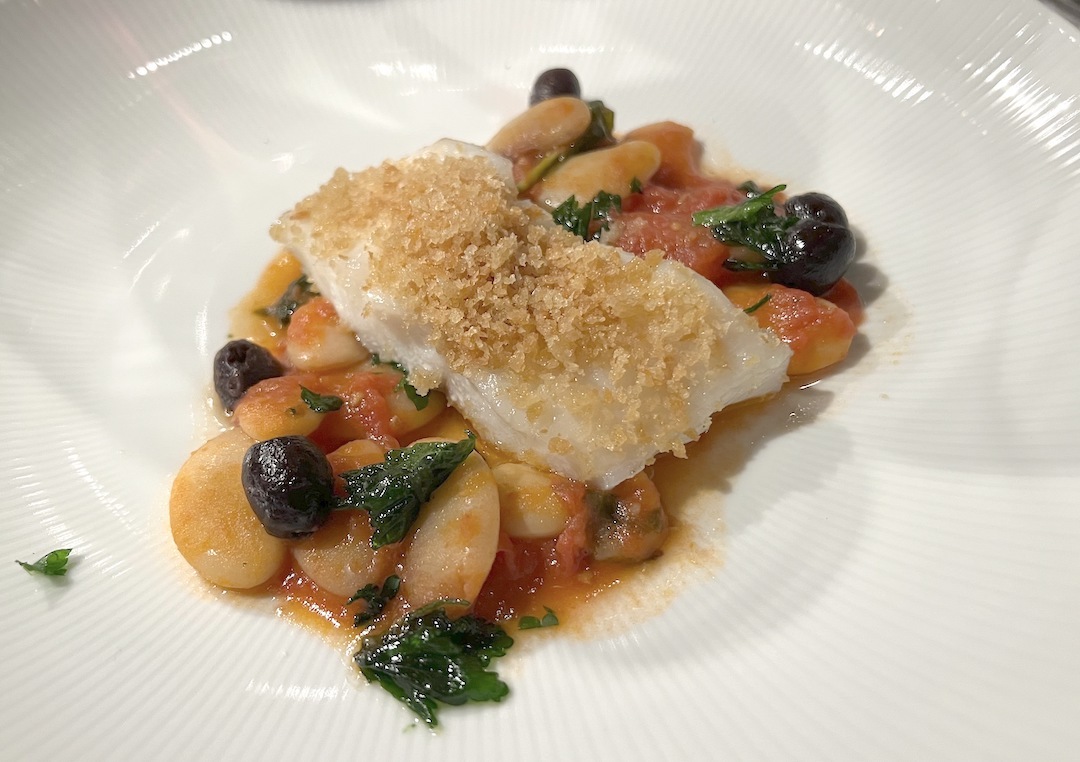
The 1990s are such a great decade for exploring now, as the wines are peaking. On this night, the 1995 is especially fine, but all the wines are deeply impressive.
The Early Days
Chef’s Seasonal Selection of Artisanal Cheeses
1991, 1986 & 1983 Cabernet Sauvignon Estate
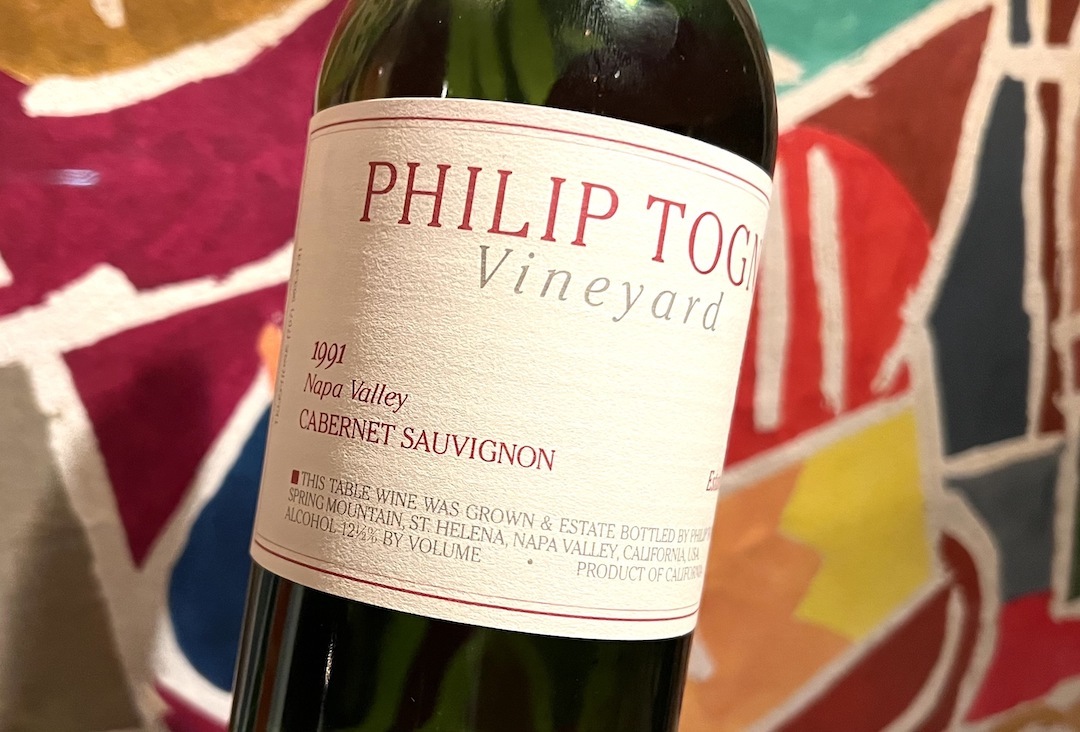
Tasting these early wines is quite a treat, as well-stored bottles are exceedingly rare. Here, too, the wines are so expressive of vintage and site, archetypes that tell a story of each growing season. Although the vines were quite young in the 1980s, Philip Togni had enough experience to get the most out of them. By the 1990s, the wines started to show additional layers of dimension and complexity.
A Rare Bird
2016 Ca’ Togni
The 2016 Ca’ Togni is the last wine of the night. One of the most distinctive sweet wines anywhere, Ca’ Togni is 100% Black Hamburgh done in a style that takes its inspiration from Constantia, the South African sweet wine.
The room is buzzing with energy as the evening starts to wind down. It’s hard to leave, quite frankly. Virtually any of these wines would be the highlight of any evening. On this night, we are very fortunate to taste so many vintages from perfect bottles. The Togni Cabernets remain timeless, wines that offer so much to discover at every stage.
© 2025, Vinous. No portion of this article may be copied, shared or redistributed without prior consent from Vinous. Doing so is not only a violation of our copyright but also threatens the survival of independent wine criticism.
You Might Also Enjoy
Napa Valley Soars: The 2023 & 2024 Cabernet Sauvignons, Antonio Galloni, November 2025
Vinous 2024 Wine of the Year: 2021 Philip Togni Vineyard Cabernet Sauvignon Estate, Antonio Galloni, November 2024
Multimedia: A historic chat between Antonio Galloni and Philip Togni, May 2024
Multimedia: Napa in the City 2023: Lisa Togni, Philip Togni Vineyard, March 2023
Multimedia: Philip Togni discusses the legendary 1969 Chappellet Cabernet Sauvignon, April 2015
Multimedia: A Conversation with Philip and Lisa Togni, October 2011