
Browse using the new Vinous website now. Launch →
Printed by, and for the sole use of . All rights reserved © 2015 Vinous Media
The Marcassin Mystique
BY ANTONIO GALLONI | JANUARY 22, 2026
There are few wineries in the United States, or the world for that matter, with the level of mystique that surrounds Marcassin. “Have you heard anything about Marcassin?” I am asked regularly. “When is the next release?” inevitably follows. A recent visit and tasting provided some answers during a wide-ranging conversation that ran the gamut from wine to vineyards to jazz. I first tasted the Marcassin wines at Robert Parker’s house many years ago. They were unlike anything I had ever tasted, totally unique and singular in every way.
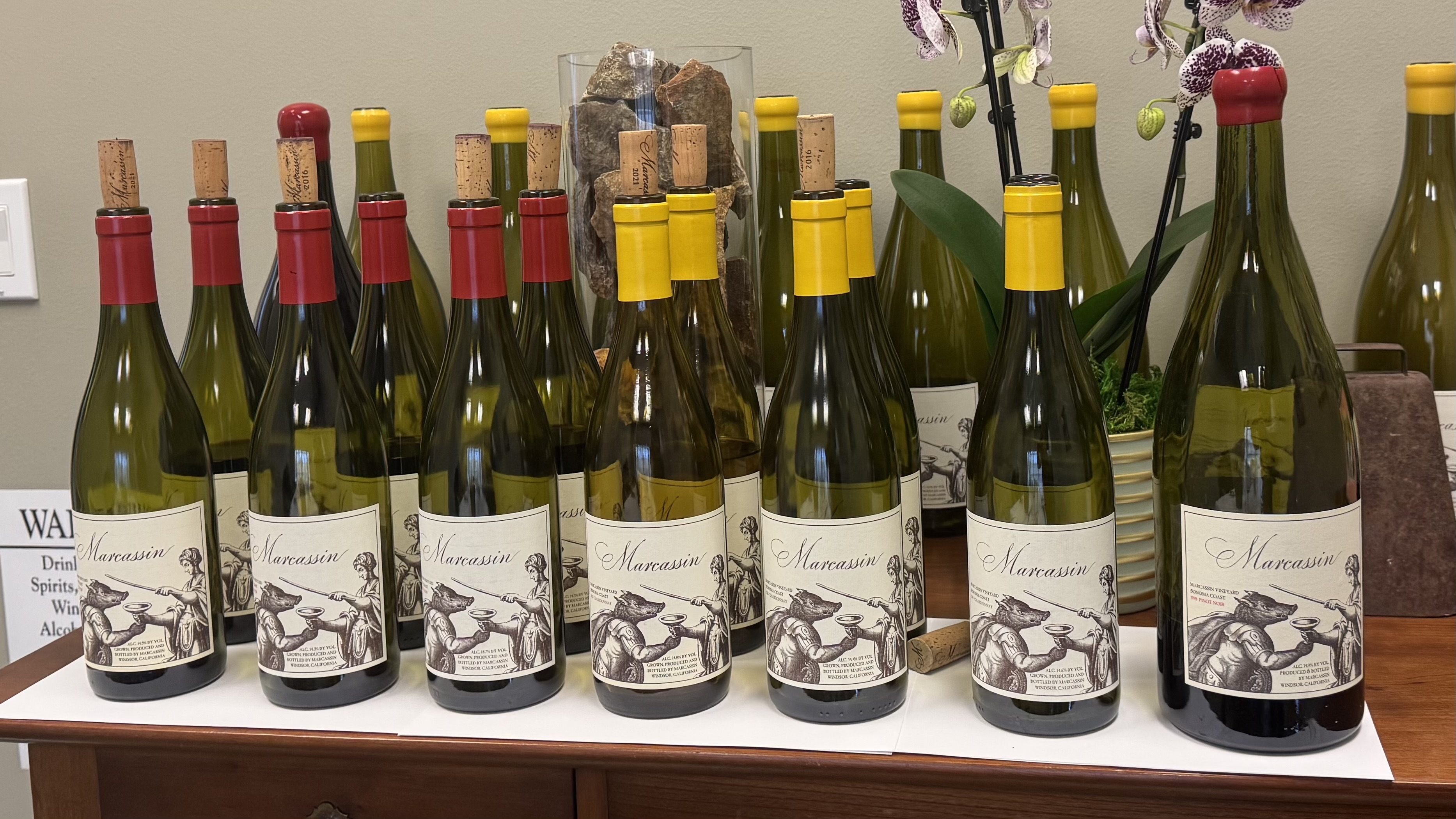
Tasting through a range of current and upcoming releases at Marcassin.
Founders Helen Turley and John Wetlaufer were in fine spirits when I stopped by recently to taste the latest releases with them and winemakers Ryan O’Donnell and Amanda McPhee. Releases might not be the most accurate term, as most of these wines have not actually made it out of the Marcassin cellars. “We had an interlude where I was under the weather, and I did not feel like writing about or selling wine,” Wetlaufer explained. That’s a poignant reminder that at this level, wine remains an artisan product made by people and not big companies. Marcassin recently offered their 2021s, which are set to ship in March 2026. Before that, the last vintage sold to the mailing list was 2013, although some restaurant customers in California received the 2014s, 2015s and 2016s. “We wanted to give customers a chance to see how the wines age, because we often get castigated for being late releasers,” Wetlaufer added with a wry smile. "I feel strongly that our wines are generally drunk too young.” The 2014s and 2016 appear to be good candidates for release in the near future. Yields were punishingly low in 2015 because of shatter, especially for Chardonnay, so there will be very little wine. In many ways, Marcassin remains quite old school in the way the wines are offered and sold. Apparently, the local bank hires temporary employees to process check payments, which most wineries and businesses stopped accepting years ago. Longstanding customers receive as many as twelve bottles of Pinot Noir and eight of Chardonnay per offer, which is how allocations used to be. Despite rabid demand, prices have remained quite stable for some time.
Helen Turley and John Wetlaufer don’t need lengthy introductions, as they remain among the most influential figures in American wine. Turley was one of Napa Valley and Sonoma’s first star winemakers. Her list of clients over the years is a who’s who of top estates, including Peter Michael, Martinelli, Colgin, Bryant, Pahlmeyer and many others. The wines she made at Colgin in the mid-1990s, wines made from purchased fruit in custom crush facilities, remain some of the greatest wines I have ever tasted, from anywhere in the world. The same is true of the wines she made at Bryant and elsewhere.
Wetlaufer came to wine with a wide range of interests, including jazz and philosophy. He later bought and sold wine at All Seasons Wine Shop in Calistoga, which was a magnet for wine aficionados and professionals during the 1980s and 1990s. Wetlaufer studied viticulture assiduously and worked alongside Turley, managing their consulting business. He also ran a tasting group that included Ted Lemon, Tony Soter, David Ramey, Burt Williams, Steve Kistler, Cathy Corison, Chris Howell and other top winemakers in Napa and Sonoma who were in the early part of their careers. Over the years, Turley and Wetlaufer acquired a reputation in some circles for being difficult. I don’t have an opinion on the subject, except to say that professionals in any field who aspire to excellence and who hold deep convictions are not always going to be easy to deal with. The wine world is very small. In the days and weeks after my visit, several winemakers who have worked with Turley and Wetlaufer in the past reached out and expressed their immense gratitude for what they learned.
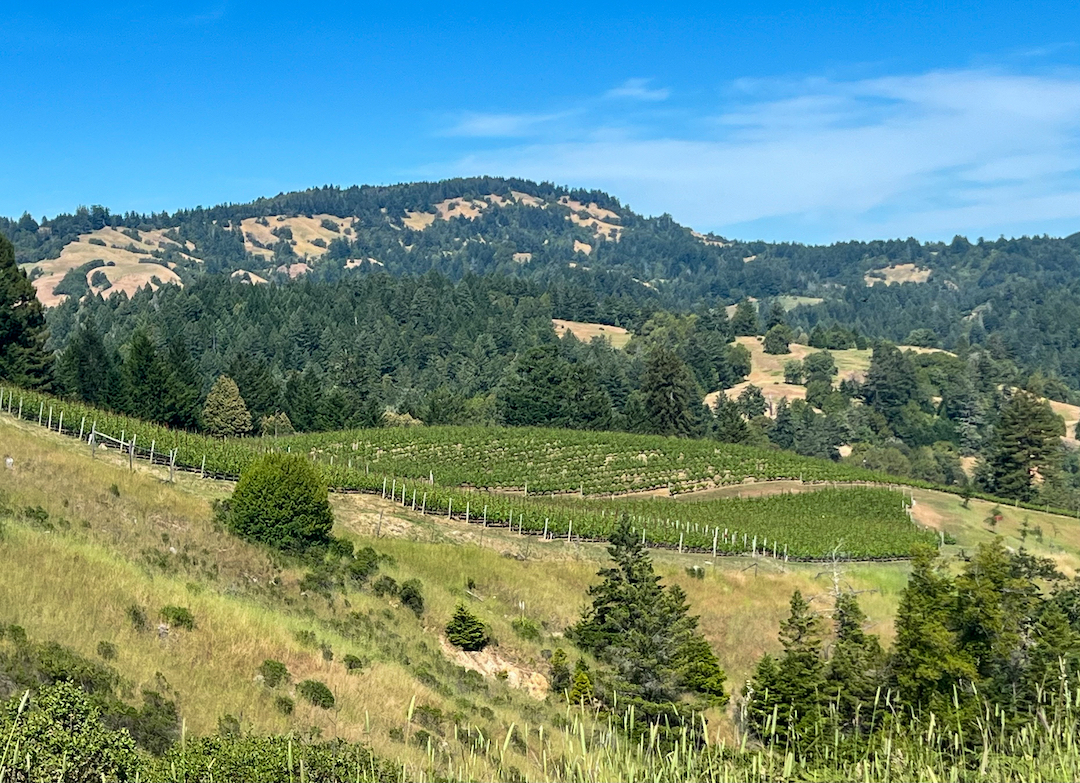
The original Marcassin Vineyard, 8.5 acres of Pinot Noir and Chardonnay first developed in 1990.
Marcassin Vineyard
Helen Turley and John Wetlaufer were pioneers in understanding the potential of Fort Ross-Seaview. They made this distinct part of the West Sonoma Coast their viticultural home well before the AVA existed, and played an integral role at many other properties. George and Martha Charles planted the first Chardonnay here in 1981. At the time, they were told that Fort Ross-Seaview was too cold to grow wine grapes, but they went ahead anyway. Their daughter, Carolyn, married Lee Martinelli Sr., joining two families with deep agricultural roots. By the 1990s, the Martinellis were ready to start their own winery. They hired Helen Turley as their first winemaker. Around this time, Turley and Wetlaufer helped the Flowers family develop their Camp Meeting Ridge property. Later, they found the Wayfarer ranch for the Pahlmeyer family.
Fort Ross-Seaview was attractive for many reasons, starting with its proximity to the Pacific Ocean. In their first site, Turley and Wetlaufer found a piece of land at elevation on marine, volcanic soils rich in fractured basalt that had been uplifted to a ridge with the shifting of tectonic plates. The elevation of 900-1250 feet was mostly above the fog line. “John’s studies in viticulture and our love for places like Chalone were early inspirations,” Turley explained. “I had been making wine since 1977, so I knew how hot the Napa Valley was." These considerations are well understood today, but very few people were thinking along these lines in the 1980s. Jim Spaulding, for whom Turley worked at Stonegate, recommended the original 40-acre property, which was for sale. Neighbors invited Turley and Wetlaufer to a pig roast. “Wild pig and Pinot Noir clinched it for us,” Turley added, alluding to the name Marcassin, French for wild boar.
Avid Francophiles, Turley and Wetlaufer aspired to make wines like the Burgundies they loved. The 1985 Ramonet Montrachet and 1978 Jayer Cros Parantoux were early "taste memories," to use Turley's term. Turley and Wetlaufer bought their first vineyard in 1985. Resources were tight, so they were only able to start developing the site in 1990. The property spanned 8.5 acres of vineyards. Rootstock went in the ground in 1990, and grafting began two years later. The first vineyard was planted with a mix of heritage and suitcase clones using 5x8 spacing, which was considered quite daring at the time. “We tasted wines from the growers we respected most many times over and narrowed down our selection based on taste,” Turley explained. “We kept clones separate, block by block, and then tried to match rootstocks to soils,” Wetlaufer added. These concepts, especially the idea of matching rootstocks to individual parcels within a relatively small vineyard, was way ahead of its time.
The first wines from this fruit were made in 1995, but the first commercial vintage was 1996. Turley and Wetlaufer subsequently acquired another property with one acre of vineyard and then a larger 10 acre piece in 2001 that began producing fruit with the 2006 vintage. The second large planting was done with tighter 3x6 spacing. There are presently 20 acres under vine, approximately two-thirds Pinot Noir and one-third Chardonnay, as measured by production in bottle.
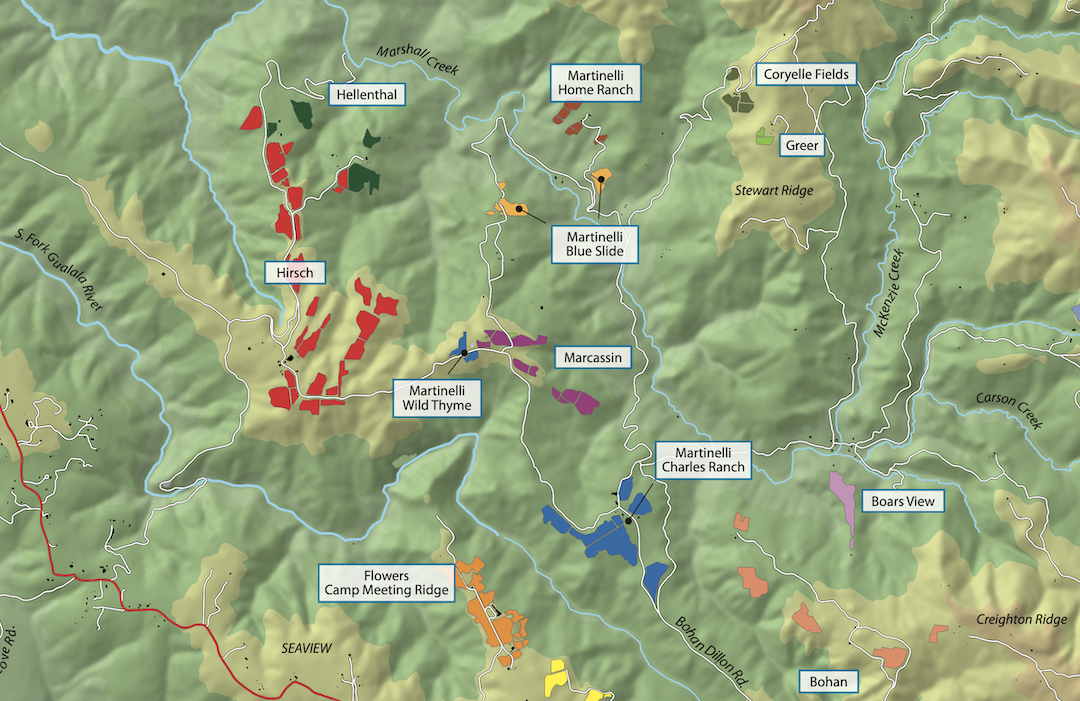
Marcassin and surrounding vineyards, as seen in the forthcoming Vinous Map: The Vineyards of Fort Ross-Seaview, by Antonio Galloni and Alessandro Masnaghetti, © 2026.
In the Cellar
Wetlaufer and Turley moved into their custom-designed winery with the 2011 vintage. It’s a nondescript building, the sort of building one might drive past many times without taking too much notice. Inside, the facility is spacious and designed for maximum efficiency. Barrels are arranged on a single level, with no stacking.
Chardonnay is done direct to press, racked into barrel that same day, inoculated and then not moved until bottling. Time in wood is 10-11 months. Pinot Noir is treated with great care. Each block has its own dedicated fermentation tank, which allows for maximum flexibility at harvest. Fruit is fully destemmed. Here, too, wines are barely touched until bottling. Both Chardonnay and Pinot Noir are aged in 100% new, heavy-toast François Frères barrels made from tight-grained, three-year-old, air-dried wood. Marcassin barrels are built with toasted heads, which is quite unusual. The wines are done with minimal SO2 and are bottled unfined and unfiltered.
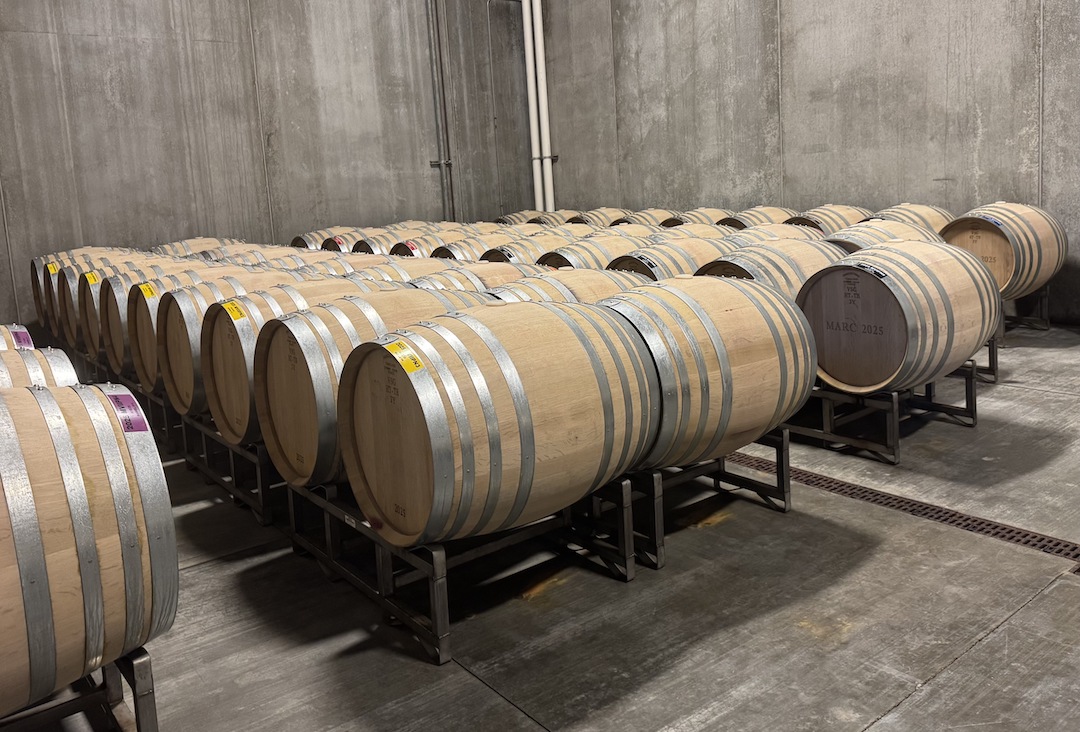
Barrels are arranged on just one level in the functional, spartan Marcassin winery.
The Marcassin Chardonnays and Pinot Noirs stand starkly apart in any tasting of Sonoma wines. Tasting them is like walking into a gallery of impressionist Monet paintings and encountering a Jackson Pollock canvas. Everything is different. The intention, materials, textures and spirit. Whereas most producers are releasing 2024s and 2023s, the last Marcassin vintage that is widely available is 2013. These Chardonnays and Pinots are unabashedly rich and opulent relative to most wines being made today. They aren’t for everyone, but that is the beauty of wine: its diversity. At their best, the Marcassin wines possess a breathtaking combination of textural richness and energy. The 2016 Chardonnay is a great example of that. At ten years of age, the 2016 is just hitting its stride. I am still thinking about it weeks later.
© 2026, Vinous. No portion of this article may be copied, shared or redistributed without prior consent from Vinous. Doing so is not only a violation of our copyright but also threatens the survival of independent wine criticism.
You Might Also Enjoy
Sonoma: The 2026 Preview, Antonio Galloni, January 2026
Sonoma and Neighbors 2022 & 2023: Opposites Attract, Antonio Galloni, January 2025
2022 Sonoma: A First Look, Antonio Galloni, January 2024
Sonoma’s Sensational 2021s, Antonio Galloni, August 2023
California North Coast: Eyes Wide Open, Antonio Galloni, January 2022
Sonoma: 2021 New Releases, Antonio Galloni, January 2021