
Browse using the new Vinous website now. Launch →
Printed by, and for the sole use of . All rights reserved © 2015 Vinous Media
The Fantastic Four: Alto Piemonte, Canavese, Valtellina & Valle d’Aosta
BY ANTONIO GALLONI | FEBRUARY 17, 2026
My annual trip through northern Italy once again highlighted the extraordinary diversity of a stretch of tiny appellations often marked by heroic viticulture and rugged landscapes. Here at the foothills and lower slopes of the Alps, readers will find some of the most fascinating, complex wines in the world. This report focuses on Alto Piemonte and also looks at Nebbiolo and Nebbiolo-based wines in nearby appellations, including Canavese and Valtellina. For the first time, I also include wines from a handful of estates in Valle d’Aosta, which shares a border with Carema.
When I was a child, my father told me about an Italian wine that was once more famous than the Barolos and Barbarescos he loved so much. That wine was Gattinara. I was immediately intrigued. My parents sold Travaglini and Antoniolo, among others, in their shop. Those wines were my first exposures to Alto Piemonte. I wrote my first article on the region in2005, during my Piedmont Report days. These were decidedly different times. Wines from historic houses such as Travaglini and Nervi were often rustic and painfully austere. Dessilani, a big name in those days, made rich, intensely oaky wines in the international style that was commercially in vogue. That was true at Ioppa as well. Sella was one of the few estates that really excelled. Quality and styles were all over the place, and not in a good way.
In the years that followed, my reviews of the best wines were included in broader reports on Piedmont and/or Northern Italy. We began covering Alto Piemonte at Vinous in 2014. Coverage was bi-annual. Feedback from these reports was minimal, but I felt the wines deserved attention. In the meantime, many of today’s top players began to appear. They, in turn, brought a newfound sense of energy that helped revitalize some of the historic names.
Then, about five years ago, readers started to take more notice. Things changed. The wines were improving. Perhaps during the Covid-19 pandemic, people were at home and had more time to read. Suddenly, feedback on these reports was considerable. Readers complained when certain estates weren’t covered and asked for more. I have never minded criticism. It’s a sign people care about what you do. But the change was clear. Ever since then, my report on Alto Piemonte has become an annual feature and has continued to expand. The wines have grown by leaps and bounds.
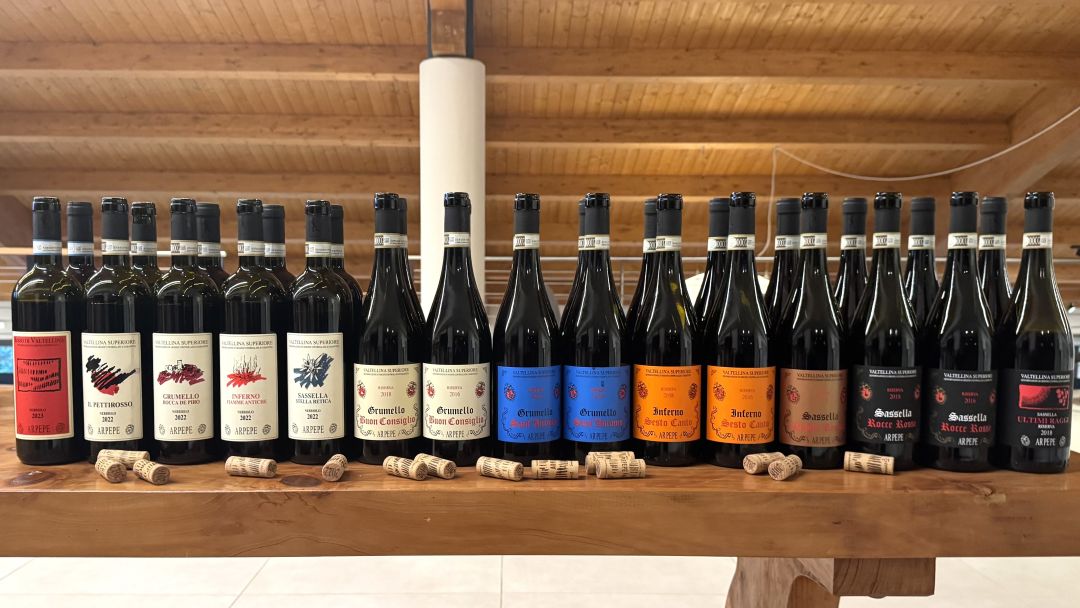
A deep selection of wines from Ar.Pe.Pe., one of thestandard-bearers in Valtellina.
Wines of the Alps
Each of the four main regions covered in this report deserves a deep dive. Not wanting to repeat myself, I refer readers to our extensive article archive, which is full of information on appellations, permitted grape varieties for each appellation and much more detailed information on Alto Piemonte, Canavese and Valtellina. In Valle d’Aosta, I hope coverage of these wines will grow in the coming years. Valle d’Aosta is nestled between France, Switzerland and Italy, which makes its a cultural melting pot in all aspects of life. Nebbiolo (known here as Picotendro) features in some DOCs, most notably Donnas and Arnad-Montjovet. Beyond that, Valle d’Aosta’s viticultural landscape is a rich mosaic of indigenous and international varieties, as readers will see in the accompanying reviews. Whites from Blanc de Morgex et de La Salle, made from Prié Blanc, are steely and intensely mineral. Reds from Enfer d'Arvier, where Petit Rouge is the main variety, can be bold and intense. And that is just scratching the surface. The finest wines are as compelling as anything in Italy.
It’s Not All Roses
As good as the wines from these appellations can be, challenges remain. The most significant of these is that quality can be inconsistent, even among the better producers. Some of this can be explained by the vagaries of climatic conditions, especially in more marginal sites where quality is variable by definition. But it’s more than that. Growers in these appellations—many of them younger and/or working with limited financial means—often struggle with maintaining consistently high quality. Some of the wineries featured in this report are micro-operations, wineries that are essentially sub-scale, often because vineyard holdings are tiny. Making small volumes of wine is extremely challenging. It's like trying to make one cup of stock. The proportions just don’t work. As an example, many small growers would like to age their wines in cask, but they don’t make enough wine to fill those casks, so they are obligated to use smaller barrels, often alongside steel and cement to minimize the wood imprint. This can work, but it’s not ideal. In some cases, the entry-level wines are better than the top selections because they have been fussed with the least. To be fair, small producers in other regions around the world face the same challenges. It’s very difficult to make a single barrel of Grand Cru wine in Burgundy, for example.
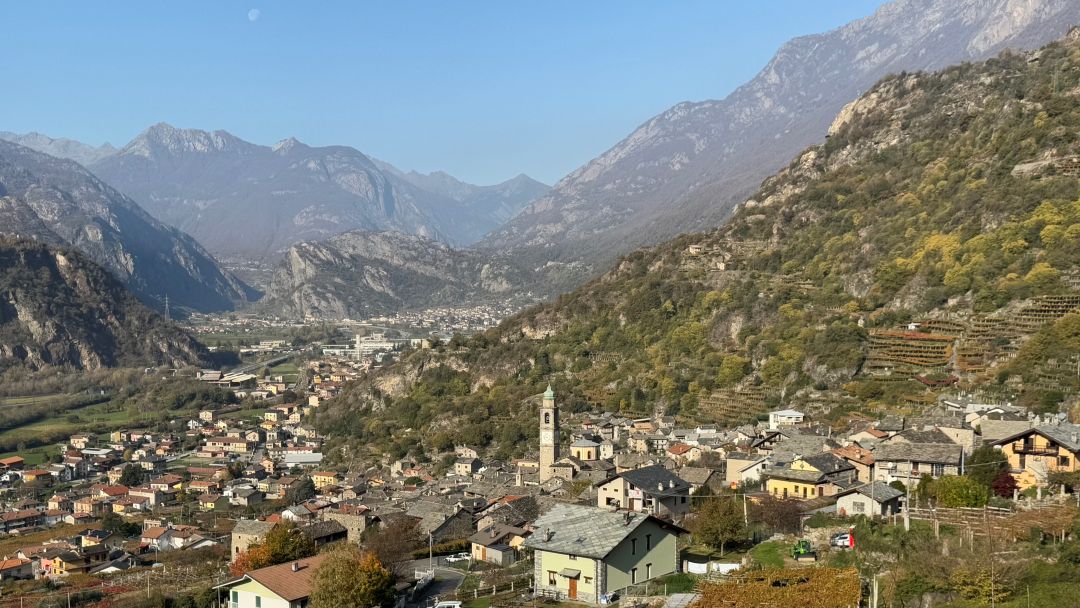
Tiny, steep hillside vineyards are typical of the best sites in Carema.
2024 – So Far So Good, But a Long Road Ahead
Thus far, I have been pleasantly surprised by the 2024s I’ve tasted. The growing season was marked by persistent rain throughout the year. It was a relatively cool year with no heat spikes. Rainfall totals were about twice those of normal years, making 2024 one of the rainiest years in history, in line with 2002 and 2014 among recent vintages. Rain continued during the critical summer and fall months. After the challenges of 2023, growers were quicker to intervene in the vineyards, one of the saving graces of 2024. The importance of learning and adaptation can’t be overstated.
Rain persisted throughout harvest, an important factor that differentiates 2024 from 2014 and 2002. These conditions gave producers tiny windows to pick. Here, too, there was a silver lining. Smaller estates, which in these regions means most estates, were better equipped to deal with narrow harvest windows because they don’t need much time to pick. Larger estates faced harder choices.
The 2024s I have tasted so far are soft wines with forward fruit. Naturally, there is some dilution, which means both the alcohols and acids are lower than they might otherwise have been. Even so, I did not encounter many wines with vegetal notes and/or hard, awkward contours. Today, I find the balance in the best 2024s better than expected given the challenges of the growing season, but that applies only to entry-level wines. Most of the more important selections are still in barrel. Some of the wines may need to be bottled on the earlier side, a reminder that great wines require constant monitoring throughout their aging, what the French call élevage—the art of raising wines in the cellar.
2023 – Progressing Well
By most accounts, 2023 was marked by heavy rain and also intense heat, although those episodes were spread out during the year. Heavy rain in May caused wide outbreaks of Peronospora (downy mildew) that ultimately decreased production significantly. In retrospect, many producers did not intervene quickly enough in their vineyards. Intense heat was a theme, but after 2022, the warmest and driest year on record, 2023 did not seem so extreme. That’s a reminder of how much perspectives of a growing season are rooted in the years that immediately precede or follow it, whereas a longer-term view is more likely to be accurate. Regardless, the 2023s I tasted for this report are promising.
2022 – Soft & Approachable
Two thousand twenty-two was the warmest and driest year ever in these parts. Not surprisingly, the wines are open-knit and quite approachable. While the 2022s naturally don’t have the dimension or complexity of the best years, they also aren’t as penalized as the wines from other regions in Piedmont, specifically Barolo. It’s a fine vintage for current drinking.
Lessona: Here’s Looking at You
Because of its long track record and size, Gattinara is the best-known appellation within Alto Piemonte. As recently as the 1960s, these wines enjoyed stronger customer demand in Italy than Barolo and Barbaresco. I would place Ghemme just behind Gattinara in terms of its prominence. In recent years, I have been especially impressed with Lessona. Sandy soils with marine deposits yield reds that are intensely aromatic, silky and incredibly distinctive. Lessona is a fascinating appellation. There was a time when most of the vineyards here were in the hands of noble families. Lessona was considered an aristocratic wine. Over time, those families gave up their holdings and Lessona’s reputation began to fade. Today, a new, younger generation of quality-driven producers is turning out wines that are increasingly expressive, wines that capture all the pedigree of the region’s best sites.
The State of the Market
Alto Piemonte, Canavese, Valtellina and Valle d’Aosta see the same pressures as most wine-producing regions do today. Some estates face very strong headwinds because they are small, bootstrapped operations with limited resources. Tariffs and an increasingly weak US dollar are challenges for every European estate, but the small, family-run wineries featured in this report simply have less room to maneuver. Prices for most wines remain extremely low in a global context. While that does mean the wines are very affordable, it also means many producers are working on slim margins, especially if they are absorbing some of the impact of tariffs, as many are. That leaves little room for investment. Additionally, there is a group of buyers, both professional and consumer, who don’t value the wines because prices are too low and therefore not suggestive of elevated quality. This is an unfortunate reality in today’s world and something that is very hard to change, especially right now, when there is little space to adjust prices upwards. I am not sure what the solution is, but savvy readers should not be dissuaded by prices that may appear low relative to wines from other regions. If anything, these are some of the very finest values in fine, artisan wine. That is especially true on restaurant wine lists, where markups are increasingly pushing the upper limits of what most consumers will accept.
I tasted all the wines in this article between November 2025 and January 2026.
© 2026, Vinous. No portion of this article may be copied, shared or redistributed without prior consent from Vinous. Doing so is not only a violation of our copyright but also threatens the survival of independent wine criticism.
You Might Also Enjoy
Alpine Soul: Exploring Alto Piemonte & Canavese, Antonio Galloni, February 2025
Alto Piemonte: Small Is Beautiful, Antonio Galloni, February 2024
Nebbiolo Shines in Alto Piemonte, Carema & Valtellina, Antonio Galloni, June 2023
Alto Piemonte, Valtellina & Points North, Antonio Galloni, March 2022
Alto Piemonte & Valtellina, Continued…, Antonio Galloni, September 2020
Nebbiolo in Its Many Guises: Alto Piemonte & Valtellina, Antonio Galloni, April 2020
The Last Frontier: The Nebbiolos of Alto Piemonte andValtellina, Antonio Galloni, June 2018
Nebbiolo’s Northern Lights: Alto Piemonte & Valtellina, Antonio Galloni, April 2016
A Different Shade of Nebbiolo: Exploring Northern Piedmont, Antonio Galloni, March 2014
Show all the wines (sorted by score)
- Agricola Garella
- Antoniolo
- Ar.Pe.Pe.
- Boniperti
- Brigatti
- Cantalupo
- Cantina Delsignore
- Cantina Togliana
- Cantine Garrone
- Castello di Castellengo
- Caves de Donnas
- Cogo
- Colombera & Garella
- Conti
- Contrordine
- Danilo Thomain
- Davide Carlone
- Favaro
- Fay
- Ferrando
- F.lli Castaldi
- Grosjean
- Guido Platinetti
- Ioppa
- La Prevostura
- Le Piane
- Le Pianelle
- Marco Ferrari
- Massimo Clerico
- Mazzoni
- Montebelluardo
- Monte Maletto
- Muraje
- Nadir Cuneaz
- Noah
- Pavese
- Podere ai Valloni
- Produttori di Nebbiolo di Carema
- Proprietà Sperino
- Rovellotti
- Sopravento
- Sorpasso
- Tenute Guardasole
- Tenute Sella
- Tenute Vercellino
- Terre Sparse
- Travaglini
- Vallana
- Viarengo
- Zambolin