
Browse using the new Vinous website now. Launch →
Printed by, and for the sole use of . All rights reserved © 2015 Vinous Media
Made of Titanium: 2022 Burgfest Whites
BY NEAL MARTIN | JUNE 9, 2026
White Burgundy must be built out of titanium. David Guetta and Sia should write a song about it. Think about it: despite late spring frosts and torrid summer heat/drought, premature oxidation, spiralling prices, the ubiquity of Chardonnay and plenty of more affordable options, consumers’ desire for anything between Corton-Charlemagne and Chassagne-Montrachet appears insatiable. Demand for Pinot Noir has softened in recent months, and one might expect its paler counterpart would fall in tandem. That has not happened—partly because tastes are shifting towards white wine, and partly due to the Côte de Beaune’s reputation as the apotheosis and Mecca of Chardonnay.
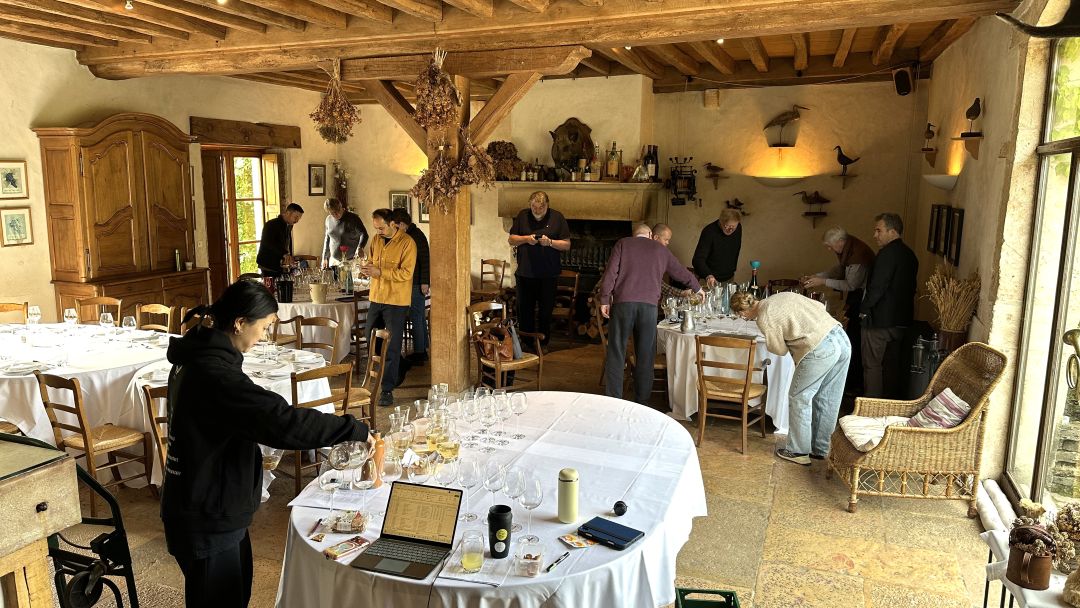
The Burgfest tasting has existed for many years and is limited to around a dozen participants. All bottles are donated by the domaines.
But how do these wines perform in the only place that matters, not the auction house or on social media, but in the glass? Does white Burgundy deserve its haloed status, or is it coasting on its reputation? Time to find out. The Burgfest group gathered at the secluded Hameau du Barbaron in the Savigny-lès-Beaune hinterland to taste nearly 250 wines blind within their respective peer groups over five days, commencing with Chablis on Monday and finishing with Montrachet on Friday. Did the 2022s manage to retain their Burgundy DNA, or had the season’s heat sapped them of acidity and freshness?
The Growing Season
After a mild and dry winter, the vegetative cycle began in early April. There were minor episodes of frost in Saint-Aubin and Puligny-Montrachet, but winemakers did not need to unwrap their wax candles. A spell of warm weather accelerated growth, necessitating intense vineyard work in terms of pruning and de-budding. It was all hands on deck. Flowering was about a fortnight earlier than normal, between May 19 and 26, interrupted by a small shower on May 24.
June was the critical month. Conditions were dry, with some exposed pockets suffering a 40% water deficit, but then thunderstorms swept across the region from June 21 to 25. These storms affected the reds more than the whites, as they were ferocious in the Côte de Nuits (for possible explanations, refer to my original in-barrel report). Afterwards, Burgundy enjoyed dry and hot conditions, with four heat waves throughout July and August. It was the second-hottest growing season since 1947 (only surpassed by 2003), with 275 additional sunshine hours. Temperatures fell at night, affording vines relief and reducing vine stress. Stress was also mitigated by intermittent showers in mid-July and another spell to harvest. Nonetheless, stomata did partially or fully close when the mercury exceeded 35°C, which moderated sugar levels and led many to postpone picking by several days.
There was a logistical challenge in picking parcels at the optimal time. This is not always possible with one or two teams of vendangeurs, so domaines might have had to prioritise their Premier or Grand Crus over regional or village wines. Many of the whites were picked from August 21 to the end of that month. Temperatures remained high, so operations with refrigerated units had a great advantage in keeping fruit cool, avoiding spoilage and regulating the pace of fruit entering the vat room.
The Wines
Let me cut to the chase. The 2022 Burgfest white Burgundy tasting was one of the best I have undertaken since joining the group in 2012. In my 2022 in-barrel report, I wrote that I could not recall a Burgundy vintage where the wines elicited so much joy from barrel. Apropos the whites, well, that joy has been safely transferred into bottle.
Assessing wines blind and juxtaposing them against their peers makes the critic more critical. The exercise compels tasters to identify shortcomings and faults, hence scores tend to be lower. And why not? Criticism is not PR. The wines in this report are rare and expensive, but they are certainly not beyond reproach. That is why Burgfest is probably the most important tasting I attend each year. The format enables participants to cut through the veil of scarcity and nobility to assess each wine’s intrinsic virtues without sight of the label. Having time to discuss and re-examine wines before identities are revealed adds more insight and forces you to double-check, question your judgements and look at each wine from every angle. And after all that, if I still feel those butterflies of joy fluttering inside my stomach, then there is no need for a label or price tag to know for certain that such wines represent a pinnacle.
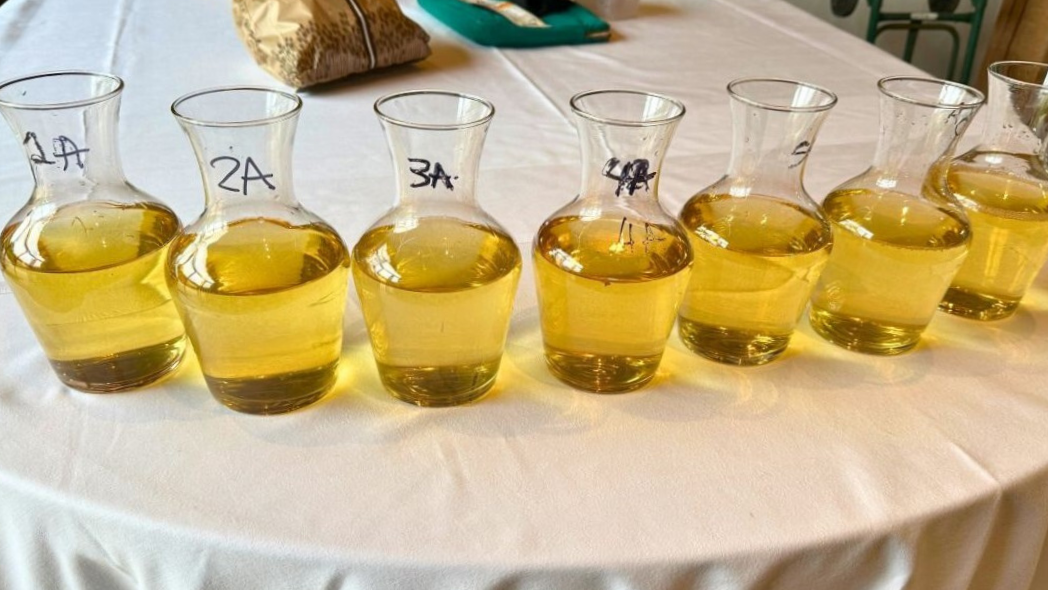
Carafes ready to be poured. The bag in the background is stuffed with gougères to be devoured at mid-morning tea.
The 2022 whites are in a different league from the 2021s, which suffered botrytis and could sometimes come across as raw and herbaceous. As you would expect, given the growing season, the 2022s are weightier and more intense, with presence and authority. Advances in viticulture and winemaking know-how, combined with the vines’ biochemical adaptation to warmer seasons, seem to be safeguarding acidity. Don’t go replacing Chardonnay with Mediterranean varieties yet. That spine of acidity is crucial for countering Chardonnay’s richness and avoiding cloyingness. The question of possible acidification arose, though there were only a couple of occasions when shrill acidity raised suspicions. Doubtless, you will find more acidification among lesser terroirs or producers who prefer a shortcut.
You could argue that the 2022 whites will not satisfy those who seek minéralité, though thrilling levels of energy and tension make up for that. Much of the vintage’s success comes down to avoiding obvious tropical scents and flavours, and when they do appear, they play supporting roles. These traits do not dominate as they might in a Mediterranean climate, where tropical notes can be part of the appeal. The 2022s are immediately and incontrovertibly identifiable as coming from Burgundy and nowhere else, typicité retained despite the mercury rising. So far.
The Tastings
The first flights of Chablis boded well for the week ahead, certainly superior to the 2021s. Part of their success is the higher yields, 29% above the five-year average, according to the BIVB. This dissipated concentration more evenly between bunches. If you seek the “cool glade” or “stony” traits of traditional Chablis, 2022 might not be up your street. However, to overlook this vintage would be to deny yourself some delicious wines, such as the Mont de Milieu from Samuel Billaud or the Montée de Tonnerre from Gérard Duplessis or Louis Michel. The Grand Crus were a step up from the Premier Crus, with a stunning Valmur from Domaine Christian Moreau and a Les Preuses from Domaine William Fèvre that sent tingles down my spine. The vintage doesn’t favor either left bank or right—rather, quality depends on the producer.
Saint-Aubin was once deemed the wannabe Puligny of the Côte de Beaune, a source of cheaper white Burgundy. That is in the past. There are just too many great producers and too many great wines. The Les Frionnes from Joseph Colin is full of nerve. Damien Colin (Joseph Colin’s brother), of Domaine Marc Colin, delivered a sapid En Remilly—one of several that seemed to contain a soupçon of botrytis.
In my original report, I predicted that Chassagne-Montrachet could be the highlight for the 2022 whites. The village remains a strong performer thanks to the likes of Alex Moreau, Jean-Marc Pillot and Domaine Paul Pillot. The finest wines in this peer group hail from the higher contours on limestone soils, translating the brilliance of sites like Les Caillerets and Les Blanchots Dessus. The latter gave rise to a spellbinding 2022 from Domaine Darviot-Perrin. Thank goodness Pierre-Antonin Darviot quit his career in the French Foreign Office in 2019, enrolled at Dijon University and took over the winemaking duties at this domaine.
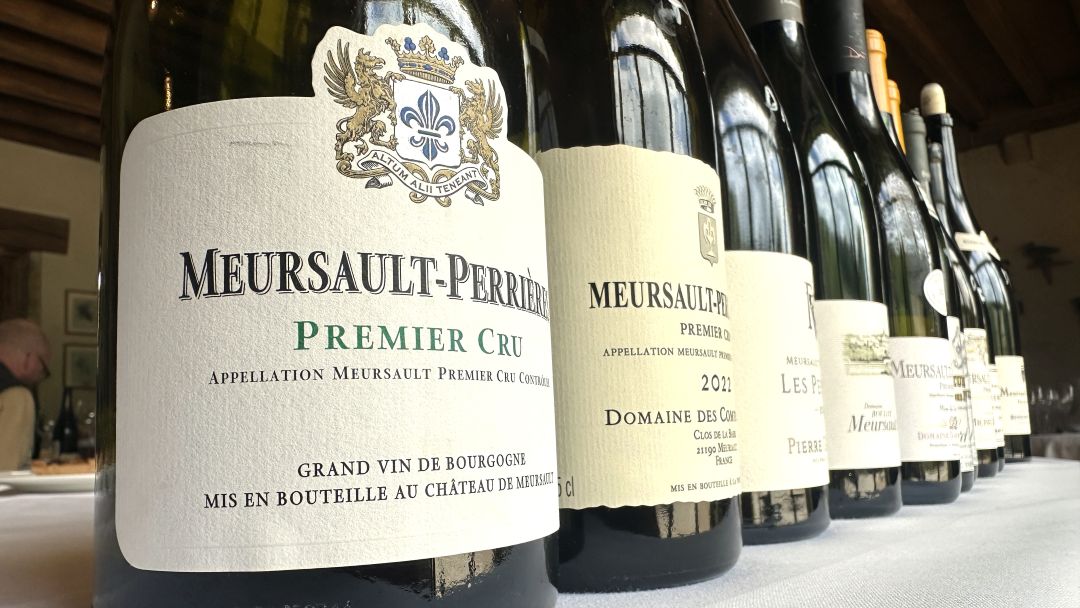
One of the highlights of Burgfest.
The flights from Meursault were the most thrilling. Right from the start, as we broached the Meursault-Blagny, I encountered classy wines from Buisson-Battault. But then things really began to sizzle, with an impressive array of wines from Le Porusots/Bouchères (Antoine Jobard, Domaine des Comtes Lafon, Roulot and Génot-Boulanger). These were complex and refined, intense yet pure and balanced, often replete with surprisingly saline finishes that were not necessarily expected in a warm vintage. That must come down to the cooler nights and earlier pickings. The following flight from Les Genevrières introduced two growers whose wines excelled throughout Burgfest: Charles Ballot of Domaine Ballot-Millot and Jean-Baptiste Bouzereau of Domaine Michel Bouzereau. These are not hipster producers. Prices are not extortionate. The wines are just achieving higher levels than ever before, and neither is desperately seeking cult status.
The series from Les Charmes was just as strong, Olivier Leflaive proving once again that their wines should not be underestimated. That is a testament to Winemaker Solène Panigai, who is regrettably just about to depart her position. Bouzereau delivered one of the standouts of the entire week, a heavenly Les Charmes-Dessus that effortlessly marries the richness of the vintage with a dazzlingly complex yet somehow tender finish. Les Perrières was bejewelled with spectacular wines from Darviot-Perrin, Roulot, Comtes Lafon and Vincent Girardin, which all overdelivered compared to their showings from barrel. I have upgraded their scores accordingly.
We were privileged with three flights solely from Corton-Charlemagne, though regrettably, Bonneau du Martray no longer participates and well, Coche-Dury is Coche-Dury. These flights were a mixed bag, as I have come to expect. Strong performances from Domaine de Montille, Tollot-Beaut, Benjamin Leroux, Rémi Rollin and the highly sought-after Pierre Girardin all impressed, whereas others either suffered from reduction that smothered terroir expression or just lacked the complexity one expects from a Grand Cru.
Let’s finish with Puligny-Montrachet, where, like Chassagne-Montrachet, we ostensibly tasted our way up the incline. Generally, I found pleasing consistency across appellations, the majority retaining their nervosité and tension, with some lovely pithy finishes. The star? Step forward, Marc and Alexandre Bachelet at Domaine Bachelet-Monnot. I have praised them for many years and, under these strict conditions, their Les Referts, Les Folatières and Bâtard-Montrachet were lauded around the room, the Bâtard one of the highest scorers of the entire week. The strongest Premier Crus were perhaps Les Pucelles and Les Combettes from Domaine Vincent Leflaive and Etienne Sauzet.
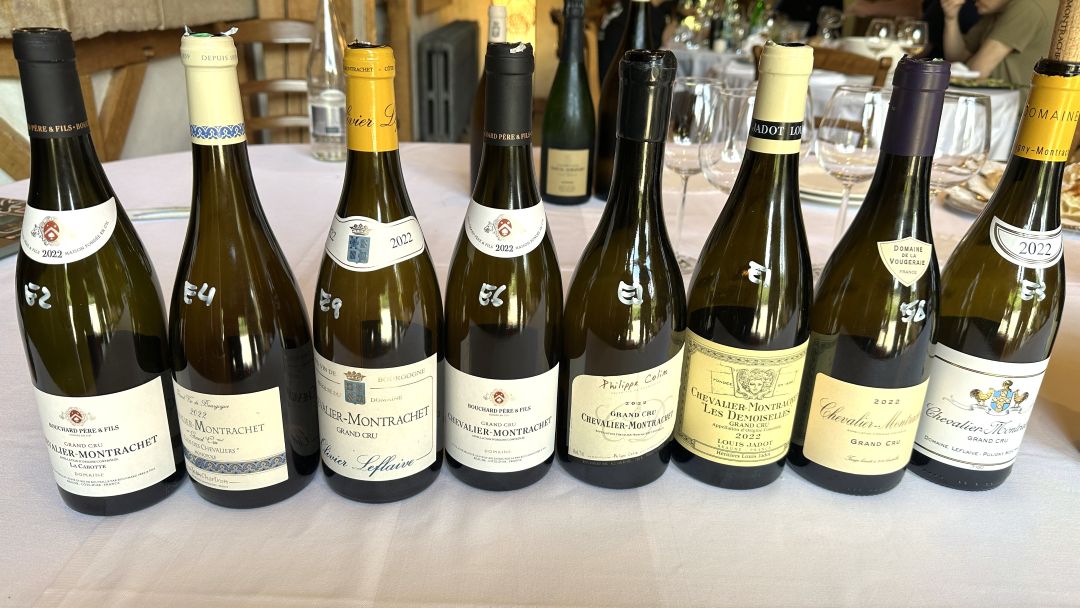
The two flights from Bâtard-Montrachet were full of greatness, courtesy of Domaine Coffinet-Duvernay, Jean-Michel Chartron, Marc Colin and Thomas Morey. You could feel the terroir coming through like an invisible hand, infusing these 2022s with more minéralité. There were still some wines that prompted heated debate. The Bâtard-Montrachet from Pierre Girardin was a prime example of a wine that could go either of two ways. Undeniably, it is burdened with a lot of reduction at this early stage, but there is a patently brilliant wine underneath, which begs the question of how it will play out with bottle age. But then, does that depend on the closure and long-term micro-oxygenation, factors we might know little about? The problem is that Pierre Girardin does not have a tremendously long track record, so we use intuition and hope for the best, hence my high score with a question mark. The enticing prospect of nine Chevalier-Montrachet wines ramped up the anticipation, and they almost uniformly delivered. You might have expected Domaine Vincent Leflaive to come out on top, but perhaps it had just shut down and still needs more time. My top-scoring wines came from Domaine Bouchard Père & Fils—albeit their regular cuvée and not La Cabotte—as well as Philippe Colin and Bruno Colin. The quartet from Montrachet was equally impressive, and incidentally, three of those were bottled under Diam. Kudos to Jean-Michel Chartron, whose Montrachet pipped both Bouchard Père and Domaine des Comtes Lafon, but really, it was like clutching at straws to compare these wines that all revel in their stature.
Final Thoughts
Burgundy can be frustrating. Encroaching corporatisation, irrational prices, cult labels and the unsavoury elitism in some quarters all erode the region’s artisan nature and seem at odds with its spirit. Sometimes, all I can do is look on helplessly as the region repeatedly goes down the wrong path. Where has the innocence and simplicity gone? It can all leave you a bit jaded and disenfranchised…
But then you taste wines like the 2022 whites, wines that remind you why you fell in love in the first place. Perhaps that is why white Burgundy’s reputation does indeed seem to be made of titanium. Say what you like, but when a white Burgundy delivers, it is enthralling, even life-affirming. Its sensory virtues convey centuries of history, a bewitching mosaic of interlocking vineyards with their own vagaries, and the personalities behind the label—their practices and their ethos. I am thrilled to say that my estimation of the wines was higher when I left on Friday than when I arrived on Monday. These wines enamoured me from barrel, and Burgfest demonstrated that they deliver in bottle. Alongside 2020, ‘22 is my favourite recent white vintage to drink right now, but based on this showing, they will repay cellaring.
The red 2022s are up for inspection in September. Following the whites, they have much to live up to. I suspect that the combination of Pinot Noir’s inherent sensitivity with the season’s wild weather conditions might mean there is less consistency. There’s one way to find out…
© 2026, Vinous. No portion of this article may be copied, shared or redistributed without prior consent from Vinous. Doing so is not only a violation of our copyright but also threatens the survival of independent wine criticism.
You Might Also Enjoy
Burgundy 2024: One Battle After Another, Neal Martin, January 2026
Now, For My Latest Trick: Burgundy 2022, Neal Martin, January 2024
A Vintage with Issues: Burgundy 2021, Neal Martin, October 2025
Herding Cats: Burgfest 2020 – The Reds, Neal Martin, October 2024
Variations on a Theme: Burgundy 2020 Whites, Neal Martin, July 2024
Show all the wines (sorted by score)
- Albert Bichot (Domaine du Pavillon)
- Alex Moreau
- Alvina Pernot
- Benjamin Leroux
- Bernard Defaix
- Camille Giroud
- Camille & Guillaume Boillot
- Charlène & Laurent Pinson
- Château de Meursault
- Daniel Dampt
- Domaine 47°N 3°E
- Domaine Albert Grivault
- Domaine Alex Moreau
- Domaine Antoine Jobard
- Domaine Bachelet-Monnot
- Domaine Ballot-Millot
- Domaine Bessin-Tremblay
- Domaine Bitouzet-Prieur
- Domaine Bouchard Père & Fils
- Domaine Bruno Clair
- Domaine Bruno Colin
- Domaine Buisson-Battault
- Domaine Chapelle de Blagny
- Domaine Christian Moreau
- Domaine Clos de la Chapelle
- Domaine Coffinet-Duvernay
- Domaine de la Chapelle de Blagny
- Domaine de la Vougeraie
- Domaine de Montille
- Domaine des Comtes Lafon
- Domaine des Croix
- Domaine des Lambrays
- Domaine d'Henri
- Domaine Didier Darviot-Perrin
- Domaine Dujac
- Domaine E&E Vocoret
- Domaine Eric Boigelot
- Domaine Etienne Sauzet
- Domaine François Carillon
- Domaine Génot-Boulanger
- Domaine Gérard Duplessis
- Domaine Gilbert Picq
- Domaine Guy Roulot
- Domaine Henri & Gilles Buisson
- Domaine Henri Prudhon
- Domaine Hubert & Olivier Lamy
- Domaine Jacques Carillon
- Domaine Jean Chartron
- Domaine Jean-Claude Bachelet
- Domaine Jean Collet
- Domaine Jean Collet & Fils
- Domaine Jean-Marc Boillot
- Domaine Jean-Marc Pillot
- Domaine Jean-Paul & Benoît Droin
- Domaine Jean-Pierre Grossot
- Domaine Joseph Colin
- Domaine Joseph Drouhin
- Domaine Julien Brocard
- Domaine Long Depaquit
- Domaine Louis Michel
- Domaine Marc-Antonin Blain
- Domaine Marc Colin
- Domaine Michel Bouzereau
- Domaine Nathalie & Gilles Fevre
- Domaine Olivier Leflaive
- Domaine Paul Pillot
- Domaine Philippe Colin
- Domaine Pinson
- Domaine Rapet
- Domaine Remi Rollin
- Domaine Samuel Billaud
- Domaine Tessier
- Domaine Thomas Collardot
- Domaine Thomas Morey
- Domaine Tollot-Beaut
- Domaine Vincent Dampt
- Domaine Vincent Leflaive
- Domaine William Fevre
- Dominique Lafon
- Etienne Sauzet
- Famille Grossot
- Louis Jadot (Domaine)
- Louis Jadot (Domaine des Héritiers Jadot)
- Lous Jadot (Domaine)
- Marc Colin et Ses Fils
- Olivier Leflaive
- Olivier Leflaive Frères
- Pierre Girardin
- Pinson Frères
- Sébastien Dampt
- Simon Colin
- Vincent Girardin