
Browse using the new Vinous website now. Launch →
Printed by, and for the sole use of . All rights reserved © 2015 Vinous Media
Henschke Mount Edelstone 1956-2024: A Rare Gem Comes of Age
BY ANGUS HUGHSON | MAY 19, 2026
Some of the world’s greatest vineyards have a natural aura about them. Their fortunate aspect, location and geography immediately display potential, with advantageous climate and soils their crowning glory. Think of the monolithic limestone dome of Corton-Charlemagne with its south-facing vineyards, or the incredibly steep Bernkasteler Doktor vineyard overlooking the Mosel. Henschke’s Mount Edelstone vineyard is another such site, with its perfect east-facing exposure and gentle slope that shields the site from afternoon heat. Mount Edelstone is steeped in local history—early German settlers named the vineyard after the edelstein, or small opal gemstones, that were once found in the area. The Angas family, whose patriarch was the first governor of South Australia, planted Mount Edelstone in 1912. Sixth-generation farmers John and Jan Angas still own the original farm just over the rise.
As was common at the time, the vineyard was initially just a small component of a mixed farm. More uncommon was the size of the vineyard, 16 hectares, planted exclusively to Shiraz, the pedigree for which traces back to some of the variety’s first imported clones, likely from Hermitage. Today, the vines from the early 1900s remain largely intact, planted on sandy loam soils over deep gravelly red clays at an elevation of 400 meters. Clays are particularly vital for retaining valuable water in drier seasons and helping to sustain the vines' impressive health.
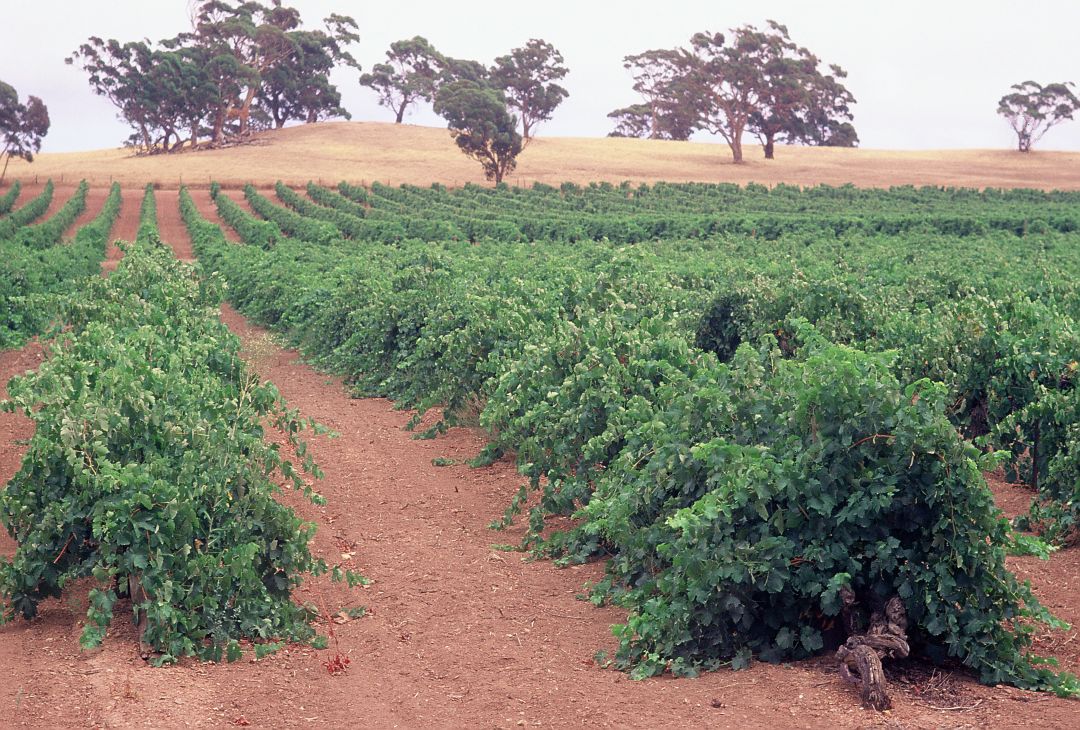
The Mount Edelstone vineyard in the 1980s.
Henschke is, of course, best known for thei Hill of Grace Shiraz, sourced from a much smaller patch of vines that trace to the 1860s. However, Mount Edelstone is in some ways more historic, as it was Henschke’s first single-vineyard bottling and, thanks to its early success, served as the model for Hill of Grace. While the Hill of Grace vineyard has long drawn visitors, with its venerated natural beauty and a charming old Lutheran church, Mount Edelstone has largely remained hidden away on a dirt road.
Unlike Hill of Grace, the Edelstone vineyard was under the care of farmers for the first six decades of its existence, with their attention spread across multiple crops and livestock. In 1952, Cyril Henschke started sourcing some of their fruit for a single-vineyard claret. The 1956 was a fabled edition that won many awards around Australia, putting Henschke on the map in the country and cementing the family’s focus on single-vineyard wines. This strategy went against the thinking of the day, a time in which most wines were regional blends. Convinced of Edelstone’s potential, Cyril Henschke purchased the vineyard, and the trajectory of this wine changed for good. But it would take decades of toil for Edelstone to fulfill its promise.
Much of the credit for Mount Edelstone’s ascent must go to Cyril Henschke’s son Stephen, the family’s fifth-generation winemaker, and Stephen’s wife, viticulturist Prue Henschke. In 1986, the Henschkes began working on numerous trials to improve fruit quality. They underwent a long, drawn-out process of researching and trialling various trellis designs, finally settling on the Scott Henry system, with canes trained both up and down—this helping to optimise sunlight and, in turn, flavour and tannin development. This system added significant cost, close to 30%, but the resulting improvement in yield and quality made this investment worthwhile. Prue Henschke attributes much of Mount Edelstone’s success to Scott Henry’s ingenious design.
“Bless his soul, Scott Henry from Oregon. He had the same issue with growing Pinot Noir in a wetter area. He was really struggling with dense canopies and decided to just split them. But it's more than just splitting the canopy, it's actually holding half of it down. We were concerned about yields and did try to go to one bunch per alternate shoot, but instead we brought the ripening process forward by two weeks. So you can thin too much.”
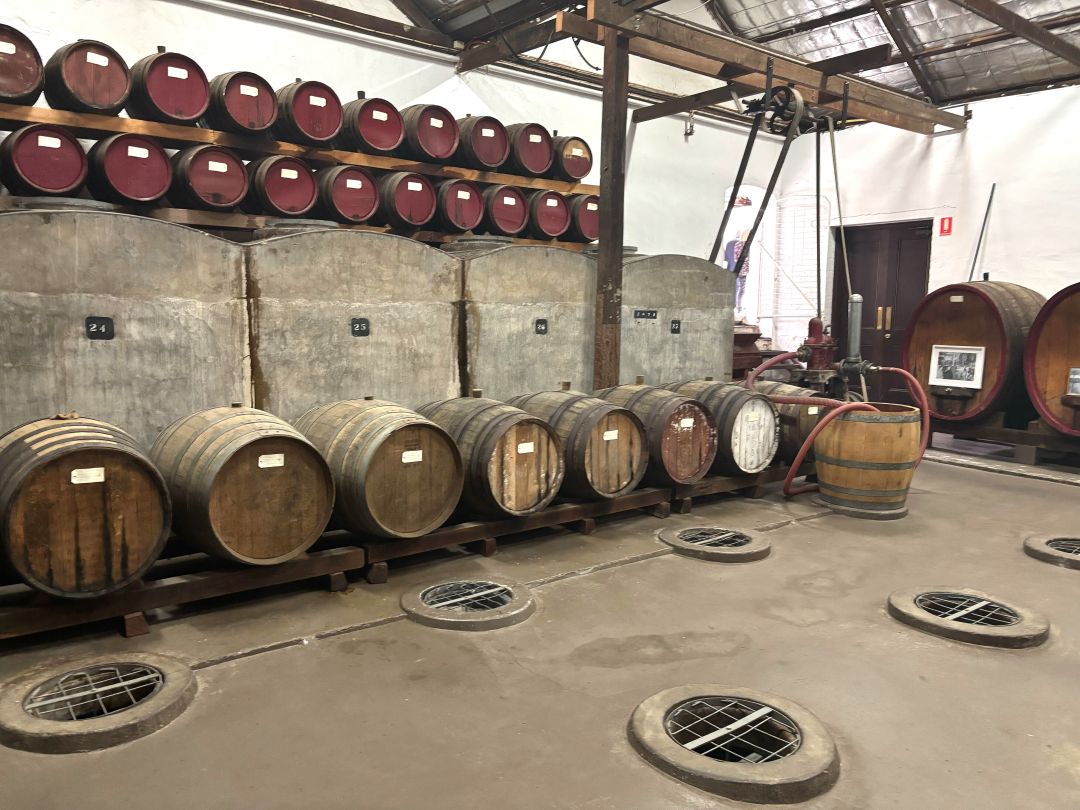
Underground tanks in an older section of the Henschke winery.
Prue Henschke was an early adherent to sustainable farming long before it was fashionable, including organic and biodynamic practices, although Henschke has never pursued certification. Increasing biodiversity within the vineyard environment has been a constant process. Native groundcovers are planted between rows, and mulch is laid every season to retain soil moisture and humidity during the warmer months, while also reducing reflective heat. The team’s key focus is now to retain the health of the historic vineyard, particularly when rainfall is becoming less reliable. The operation also includes a nursery where cuttings from promising vines are propagated to replace aging vine stock when the time comes.
Winemaking for Mount Edelstone has remained fairly consistent over the years, with most changes due to advances in technology. Early vintages went through a basic crusher that retained some whole berries, before a natural yeast open ferment with a submerged cap, which remains the practice to this day. Basic cooling kept the temperature down if required, with twice-daily pumpovers and a quick ferment of five to six days. Minimal pressings were blended into the final wine, which then aged in large, old barrels for two years or more. Some wines were transferred into hogsheads and shipped around Australia to retailers for bottling, while others were hand-bottled on site straight from barrel.
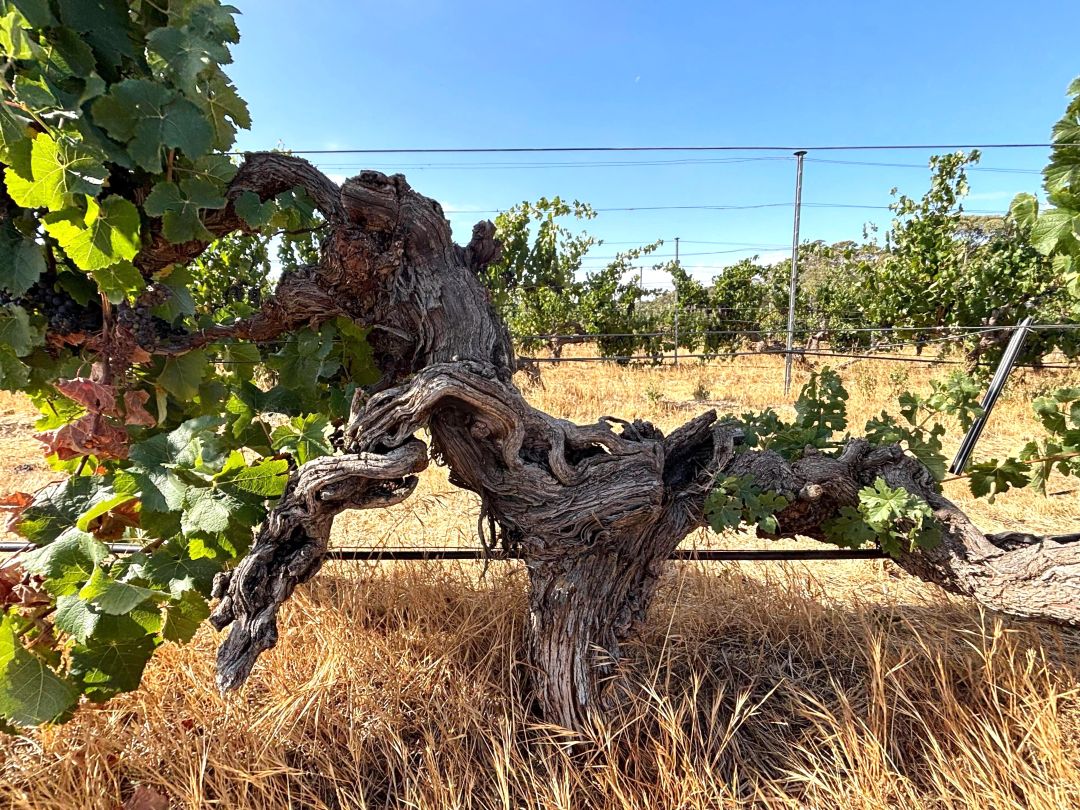
A Shiraz vine planted in 1912 with Scott Henry trellising.
Today, destemmed grapes are largely crushed, leaving a small proportion of whole berries. Open-top fermenters, submerged-cap maceration and twice-daily pumpovers are still employed. The team now uses both the original concrete fermenters as well as new open-top stainless steel fermenters, which allow for more control; these were constructed with the same surface area to volume ratio as the original concrete fermenters, so as to retain the Edelstone style. A short cold soak is followed by an up-to-ten-day ferment, without any extended maceration. Pressings are mostly added back into the wine, which completes its ferment in new to three-year-old French and American oak with some extended lees contact. Total time in oak is up to two years. The various vineyard parcels are kept separate until a final blending and bottling on site. While the overall philosophy has remained unchanged, greater precision and control during the winemaking process is clearly reflected in the wines’ improved fruit purity and texture, particularly over the last two decades.
Tasting back to the 1956 provided a fascinating snapshot of each era, and an opportunity to track the various stages of Mount Edelstone’s rise to glory. Wines from the first few decades, when the Henschkes were purchasing fruit, were more variable. The selected vintages displayed opposite styles, the ethereal and utterly charming 1956 contrasting the more robust 1965 from a dry vintage, which, while at peak, still has at least a decade ahead of it. Similarly, the earlier vintages from the 1970s were a little light, but the 1978 showed greater fruit definition and focus. The 1979 possessed excellent density and structure. The 1986 is from a fabled vintage, and the best bottles still deliver delightful exotic spice with a slight edge of rusticity. But it is from 1990 onward that Mount Edelstone really hits its straps, with much improved consistency and greater amplitude, fruit definition and staying power. The 1991 is extraordinary, while the 1996 is not far behind.
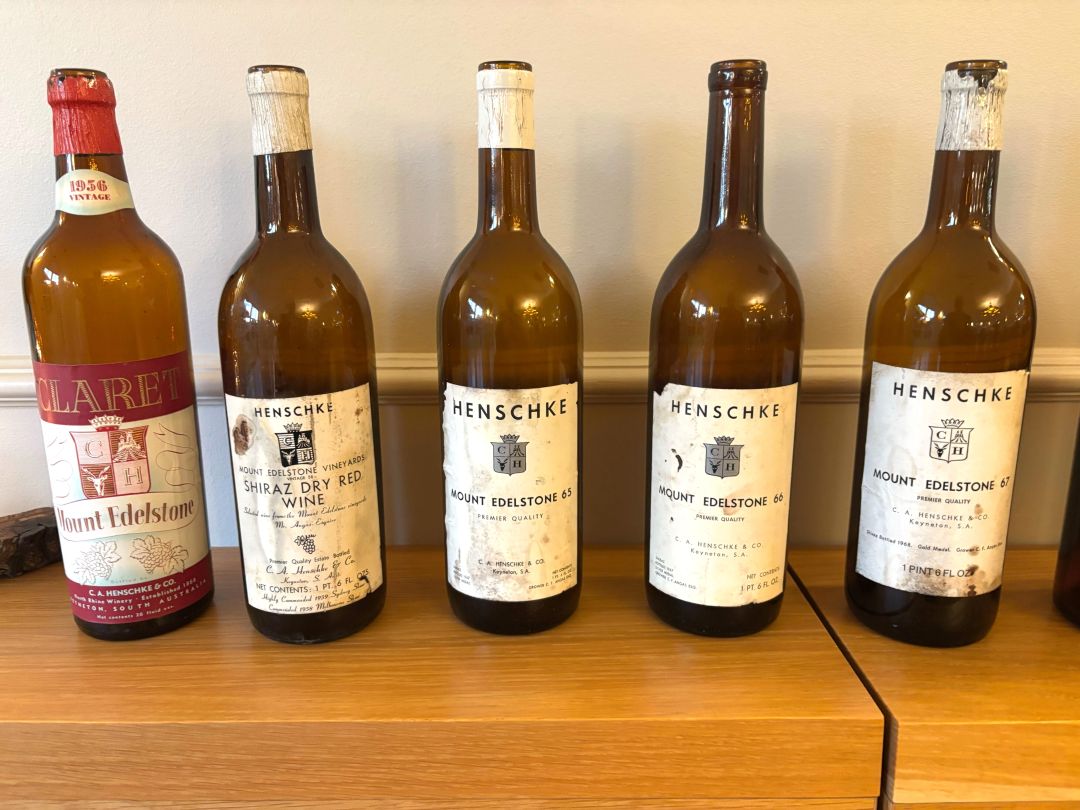
Early vintages of Mount Edelstone.
Over the last 20 years, finesse, detail and oak integration have been on the rise, with consistently sublime releases since 2010. Unsurprisingly, there are occasional misses thanks to some very challenging vintages. The Eden Valley does not always live up to its name—especially in dry, frosty years—but when on song, Mount Edelstone is without doubt one of Australia’s finest wines.
Fascinatingly, Cyril Henschke’s early categorization of Mount Edelstone as a claret is now more apt than ever, with recent vintages delivering refinement, savoury complexity and a firm, ageworthy structure. Now, with over 50 years under the Henschke family’s ownership, this vineyard is truly humming, so much so that there is now a strong argument that Mount Edelstone is more or less equal to Hill of Grace. Individual preferences now come down to differences in style rather than quality. It has only taken 70 years.
© 2026, Vinous. No portion of this article may be copied, shared or redistributed without prior consent from Vinous. Doing so is not only a violation of our copyright but also threatens the survival of independent wine criticism.
You Might Also Enjoy
Australian Syrah: The Quest for Refinement, Angus Hughson, January 2026
Barossa and Clare Valley: The Champion and the Contender, Angus Hughson, August 2025
Cellar Favorite: A Landmark Vintage – Henschke 2021, Angus Hughson, April 2025
Barossa 2022: Run, Don’t Walk, Angus Hughson, August 2024
Henschke’s Hill of Grace - The Garden of Eden, Angus Hughson, April 2023