
Browse using the new Vinous website now. Launch →
Printed by, and for the sole use of . All rights reserved © 2015 Vinous Media
Dom Pérignon Rosé Through the Decades at Vinous Icons
BY ANTONIO GALLONI | JULY 16, 2026
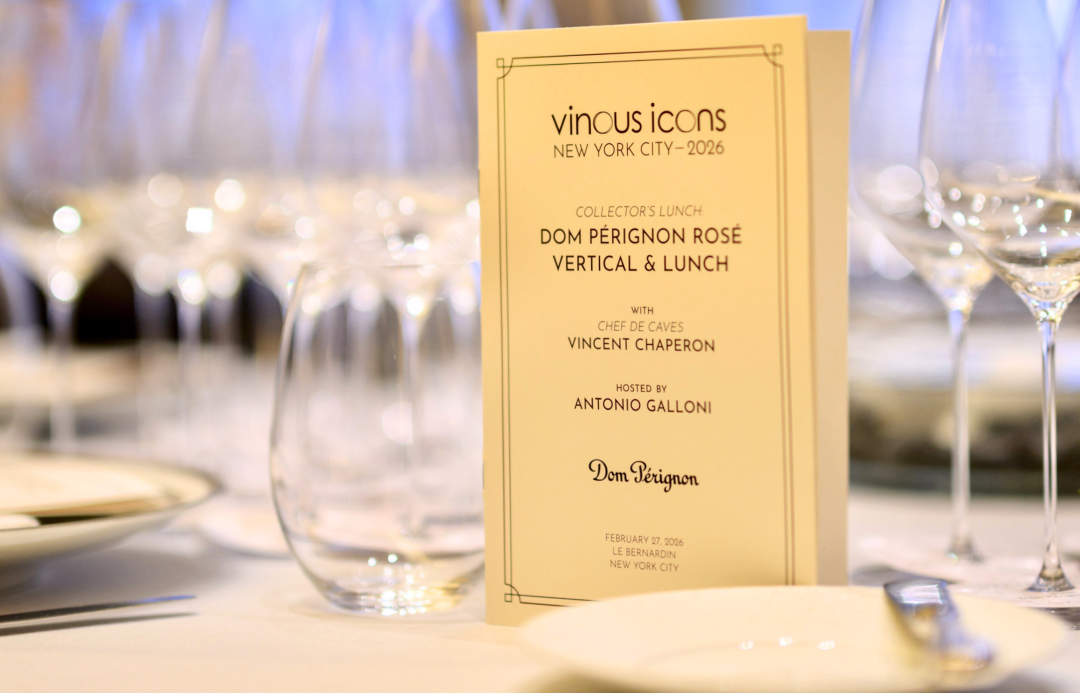
“What is the greatest tasting you have ever gone to?” It’s one of the questions I am asked most often. Of course, it is an impossible question to answer. A few events come to mind. One is an extraordinary tasting of Dom Pérignon Rosé I attended in 2015. There were only about a dozen of us at the table. We surveyed a breathtaking array of wines from vintages back to 1962, the inaugural commercial release. That evening was the inspiration for a very special Dom Pérignon Rosé lunch we hosted recently at Vinous Icons. Chef de Caves Vincent Chaperon added his invaluable insights from two decades at Dom Pérignon, a period marked by many inflection points in all aspects of winemaking, from farming to blending, and then to shaping the future.
Dom Pérignon Rosé: A Brief History
First released in 1936 with the 1921 vintage as Moët & Chandon’s tête de cuvée, Dom Pérignon quickly established itself as one of the most coveted Champagnes in the world. Consistency over time and a considerable production that is remarkable at this level of quality have made Dom Pérignon arguably the most visible wine in Champagne.
Interestingly, Dom Pérignon Rosé flies in a different orbit, one marked by a much lower profile. Dom Pérignon first made a Rosé in 1959, a measly 250 magnums to mark the 2,500th anniversary of the Persian Empire. The first commercial release was the 1962. Since then, Dom Pérignon has bottled the Rosé just 29 times. Production remains quite small compared to the Blanc. Vertical tastings are rare; the first Dom Pérignon Rosé-focused lunch or dinner took place only about 20 years ago.
Dom Pérignon Rosé has seen numerous evolutions over the years. In the early 2000s, former Chef de Caves Richard Geoffroy pushed the Rosé in a decidedly vinous direction by increasing still Pinot Noir in the blend significantly into the 20-25% range (very high for a Rosé d'assemblage), as readers will see in looking at the blends for various years. Geoffroy was the first Chef de Caves that I saw using a still Pinot Noir glass for Rosé. He also launched the Dom Pérignon’s late-release Plénitude 2 and Plénitude 3 wines (first called Oenothèque), Champagnes that show how wines aged under cork (rather than crown capsule for the original release) mature. In recent years, the still Pinot has come down, a result of warmer years in which the still Pinot is riper and richer than it was when Geoffroy was driving still Pinot in the blend.
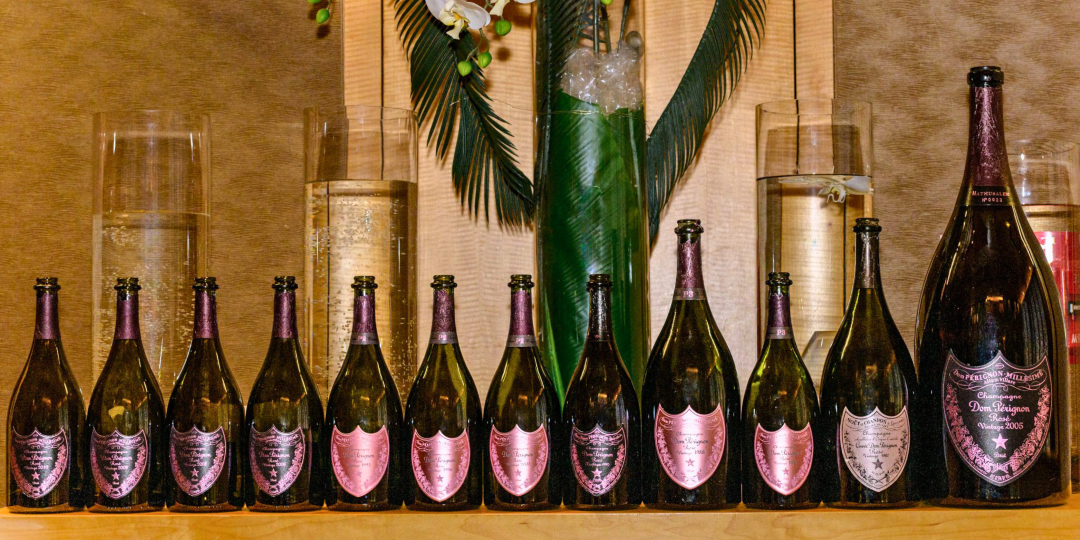
A stunning collection of Dom Pérignon Rosé back to 1982.
Changing of the Guard
About 20 years ago, I met a young winemaker in New York who had just joined Dom Pérignon. Today, Vincent Chaperon is only the seventh Chef de Caves in Dom Pérignon's illustrious history. Originally from Pomerol, where his family once owned Château Nénin, Chaperon worked alongside Richard Geoffroy for 17 years as part of a gradual transition that saw him take over with the 2018 harvest. Although Geoffroy has moved on to other ventures, the two winemakers remain very close.
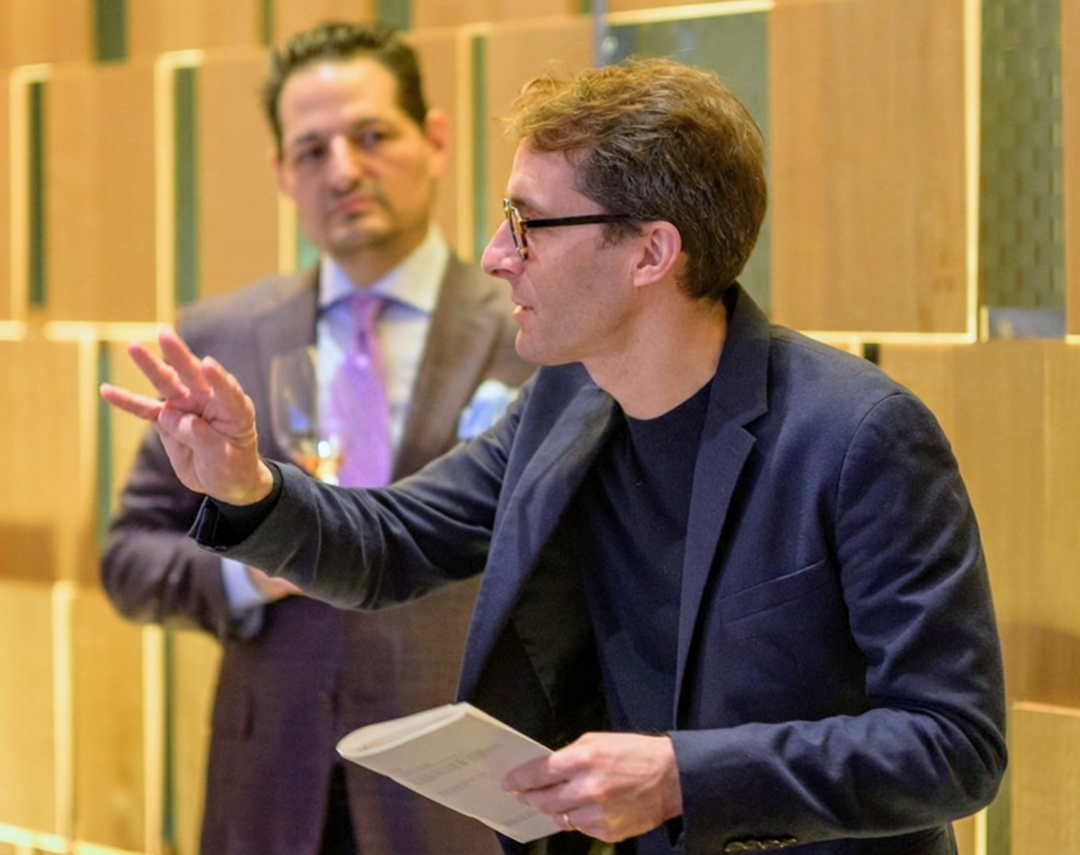
Chef de Caves Vincent Chaperon discusses his approach to blending for Dom Pérignon Rosé.
Quiet and introspective at first, Chaperon embodies the qualities of the new generation of Chefs de Caves. In all the years I tasted with Geoffroy, I don’t remember him ever mentioning a vineyard. When I taste with Chaperon, he brings detailed maps of all the maison’s key sites. Geoffroy never talked about sustainable farming practices or any other concepts along similar lines. Chaperon and his team are spearheading a massive initiative to revitalize the maison’s historic vineyards through low-intervention farming and a restoration of ecosystems that involves planting a variety of trees in and around the vineyards. Geoffroy rarely showed vins clairs, preferring instead to focus on current and upcoming releases in extensive flights that often included numerous P2 and P3 wines. Chaperon, on the other hand, presents several dozen samples of the new vintage every year. Let me be clear. These are not criticisms, but rather examples of how dramatically the Chef de Caves role has evolved in recent years. The same holds true for concepts of farming and overall sustainability, all of which are relatively recent. Today, Chaperon has imbued Dom Pérignon with a feeling of renewed energy, precision and intent.
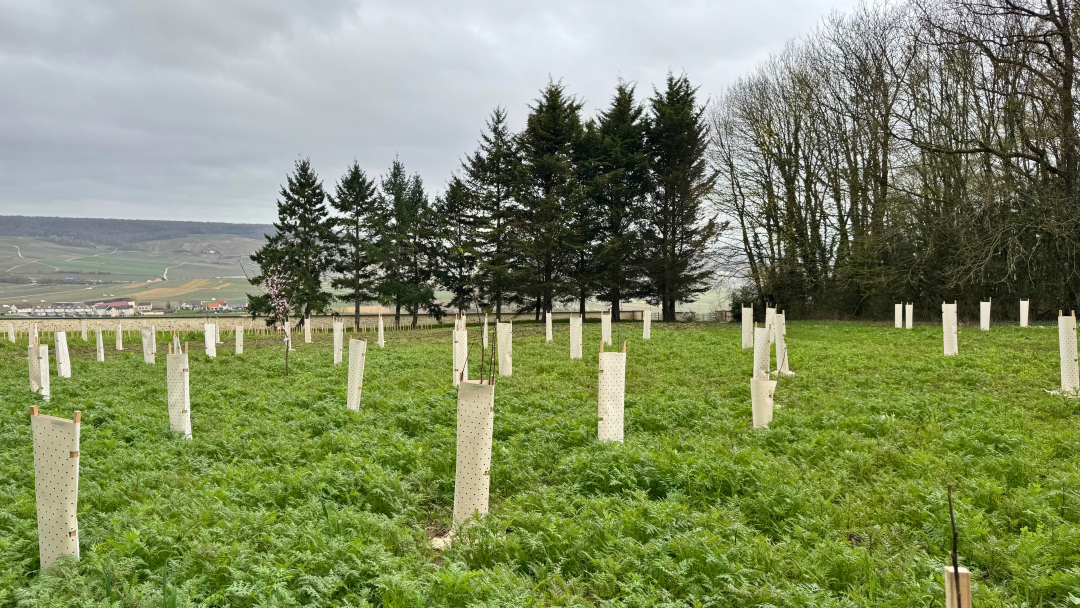
Dom Pérignon's experimental vineyards in Hautvillers, where the maison has embarked on an ambitious program to restore the local ecosystem through low-intervention farming and planting trees in and around vineyards.
A Spectacular Lunch at Le Bernardin
Lunch was at Le Bernardin, which remains a beacon for exceptional wine and food in New York City. Executive Chef/Owner Eric Ripert and his team prepared a stunning menu, while longtime Wine Director Aldo Sohm and his sommeliers took care of the wines with their customary level of attention.
There were a few hiccups that turned out to be happy accidents. At about 10 am, as I headed to Le Bernardin, a phone call arrived. “The restaurant can’t find the 1980s wines,” James said on the other end of the line. “I’m just telling you what I know,” followed, perhaps with the expectation of a strong reply on my part. For whatever reason, these sorts of things no longer bother me like they used to. I immediately started thinking of Plan B and Plan C.
Tracking down a single bottle of Dom Pérignon Rosé is a challenge. Finding the three or four vintages from the 1980s that we needed for this lunch with no notice is next to impossible. Fortunately, I made some progress. A dear friend had two magnums of the 1982 from the original release. Things were looking better. A few minutes later, the missing wines were found, and everything was back on track. We decided to add the 1982. It turned out to be fascinating to taste an original release next to two P3s.
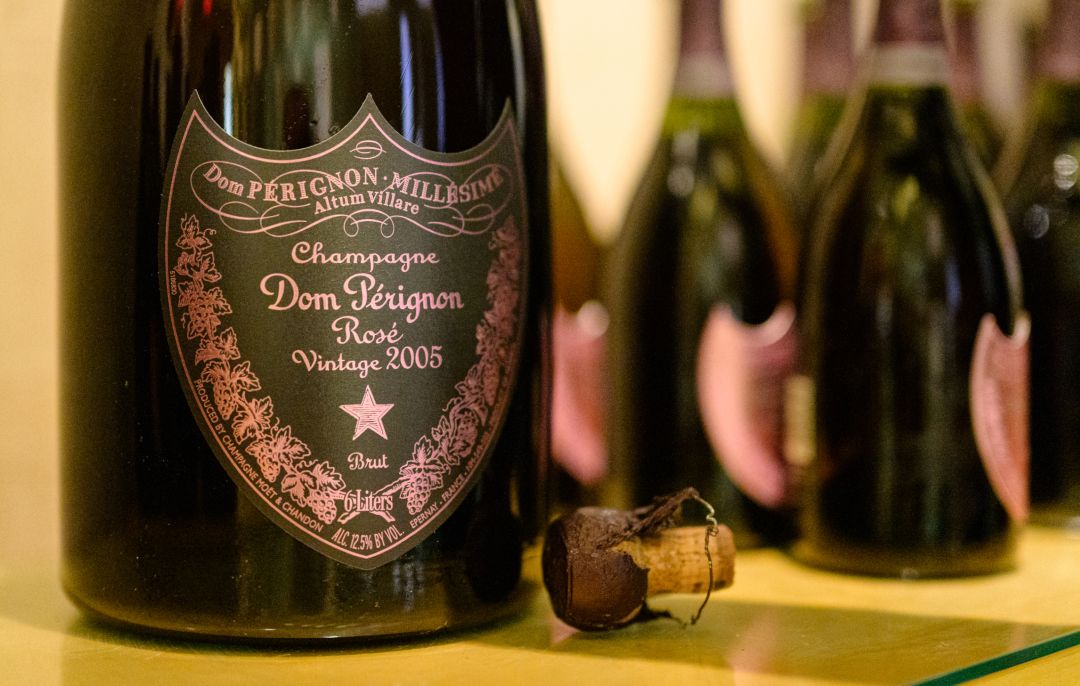
Aperitif
Passed Canapés
2005 Dom Pérignon Rosé Methuselah
The energy in the foyer was palpable as guests started to arrive. The 2005 Dom Pérignon Rosé from Methuselah was a feast for the senses. I suspect the large format, the equivalent of eight 750ml bottles, imparts a real feeling of abundance. Pours were generous and our guests were seemingly quite thirsty. I had originally envisioned serving half of the Methuselah for the welcome aperitif and the other half with lunch. At some point, it became clear that that was not going to work. When all is said and done, we did indeed polish off an entire Methuselah before the first course was served. Luckily, abundance turned out to be a theme of the day.
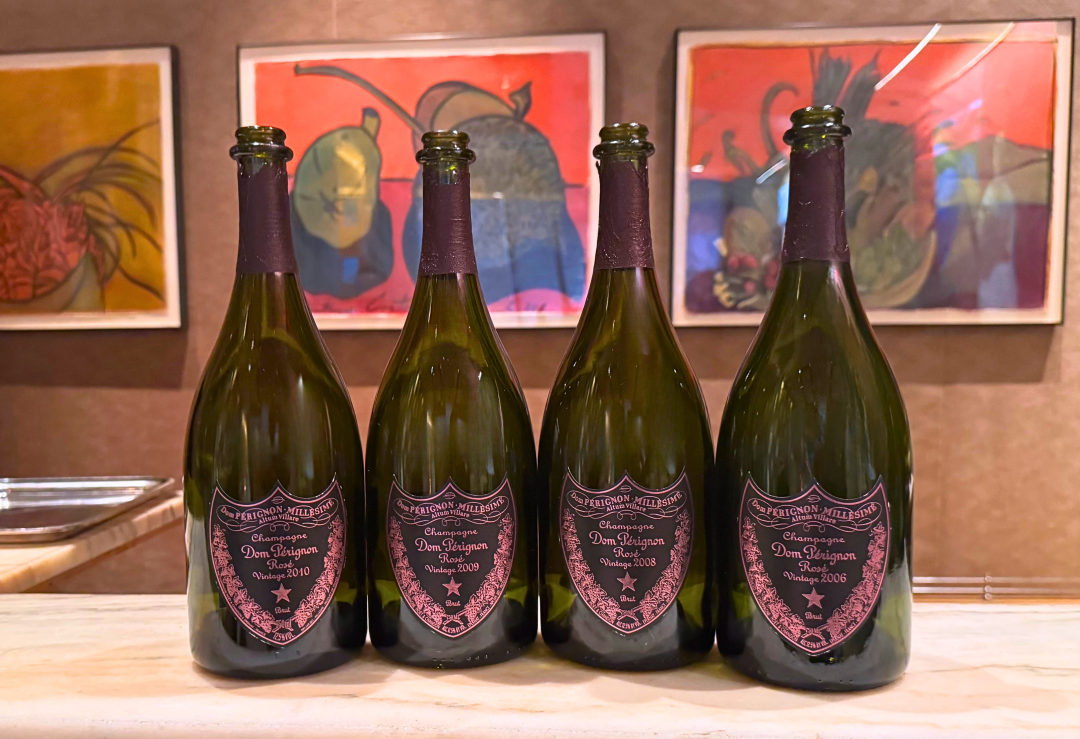
A captivating first flight of Dom Pérignon Rosé spanning vintages 2006 through 2010.
First
Yellowfin Tuna; Foie Gras, Toasted Baguette, Chives
2010 Dom Pérignon Rosé, 2009 Dom Pérignon Rosé, 2008 Dom Pérignon Rosé, 2006 Dom Pérignon Rosé
Four more vintages from the 2000s followed. The 2010 is the most delicate, airy and crystalline of the Rosés in this flight. That theme of nerviness reappears in the 2008, but amplified by the pedigree of a much more important vintage. I tend to prefer Dom Pérignon Rosé in riper years such as 2009 and 2006, because greater warmth adds generosity and voluptuousness to the Pinot Noir. The contrasts between the two sets of vintages — 2010 and 2008, then 2009 and 2006 — are fascinating. Le Bernardin’s Yellowfin Tuna and Foie Gras on Baguette is a classic here.
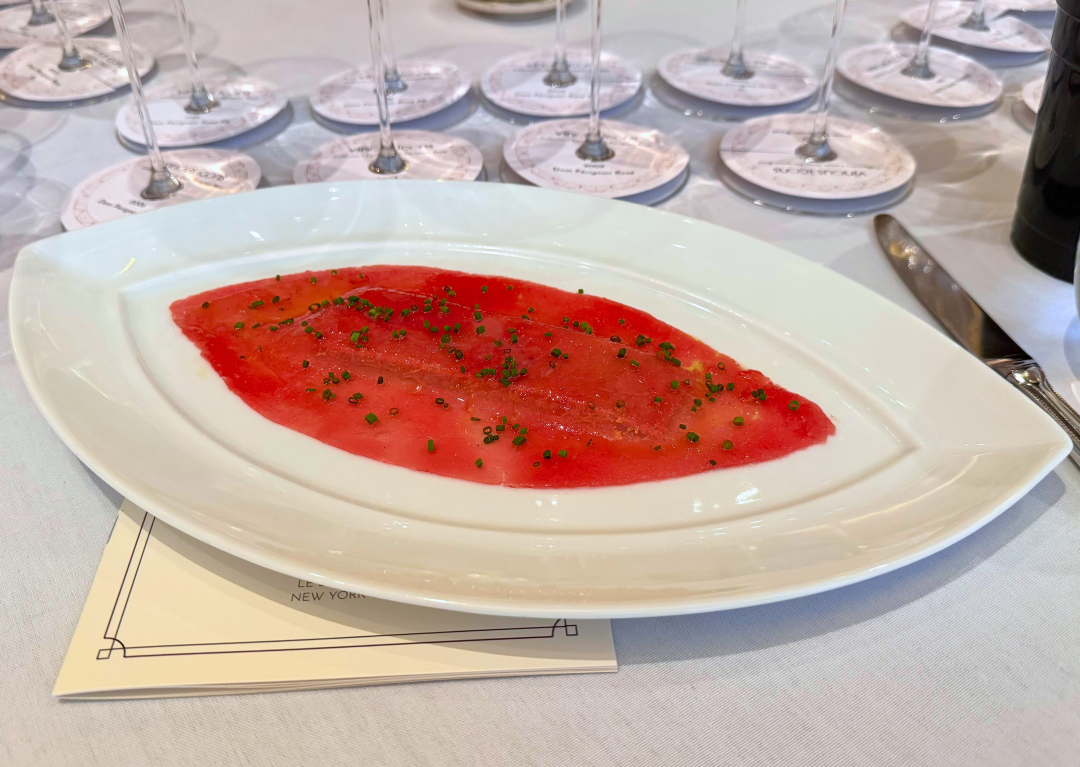
Le Bernardin's Yellowfin Tuna with Foie Gras, Toasted Baguette and Chives remains a classic.
Second
Miso-Glazed Black Cod; Baby Turnip Salad, Yuzu Kosho, Citrus Olive Oil
2005 Dom Pérignon Rosé Methuselah, 2002 Dom Pérignon Rosé Plénitude 2, 1996 Dom Pérignon Rosé Plénitude 2, 1995 Dom Pérignon Rosé Plénitude 2
Our next flight comprised the 2005 followed by three vintages from the Plénitude 2 series. A miscommunication with our sommeliers resulted in two Methuselahs of the 2005 being opened rather than one. I admit I was a bit annoyed at first, but it turned out we needed the wine after guests ravaged through the first Methusaleh during the cocktail hour. The second Methuselah is a bit brighter and more focused. For those who might be wondering, no, we did not finish a second Methuselah at lunch; instead, the leftovers were served to lucky guests at the Vinous Icons walkaround later that afternoon.
The three Dom Pérignon Rosé Plénitude 2s opened the door to an in-depth discussion of the late-release program (initially called Oenothèque) launched under Chef de Caves Richard Geoffroy’s tenure, bottlings that correspond to what Dom Pérignon defines as the three phases of maturity for their Champagnes. All three are gorgeous. I especially admire the 1995, a wine that, like all 1995s, has always lived in the shadows of the much more famous 1996. Now that the wines are at maturity, the 1995 has a small but noticeable edge over its younger sibling. Eric Ripert’s Miso-Glazed Black Cod is sublime. That’s all there is to it.
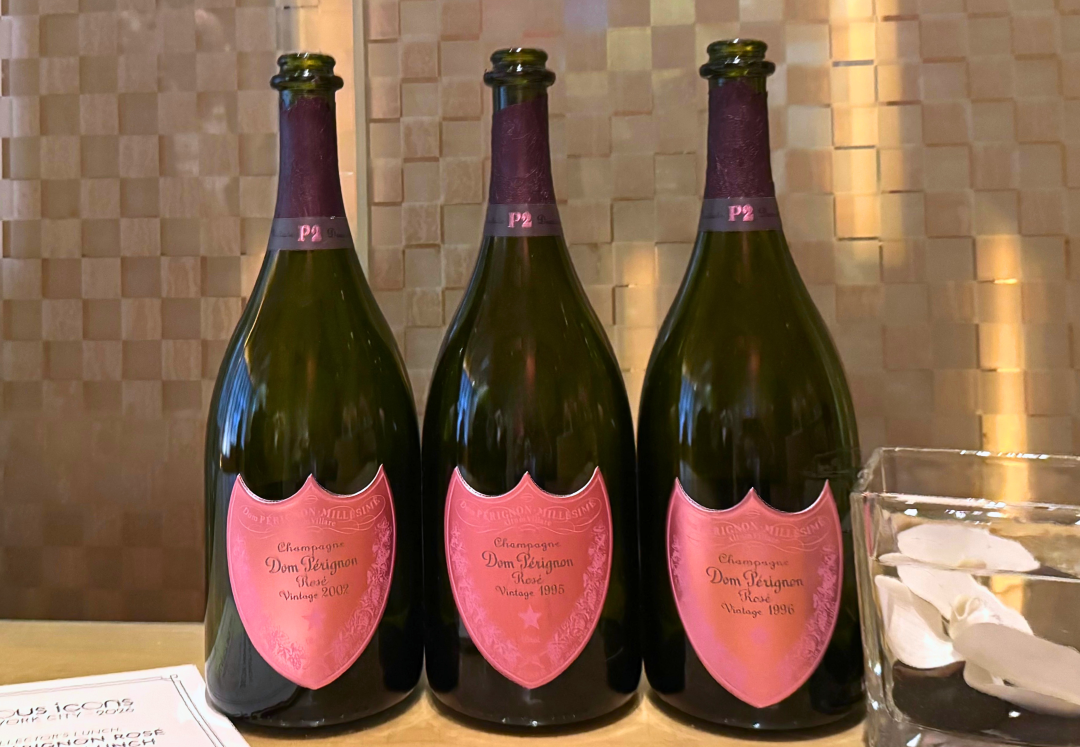
Three beautiful vintages in Dom Pérignon Rosé P2 series illustrated how the wines age with extended time on the lees.
Third
Steamed Halibut; Truffled Morels, Wild Mushroom Bouillon
1990 Dom Pérignon Rosé Oenothèque, 1988 Dom Pérignon Rosé Plénitude 3 Magnum, 1986 Dom Pérignon Rosé Plénitude 3, 1982 Dom Pérignon Rosé Magnum
Our last flight featured four mature Dom Pérignon Rosés. The 1990, from a warm year, is peaking. It’s great to see the 1988 in such great shape, but the 1986 is the surprise of this flight. It emerges from a long-forgotten year in which Dom Pérignon made only a Rosé and no Blanc. I have only had the 1986 once before. This is a truly special bottle. Thanks to the generosity of a dear friend, we had two magnums of the 1982 Dom Pérignon Rosé to taste next to the late releases. This is a great vintage for the Rosé. All I can say is I am thrilled we found the “missing’” 1980s Champagnes and also had the 1982 original release, as the flight of four wines encapsulated what mature Dom Pérignon Rosé is all about. The Steamed Halibut, served with Truffled Morels and Wild Mushroom Bouillon, is that rare dish that delivers understated richness. It was perfect with these Champagnes. We never serve Champagne with dessert. The Spiced Date Toffee Cake made for a delicious palate refresher.
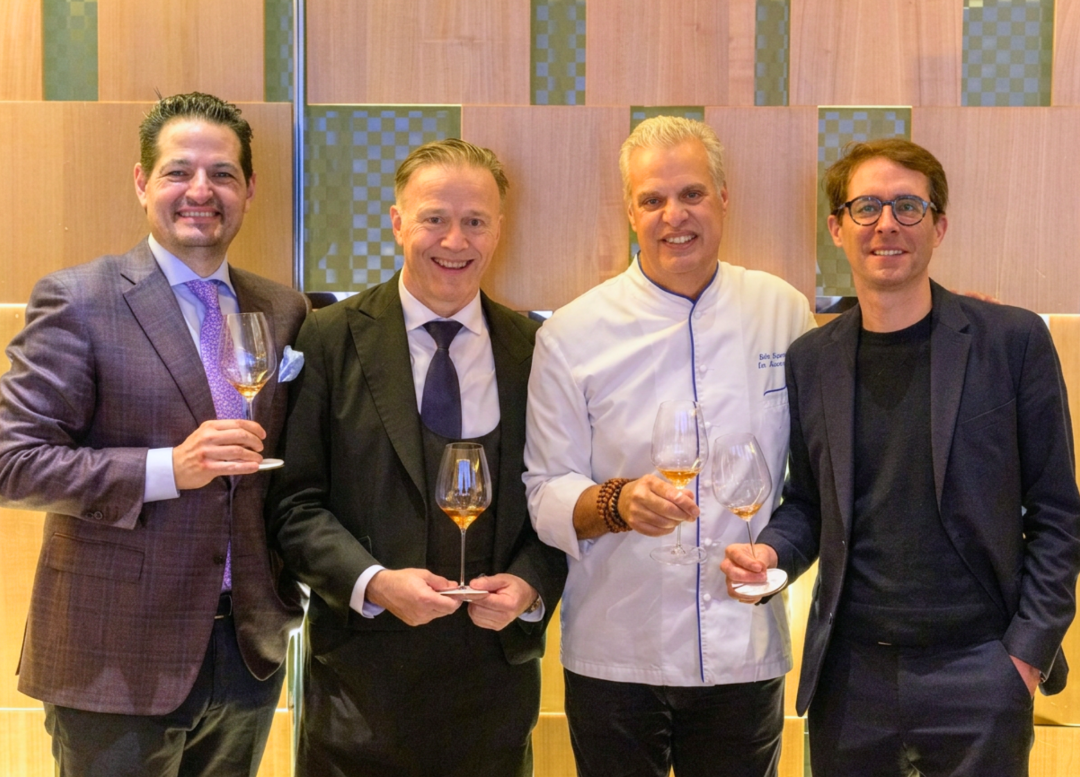
With Le Bernardin Wine Director Aldo Sohm, Chef/Owner Eric Ripert and Dom Pérignon Chef de Caves Vincent Chaperon, from left to right.
Dessert
Spiced Date Toffee Cake; Coffee Ice Cream
With that, it was time to head over to the main Vinous Icons tasting. I can’t blame guests who lingered over the last drops of Champagne. This was such a special lunch, the kind of lunch I wish could last forever. As always, we are incredibly grateful to our guests for bringing so much genuine passion and interest to our events. And for next year…
© 2026, Vinous. No portion of this article may be copied, shared or redistributed without prior consent from Vinous. Doing so is not only a violation of our copyright but also threatens the survival of independent wine criticism.
Photos by Antonio Galloni and Mikhail Lipyanskiy.
You Might Also Enjoy
Champagne: The 2026 Spring Preview, Antonio Galloni, May 2026
2025 Champagne: New Releases, Antonio Galloni, April 2025
Dom Pérignon in Three Acts, Antonio Galloni, November 2017
Dom Pérignon: 2002-2006, Antonio Galloni, October 2015
Dom Pérignon: A Rosé Retrospective: 1962-2004, Antonio Galloni, May 2015
Dom Pérignon: No Guts, No Glory, Antonio Galloni, March 2010