
Browse using the new Vinous website now. Launch →
Printed by, and for the sole use of . All rights reserved © 2015 Vinous Media
Bouchard Père: Beaune Les Marconnets 1864-2023
BY NEAL MARTIN | OCTOBER 27, 2026
Beaune deserves more respect. The appellation gazes enviously upon pilgrims travelling up to Vosne-Romanée or down to Puligny-Montrachet with barely a second thought to the mosaic of vineyards on their doorstep. Take it from someone who jogs through Beaune’s noblest climats each Sunday morning during a yearly six-week-long barrel tasting marathon: Beaune is as picturesque as anywhere else in the Côte d’Or, not least when ablaze with autumnal hues. The wines consistently represent better value than their counterparts elsewhere, and as this tasting confirmed, they can age over many years. Following a recent seminar on the Beaune appellation, renowned geologist Françoise Vannier proposed that Beaune’s topography, geology and pedological morphology are in no way inferior to Volnay or Pommard. In that case, why do Burgundy lovers pay less attention to Beaune’s wines?
You could cite the absence of a Grand Cru or perhaps even one standout Premier Cru. Sure, Clos des Mouches, Grèves and Bressandes are all bestowed with what could be described as “rationed eminence,” which is to say that none trigger the same endorphin rush as Les Perrières or Malconsorts, for example. To rub salt into the wound, many would argue that 335.5 hectares of Beaune Premier Cru is overly generous. That figure represents 49% of the appellation’s vineyards, compared to the 20% that are Village cru. The appellation’s proximity to its namesake town does not help. There is a common misconception that an urban area and top-notch terroir cannot exist cheek by jowl, a subliminal falsehood wired into our brains that one must journey to a hallowed destination to discover great terroir, ignoring that it might lie on your doorstep. In Beaune’s case, a comfortable stroll away.
Add to this the perception of Beaune as an appellation dominated by traditional négociants, such as Louis Jadot and Bouchard Père & Fils, who might stand accused of being apathetic to applying for Grand Cru status because of the taxes that would be imposed at the time of AOC inception. That aside, both own swathes of prime vineyard, the latter now strictly adhering to a 100% estate-grown model. Burgundy aficionados fixate on the idea that “small is beautiful,” conveniently overlooking how that can stymie quality because smaller producers do not have the flexibility to deselect inferior lots. Consequently, these historic names lack the kudos afforded to artisans eking out a handful of barrels with calloused hands. Economies of scale? Not a turn-on for those seeking F.O.M.O. labels to plaster over their social media feed.
Finally, you could argue that Beaune misses a charismatic celebrity or “hipster” winemaker, though who doesn’t adore David Croix, a vigneron par excellence?
In June, I was lucky enough to attend two verticals of Beaune Premier Crus spanning more than a century: Domaine Bouchard Père Les Marconnets and Héritiers Louis Jadot Clos des Ursules. Their uniqueness warrants standalone articles. These wines are not likely to convert Burgundy lovers who habitually dismiss Beaune as an also-ran, but I hope these verticals dispel the notion that Beaune’s most vaunted wines are inferior to their peers, that they cannot reach the apex of Burgundy. These tastings proved beyond doubt that a top-notch Beaune rewards cellaring as well as the most revered Premier Cru, which should come as no surprise. Past and present, these vines are tended with equal skill and dedication.
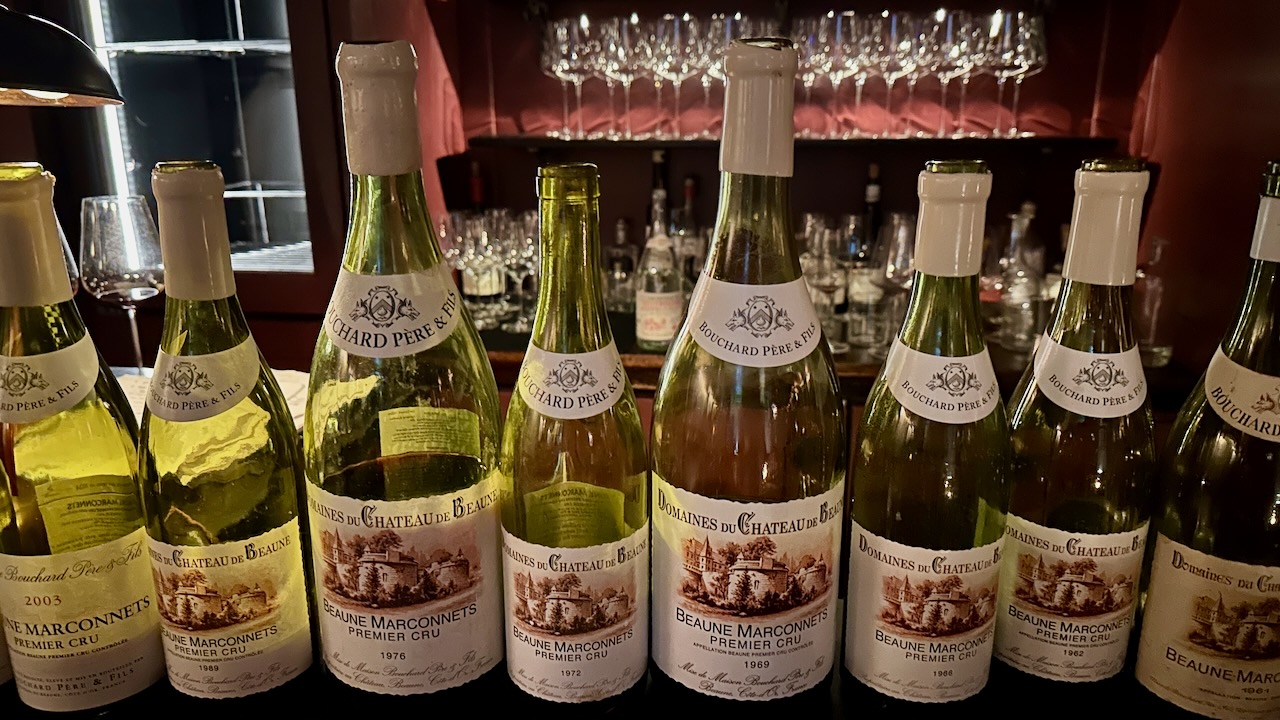
The catalyst for this vertical of Les Marconnets was last November’s “fours” dinner at Domaine Bouchard Père & Fils, where the 1864 Beaune Les Marconnets dazzled so brightly that it shaded the preceding flotilla of venerable Grand Crus. Nobody was quite prepared for its otherworldliness, the manner in which it nonchalantly folded 16 decades into one or two. The 1864 inspired one munificent attendee to assemble a vertical dedicated to Beaune Les Marconnets and, with the cooperation of Frédéric Engerer, a comprehensive tasting was organised at Noble Rot in Mayfair.
History
According to Landrieu-Lussigny and Pitiot's Climats et Lieux-Dits des Grands Vignobles de Bourgogne, the name “Marconnets” derives from the ancient French for marc, “marrais.” The introduction in our tasting booklet, however, cites a German tribe known as the Marcomans, who settled in the vicinity in the third century AD. In 1831, Dr. Morelot listed Marconnets among Beaune's nine best, though Dr. Lavalle scurrilously omitted it from his list of têtes de cuvée in 1855. Camille Rodier corrected that oversight in his 1920 grading, citing Marconnets as “solid but perfumed.”
This 9.39-hectare climat sits on the northern border with Savigny-lès-Beaune, just up the slope from the better-known Clos du Roi. Les Marconnets sits in the shadow of the A6 autoroute to Paris. This is perhaps another reason Beaune is given short shrift, as if nearby tarmac somehow compromises the geology, soil profile and orientation of the vineyard itself. Marconnets lies on the same contours as Grèves and Aux Cras, on a mixture of limestone and marl. The largest holding belongs to Domaine Chanson. Writing in his indispensable Côte d'Or, Clive Coates MW avers: “Marconnets can be too muscular to have real finesse.”
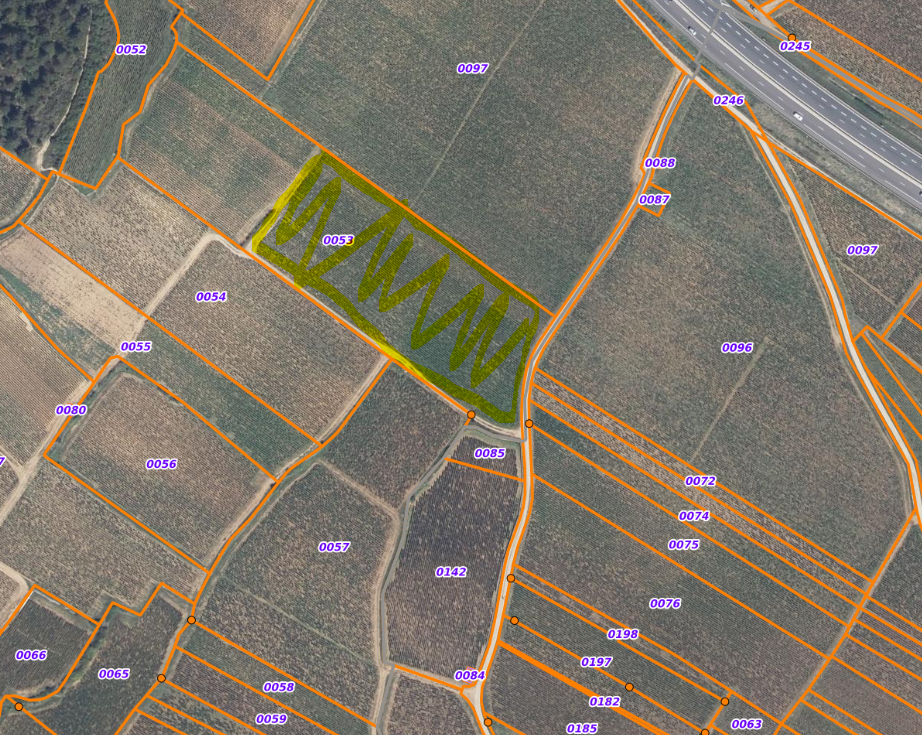
Bouchard Père's parcel of Les Marconnets.
Bouchard Père has owned their 2.32-hectare plot since 1791. “We share the vineyard with Bouchard Aîné,” said Head Winemaker Frédéric Weber. “When the cabottes [old circular, dry stone shelters dotted around the Côte d'Or] were created, we retained 1.09 hectares situated right where the slope breaks. It is my favourite section for winemaking, as it features cooler, calcareous marl and clay soils that are well drained and enjoy an easterly exposure. The vines are 50 years old, planted in 1974 and 1977. We prune with respect to the flow of sap, similar to the Simonit technique [a gentle pruning approach designed to sustain the longevity of old vines].”
I asked whether there is a habitual point during picking when the Marconnets is harvested.
“It is typically a cooler, later-ripening terroir, which is why I convinced Frédéric Engerer to keep it. I believe it is a truly great terroir for the future in the context of global warming, as it is better able to withstand very hot and dry summers. Generally, I pick Marconnets after Teurons, and Grèves at the same time with Clos de la Mousse. It depends on the weather and grape maturity. Each year is really different. The advantage, as with the Clos de la Mousse, is that it is very rare to observe hydric stress in Marconnets.”
Asked about vinification, Weber explained, “We pick by hand and use a sorting table, and we keep 30% to 50% whole clusters. The wine undergoes a natural fermentation, not too long in terms of maceration, 10 to 12 days, depending upon the year. We use a vertical press to select vin de presse. After de-vatting, I wait a minimum of one to two weeks before barrelling down with 35% new oak for two years, and I sometimes rack before the first summer.”
The Wines
This tasting broached 25 vintages from youngest to oldest, from 2023 back to 1864 once again, with representation from all but one decade of the twentieth century. Given such venerability, there was inevitably bottle variation, though I was impressed by the overall consistency across decades. The 1926 Beaune Les Marconnets provided additional proof of longevity, suffused with extant vivacity and purity, still quite tart and with transparency that made this centurion feel a fraction of its age. The 1864 was also time-defyingly sublime, even if last year’s bottle emitted a little more brightness. (As an aside, I proffered a glass to my Gen Z daughter — her shrug of “whatever” upon learning the wine was 162 years old suggested she needs a lot of vinous education.) Another high point was the postwar period. Both the 1947 and, especially, the ethereal 1949 were equal to any Pinot Noir that shared those same birth years. The 1960s were a particular purple patch, with impressive showings from 1961, 1966 and 1969; only the 1962 was a letdown on this occasion.
Like much of Burgundy, the 1970s were rum in terms of growing seasons and viticulture. The 1972 Les Marconnets was a very pleasant surprise given its infamous high yields, defying the notion that tiny yields are a prerequisite for great, long-lived wine. The 1980s were represented by just the 1989, a wine that perhaps suggested the winemaking lost its way a little during that period. Quality clearly ratcheted up under Frédéric Weber, evidenced by splendid showings of the 2019 and 2020.
Final Thoughts
This vertical reinforced the idea of a more structured Beaune that rewards maturation in bottle, though tannin management techniques, gentler pressings and cooler, more controlled ferments rendered recent vintages more malleable compared to their forebears. The pedigree of this less-familiar Premier Cru shone through. I would happily serve these wines alongside more renowned Premier Crus, preferably blind, just to ram home the point. Under Bouchard Père and Frédéric Weber, these vines are in good hands, though I doubt any of us will be around to see whether they age over sixteen decades like that 1864.
Next, I turn my attention to another Beaune Premier Cru… with even more vintages under the spotlight.
© 2026, Vinous. No portion of this article may be copied, shared or redistributed without prior consent from Vinous. Doing so is not only a violation of our copyright but also threatens the survival of independent wine criticism.
You Might Also Enjoy
Curse of the Fours: Bouchard Père 1861-2014, Neal Martin, March 2026
Pinball Number Count: Bouchard Père 1923-2013, Neal Martin, April 2025
Oldies But Goodies: Bouchard Père 1892-2012, Neal Martin, April 2024